
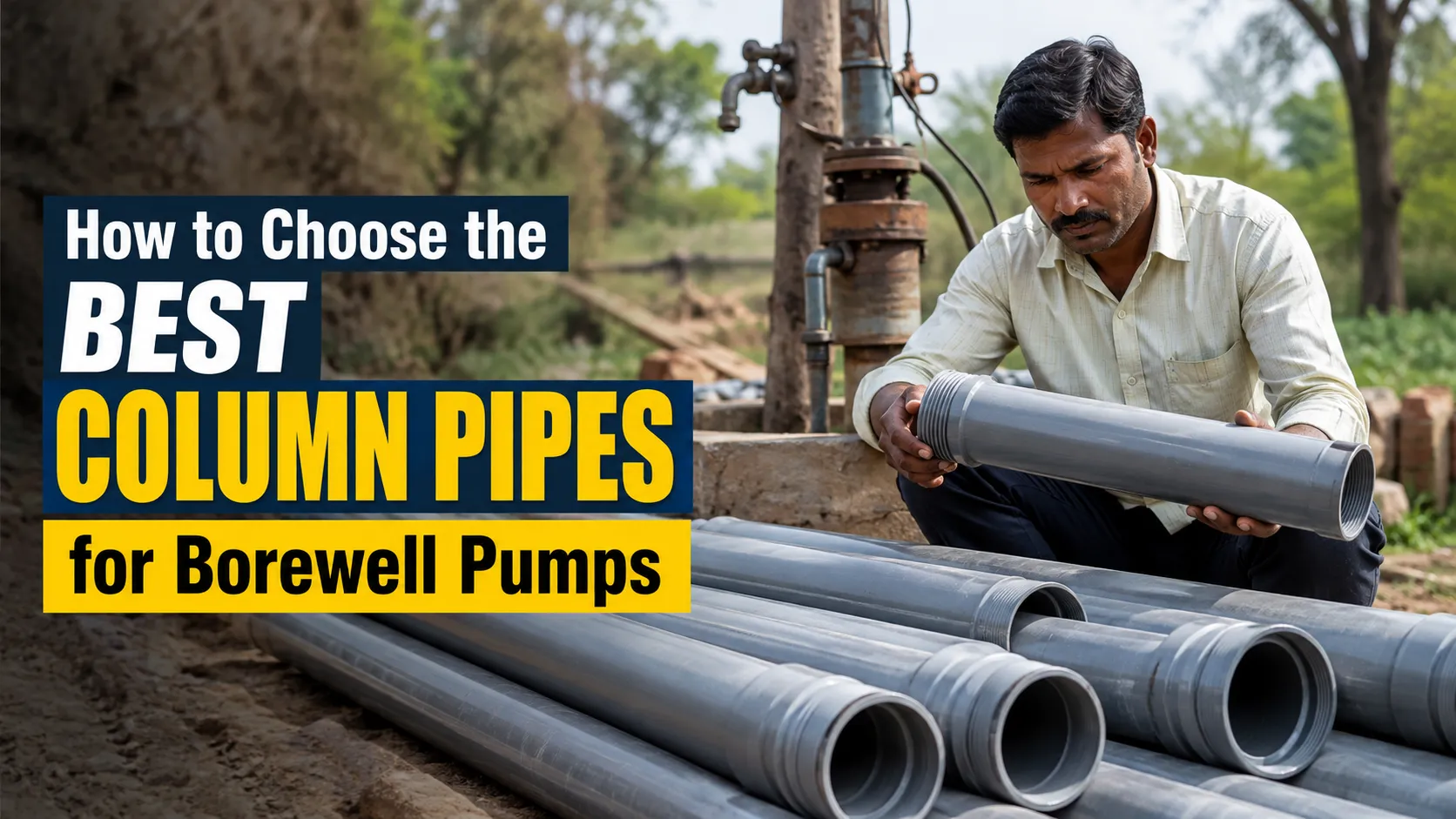
The Right Pipe Can Make a Big Difference
A borewell pump may be powerful, but the system can still struggle if the Column Pipes are not suitable for the borewell depth, pump capacity, and water pressure. Farmers, contractors, builders, and infrastructure teams often focus heavily on the pump while giving less attention to the pipe that carries water from deep underground to the surface.
Imagine a farmer installing a new submersible pump before an important irrigation season. The pump works well during testing, but after regular operation, the pipe joints start creating problems. Removing a deep-set pump to correct a pipe issue can turn a simple installation into an expensive job.
This is why choosing the right column pipe should be part of the planning process, not an afterthought.
The right pipe should handle the operating pressure, support the pump assembly properly, resist wear, and remain reliable for years. Whether you are developing an agricultural borewell, residential water system, construction project, or public infrastructure, the selection should be based on actual site requirements.
In this guide, we will explain how to choose the right solution in simple language, what factors matter most, common mistakes to avoid, and how dealers and contractors can help customers make better decisions.
What Are Column Pipes and Why Are They Important?
Column pipes are installed with submersible borewell pumps to carry water from the underground pump to the surface. They form an important connection between the pump and the delivery system.
When a pump is installed at considerable depth, the pipe has to deal with more than just water flow. It also experiences the weight of the suspended pipe and pump assembly, internal water pressure, repeated starting and stopping of the pump, and installation-related stress.
For a farmer, poor pipe selection can affect irrigation reliability. A contractor may face installation delays or service complaints. Builders and government departments may have to deal with higher maintenance costs when unsuitable materials are used.
A good selection therefore considers pipe strength, pressure handling, joint reliability, diameter, borewell depth, installation conditions, and expected service life together.
How to Choose the Right Column Pipes for Borewell Pumps
There is no single pipe that is perfect for every borewell. The correct choice depends on the complete pumping system.
Before buying, start by understanding the following factors.
1. Check the Borewell Depth
Borewell depth is one of the first things to consider.
A shallow borewell and a deep borewell do not place the same demands on the pipe. As installation depth increases, the suspended weight and pressure conditions become more important.
For example, a pipe selected for a small residential borewell may not be suitable for a deep agricultural installation. The pump capacity and water level also need to be considered along with total depth.
Before placing an order, note:
- Total borewell depth
- Pump installation depth
- Static water level
- Dynamic water level
- Required delivery height
- Expected flow rate
This information gives the supplier or contractor a much clearer picture of what the system requires.
2. Match the Pipe With the Pump
The pump and pipe should work as one system.
A high-capacity pump connected to an unsuitable pipe can create unnecessary pressure and flow problems. Similarly, selecting a pipe with a diameter that does not match the pump’s delivery requirements may reduce system efficiency.
Pump horsepower, discharge rate, delivery head, pipe diameter, and operating pressure should therefore be reviewed before final selection.
For larger agricultural and commercial installations, this step becomes even more important because the system may operate for several hours every day.
3. Look at Pressure Requirements
Water pressure is another major consideration.
The deeper the pump is installed and the higher the water needs to travel, the more carefully pressure requirements should be evaluated. A suitable pipe should have enough pressure-handling capacity for the actual operating conditions.
Do not select a product only because it looks thick or feels strong. The technical specifications, application, pipe size, and pressure rating are more useful indicators.
This is particularly important for contractors handling multiple borewell projects where the depth and pump configuration may change from site to site.
Column Pipes: Material Selection Matters
The material affects strength, weight, durability, handling, and overall performance.
Different projects may call for different pipe materials. The choice should be based on the installation environment and pumping requirements rather than simply selecting the cheapest option.
PVC and uPVC-based solutions are commonly considered for many water applications because they can offer advantages in handling, corrosion resistance, and installation. However, the exact product should always be selected according to its intended application and technical specifications.
A reliable PVC Pipe Manufacturer in Indore can help dealers, contractors, and project teams understand which product is appropriate for a particular installation.
Likewise, businesses already sourcing from an HDPE Pipe Manufacturer in Indore may need different products for other sections of a water or irrigation network. HDPE solutions are widely considered for applications where flexibility, impact resistance, and corrosion resistance are important.
The key point is simple: material should be selected according to application, not just price.
Choose the Correct Pipe Diameter
Pipe diameter directly influences water flow.
If the diameter is too small for the required discharge, water velocity and friction losses can increase. If the system is oversized without a practical reason, the project may carry unnecessary material and installation costs.
For this reason, pump discharge and delivery requirements should be calculated before choosing the pipe size.
A professional HDPE Pipe Supplier in Indore or PVC Pipe Supplier in Indore can help customers compare available sizes and applications.
Farmers should also share their actual irrigation requirements rather than simply asking for the largest available size. A properly matched system can provide better performance without unnecessary expenditure.
Pay Attention to Joints and Connections
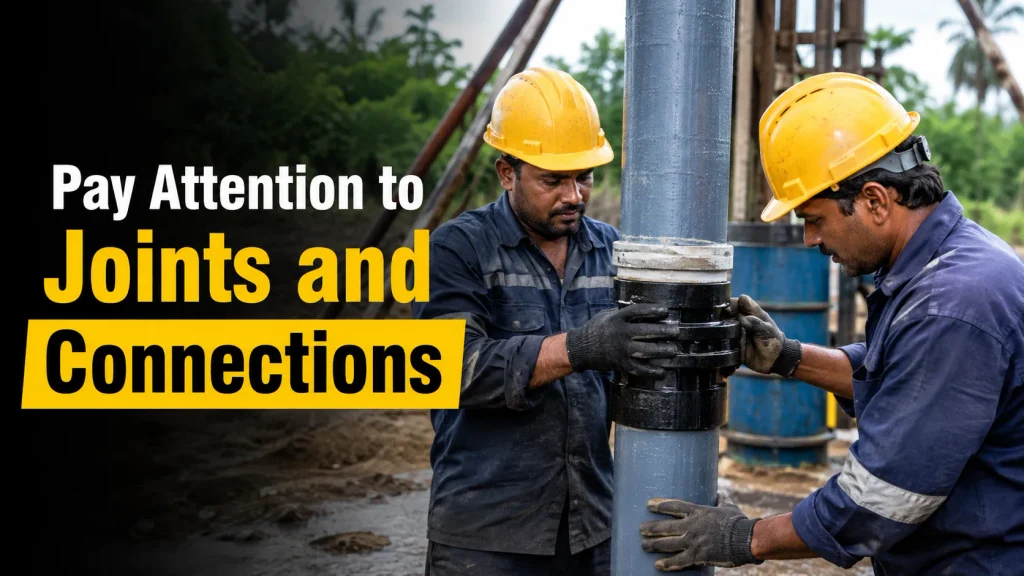
The pipe itself may be strong, but poor joints can become the weak point of the installation.
Borewell pipes are installed underground and are often difficult to access after installation. That makes dependable connections especially important.
Before installation, check:
- Joint design
- Thread or connection quality
- Proper alignment
- Sealing method
- Compatibility between pipe and fittings
- Installation procedure
A contractor should never rush the joining process simply to finish the installation faster.
One poorly prepared connection can create a problem that is much harder to fix once the pump has been lowered into the borewell.
Column Pipes vs Other Water Pipes
It is important to understand that not every water pipe is automatically suitable for a borewell pump installation.
| Factor | Column Pipe | Regular Water Supply Pipe | Irrigation Delivery Pipe |
|---|---|---|---|
| Main purpose | Borewell pump delivery | Water transportation | Field water distribution |
| Pump support role | Important | Usually not applicable | Usually not applicable |
| Deep installation | Designed for specific applications | Depends on product | Depends on product |
| Pressure consideration | Critical | Important | Important |
| Joint reliability | Very important | Important | Important |
| Selection basis | Pump + depth + pressure | Water supply requirements | Irrigation requirements |
This distinction is useful for dealers because customers often use the word “pipe” broadly. A knowledgeable Pipe Manufacturer in Indore can help identify the correct product instead of treating every pipe as interchangeable.
A Practical Example From a Farm Borewell
Consider a farmer who has a deep borewell used for crop irrigation.
The pump is installed deep underground and operates for several hours during irrigation. The farmer wants a solution that can handle regular pumping without frequent maintenance.
Instead of selecting a pipe based only on price, the contractor checks the pump discharge, installation depth, pipe diameter, operating pressure, joints, and expected usage.
The final selection is based on these conditions.
This small planning step can make a major difference. The farmer gets a system designed around actual requirements, while the contractor reduces the chances of future complaints and unnecessary service work.
The same approach can be applied to residential projects, industrial sites, housing developments, and public water infrastructure.
Expert Insight: Think About the Complete System
One of the most common mistakes is treating the pipe as a separate product.
In reality, the borewell pump, column pipe, fittings, delivery line, valves, and end-use application all influence one another.
A professional Irrigation Pipe Manufacturer in Indore can help customers understand how different piping products fit into an irrigation network. Similarly, a Sprinkler Pipe Manufacturer in Indore may be better suited when the requirement moves from borewell water lifting to field-level sprinkler distribution.
The same supplier does not necessarily need to provide every product for every application. What matters is selecting a product that matches the job.
Common Mistakes to Avoid When Buying Column Pipes
Choosing Only on Price
The cheapest option may appear attractive initially, but replacement and maintenance costs can make the overall project more expensive.
Ignoring Borewell Depth
A pipe suitable for one installation may not be appropriate for another. Depth should always be part of the discussion.
Selecting Without Checking Pump Capacity
The pipe diameter and pressure requirements should be compatible with the pump.
Mixing Incompatible Components
Pipe, fittings, joints, and accessories should be compatible. Mixing products without checking specifications can create installation problems.
Buying From an Unverified Source
Customers searching for a Pipe Supplier Near Me or HDPE Pipe Dealer Near Me should look beyond proximity. Product specifications, technical support, consistency, and after-sales assistance matter too.
How Dealers and Contractors Can Guide Customers Better
For Pipe Dealers & Distributors, selling the right product begins with asking the right questions.
Instead of asking only, “Which size do you need?”, ask about borewell depth, pump horsepower, discharge, installation conditions, and intended use.
Contractors can also create a simple project checklist before ordering material.
If a customer needs additional irrigation products, a Sprinkler pipe dealers near me search may be useful for locating suitable field irrigation options. For complete irrigation requirements, customers may also look for a Sprinkler irrigation pipe dealer in indore or a Sprinkler system dealer in indore.
These products should still be selected according to the actual irrigation design.
Where Other Pipe Products Fit Into the Project
A borewell project may require several types of piping products.
For example, suction and delivery arrangements may require different specifications. Someone searching for a Suction pipe delear in indore should clearly explain whether the requirement is for suction, delivery, irrigation, or another application.
Similarly, agricultural customers may need additional flexible hose products. A Pipe hose shop near me search can help identify nearby suppliers, but product suitability should be confirmed before purchasing.
Garden and landscaping projects may also require flexible piping, making a Garden pipe dealer near me relevant for smaller water distribution requirements.
For specialized applications, a High density pipe dealer in indore may be considered when HDPE products are required.
The goal is not to use one type of pipe everywhere. The goal is to use the right product in the right location.
Why Product Quality Matters for Large Projects
Builders, construction companies, and government departments often manage projects where reliability matters over a long operating period.
A small material saving during installation may not justify repeated maintenance later.
For larger procurement requirements, buyers should review:
- Product specifications
- Available sizes
- Pressure ratings
- Material quality
- Jointing system
- Supplier consistency
- Technical documentation
- Installation support
- Expected application
- Warranty or manufacturer support, where applicable
A dependable Plastic pipe manufacturer in indore can be useful when projects require consistent supply across multiple sites.
Dealers may also work with a Plastic pipe dealer in indore when customers need a combination of products for different water applications.
Industry Trend: Smarter Water Infrastructure
Water infrastructure is becoming more focused on efficiency, durability, and reduced maintenance.
Agricultural users are increasingly looking at better irrigation planning because water availability and operating costs directly affect farm productivity. Builders and infrastructure teams are also paying more attention to lifecycle performance rather than only initial purchase price.
This trend is encouraging greater attention toward modern plastic piping solutions, efficient pumping systems, improved joints, and better installation practices.
The growth of organized irrigation systems is also increasing demand for specialized suppliers, including businesses offering sprinkler, HDPE, PVC, and borewell-related products.
For dealers, this creates an opportunity to move from simple product selling toward technical guidance.
Quick Buying Checklist for Column Pipes
Before purchasing, ask yourself these questions:
What is the total borewell depth?
At what depth will the pump be installed?
What is the pump horsepower?
What discharge rate is required?
pipe diameter is suitable?
What pressure will the system experience?
Which material is appropriate?
Are the joints compatible with the pipe?
Will the system run occasionally or for long hours?
Is the supplier able to provide consistent product quality?
Are installation instructions available?
Does the product match the intended application?
If you can answer these questions clearly, you are already in a much better position to make the right purchase.
How to Find the Best Column Pipe Supplier

Searching for the Best column pipe dealer in indore is only the first step.
A good supplier should understand the difference between agricultural, residential, industrial, and infrastructure requirements. They should be able to explain product specifications in simple language and help customers identify the appropriate option.
If your project requires multiple piping products, it is also useful to work with a supplier that can understand the complete water management requirement.
For customers comparing a Best Pipe Manufacturer in Indore, look at product range, technical knowledge, manufacturing consistency, availability, and service rather than relying only on online listings.
The same principle applies when searching for a HDPE pipe manufacturer in indore or PVC pipe manufacturer in indore. The right supplier should be able to connect the product specification with the actual project requirement.
Practical Tips for Farmers
Farmers should keep records of borewell depth, pump capacity, pipe size, installation date, and maintenance history.
This information becomes valuable when replacing a pump or expanding an irrigation system.
Avoid choosing a product only because another farmer is using it. Two farms may have different borewell depths, water levels, pump sizes, and irrigation requirements.
A product that works well in one location may not be the right choice for another.
Practical Tips for Contractors and Builders
For contractors, standardizing a basic selection process can reduce mistakes.
Start with the site data. Then match the pump, pipe size, material, pressure requirement, and fittings.
For builders and construction companies, documentation is equally important. Keep product details and installation records with the project file so future maintenance teams can identify what was installed.
Government and infrastructure departments can take the same approach on a larger scale by evaluating quality, technical specifications, supply consistency, and lifecycle requirements during procurement.
Frequently Asked Questions
What are Column Pipes used for?
They are used with submersible borewell pumps to carry water from the pump installation point to the surface. Their selection depends on depth, pump capacity, pressure, pipe size, and installation conditions.
How do I select the right size?
Start with the pump’s discharge requirement and delivery conditions. Pipe diameter should be selected based on the required flow and the overall pumping system.
Are PVC-based pipes suitable for borewell applications?
Suitable products may be used for specific borewell applications, but the product’s technical specifications and intended use should always be checked before installation.
Does borewell depth affect pipe selection?
Yes. Greater depth can increase the mechanical and pressure demands placed on the installation, making proper selection more important.
Should pipe selection be based only on price?
No. Initial price is only one factor. Durability, compatibility, installation requirements, maintenance, and expected service life should also be considered.
Can the same pipe be used for borewell and sprinkler irrigation?
Not necessarily. Borewell pump delivery and field sprinkler distribution have different requirements. Each section should use products designed for its application.
Final Thoughts: Choose for Performance, Not Just Price
Choosing the right Column Pipes is a small decision that can have a major impact on the performance of a borewell pumping system.
The best approach is simple: understand the borewell, check the pump, calculate the requirements, select the appropriate material and diameter, and pay close attention to joints and installation.
Farmers can reduce avoidable maintenance problems. Contractors can improve installation reliability. Builders and infrastructure teams can make more informed procurement decisions. Dealers can provide better technical guidance to their customers.
Whether you are sourcing from an HDPE Pipe Manufacturer in Indore, comparing a PVC Pipe Manufacturer in Indore, looking for a Pipe Supplier Near Me, or evaluating a Best Pipe Manufacturer in Indore, always start with the application.

