
Demystify outer diameters, material grades, and dimension ratios to choose the perfect HDPE Pipe for your agricultural or industrial project. This beginner’s guide from Indore’s premier manufacturer helps you prevent costly bursts, maximize fluid flow, and find the right HDPE Pipe to protect your budget.
If you have ever stepped onto a modern agricultural farm, managed a municipal water project, or handled a commercial construction site, you have likely encountered an HDPE Pipe. High-Density Polyethylene (HDPE) has rapidly become the gold standard for fluid and gas transportation. Its seamless blend of flexibility, rugged durability, and leak-free jointing makes it a go-to choice globally. However, for beginners, walking into a yard full of different pipe wall thicknesses, diameters, and colorful stripes can feel overwhelming.
Choosing the right HDPE Pipe isn’t just about picking a diameter that looks right. Installing a pipe that cannot handle your system’s fluid pressure can lead to catastrophic bursts and costly downtime. Conversely, over-specifying means you are throwing money away on excessive material. As a premier HDPE pipe manufacturer in Indore, Vishal Pipes is dedicated to helping you demystify these technical metrics. This guide will break down HDPE sizes, material grades, and pressure ratings in plain, simple language so you can make informed decisions for your next project.

The Basics: What Do the Markings on an HDPE Pipe Mean?
When you look at the surface of a certified HDPE pipe, you will notice a string of printed text, letters, and codes. A typical marking includes the brand name, the specific manufacturing standard code, the nominal diameter designation, the material grade indicator, the nominal pressure ranking, and the dimension ratio standard.
To understand what you are buying, you need to crack this code. Let’s break down the three most critical components: Size, Material Grade, and Pressure/Wall Thickness.
One. HDPE Pipe Sizes: Understanding Outer Diameter
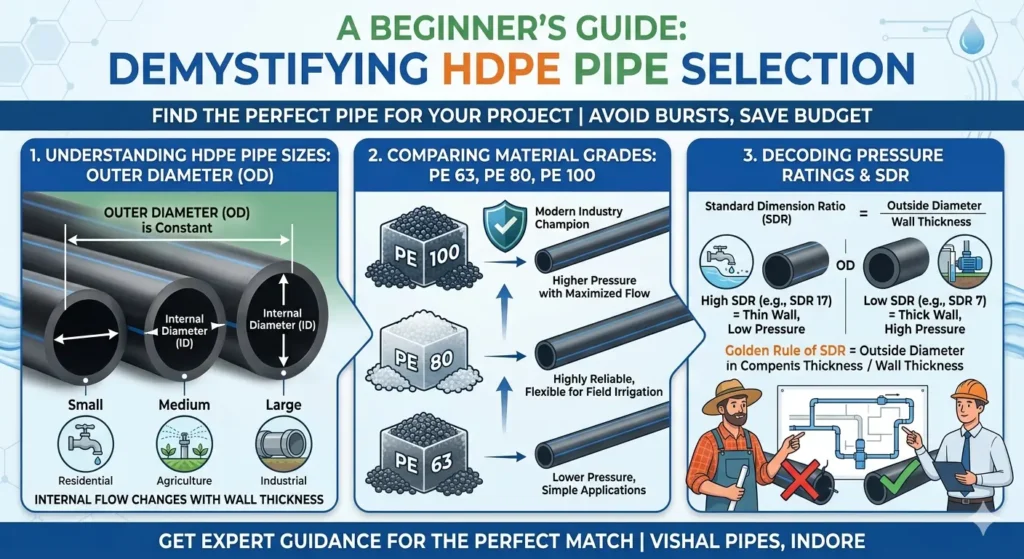
Unlike traditional metal or concrete pipes that are often measured by their internal bore, plastic pipes are categorized by their Outside Diameter, structurally referred to as Nominal Diameter.
Because the outside diameter stays completely constant for a specific size, the internal diameter (the actual space available for water to flow) will shrink or expand depending on how thick the pipe walls are.
At Vishal Pipes, we manufacture and supply a versatile range of sizes designed to meet diverse requirements:
- Small Dimensions: Commonly distributed by residential setups and a trusted plastic pipe dealer in Indore for domestic plumbing, micro-irrigation, and jet pump lines.
- Medium Dimensions: The sweet spot for agricultural sprinkler networks, submersible borewell columns, and main distribution lines.
- Large Dimensions: Heavy-duty piping engineered for municipal water distribution, industrial chemical lines, and extensive sewage systems.
Two. Material Grades: Comparing Density Options
Before diving into pressure classifications, you need to know what the pipe is made of. The grade name indicates the material foundation and the minimum required strength of the resin after decades of continuous use under standard temperatures.
- Lower Density Generations: The legacy generation of polyethylene. It has a lower density and is mostly utilized today for lower-pressure systems, structural ducts, or simple agricultural applications.
- Medium Density Generations: Known widely as medium-density material. It is flexible, highly reliable, and heavily utilized by any prominent sprinkler system dealer in Indore for field irrigation networks and medium-pressure applications.
- High Density Generations: The modern industry champion. This offers superior crack resistance and immense structural strength. Because the material is inherently stronger, these modern high-density pipes can handle higher pressures with thinner walls, leaving more room inside the pipe for maximum water flow rate.
Three. Pressure Ratings: Decoding Wall Thickness Relations
This is where most beginners get tripped up, but the relationship between pressure handling and wall thickness is actually quite straightforward.
Understanding Nominal Pressure
The nominal pressure rating tells you exactly how much working pressure the pipe can safely handle, measured in standard fluid pressure units. These span from very low ratings meant for gravity lines and drainage, up to medium ratings for standard farm irrigation, and finally extreme ratings designed for deep-well submersibles and heavy industrial pumping.
Understanding the Standard Dimension Ratio
The dimension ratio is a structural relationship used to determine a pipe’s structural wall thickness. It is calculated by dividing the outside diameter by the wall thickness of the pipe.
The Golden Rule of Dimension Ratios: The lower the ratio number, the thicker the pipe wall, and the higher the pressure it can handle.
For example, a pipe with a very low dimension ratio will have a much thicker wall than a pipe with a high dimension ratio of the exact same outer diameter. Consequently, the lower ratio pipe has a superior pressure rating and is much tougher against crushing forces.
Core Applications and Pressure Mapping
- Very High Ratios (Thin Walls): Ideal for gravity flow sewers and low-head open irrigation where pressure is minimal.
- Medium Ratios (Standard Walls): The perfect choice for agriculture mains and standard water transmission across fields.
- Low Ratios (Thick Walls): Essential for deep borewells, municipal mainlines, and high-head pumps that require maximum strength.
Why Choosing the Right Specs Matters for Your Project
Selecting the ideal match of size and pressure rating keeps your system healthy for decades. Here is how picking the correct specifications impacts different fields:
- For Farmers: If you are running high-volume water from a river or a deep tubewell, you need heavy-duty lines to connect to your fields. If you use a thin-walled pipe where a thick one is required, surging water pulses will cause splits. Working with an authorized sprinkler system dealer in Indore ensures your layout balances flexible lateral coils with high-grade main transmission lines.
- For Dewatering & Industrial Pumping: High-performance suction systems pull vast amounts of water quickly. Choosing a low dimension ratio (thick wall) pipe prevents the pipe from collapsing under vacuum pressure when hooked up to a high-horsepower pump.
Looking for Reliable Piping Solutions?
Understanding the technicalities of HDPE pipes saves you time, money, and structural headaches down the road. But you don’t have to figure it out alone.
At Vishal Pipe, located conveniently at New Siyaganj in Indore, we don’t just supply products—we provide complete engineering peace of mind. Whether you are a contractor looking for a trusted local manufacturing partner, or a standard buyer seeking advice on standard dimensions, our team helps you map out the perfect wall thickness and sizes for your unique budget and application.
Frequently Asked Questions (FAQs)
1. Why are HDPE pipes measured by their outer diameter instead of the inner diameter?
HDPE pipes use a constant outside diameter so that fittings always fit perfectly, meaning the internal flow space changes based on wall thickness.
2. What is the “Golden Rule” of the Standard Dimension Ratio?
The lower the ratio number, the thicker the pipe wall, allowing it to handle much higher fluid pressures.
3. What happens if I choose the wrong pressure rating for my project?
Choosing a rating too low causes catastrophic pipe bursts while choosing a rating too high wastes your budget on unnecessary material.
4. Which material grade is best for high-pressure applications?
High-density generations are best because their superior strength allows them to handle extreme pressure with thinner walls, maximizing water flow.
5. What are the common applications for medium-dimension HDPE pipes?
They are ideal for agricultural sprinkler networks, submersible borewell columns, and standard water distribution lines.
6. Where can I find the technical specifications on an HDPE pipe?
All certified technical details—including size, material grade, and pressure rating—are printed directly in a text string on the pipe’s surface.