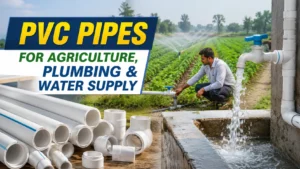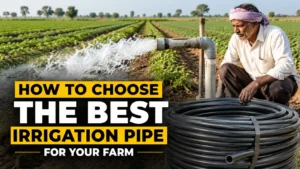
Every farmer knows that water management can make or break a harvest. Traditional flood irrigation often leads to uneven water distribution, high labor costs, and massive water wastage. This is why thousands of forward-thinking agriculturalists are upgrading to a Sprinkler Irrigation System.
By distributing water uniformly—mimicking natural rainfall—this modern solution optimizes crop yield and slashes water consumption by up to 50%.
If you are planning to upgrade your farmland, calculating the initial investment is your first step. This complete guide breaks down the real-world costs of a Sprinkler Irrigation System in India, detailing everything from component prices to government subsidies and regional sourcing.
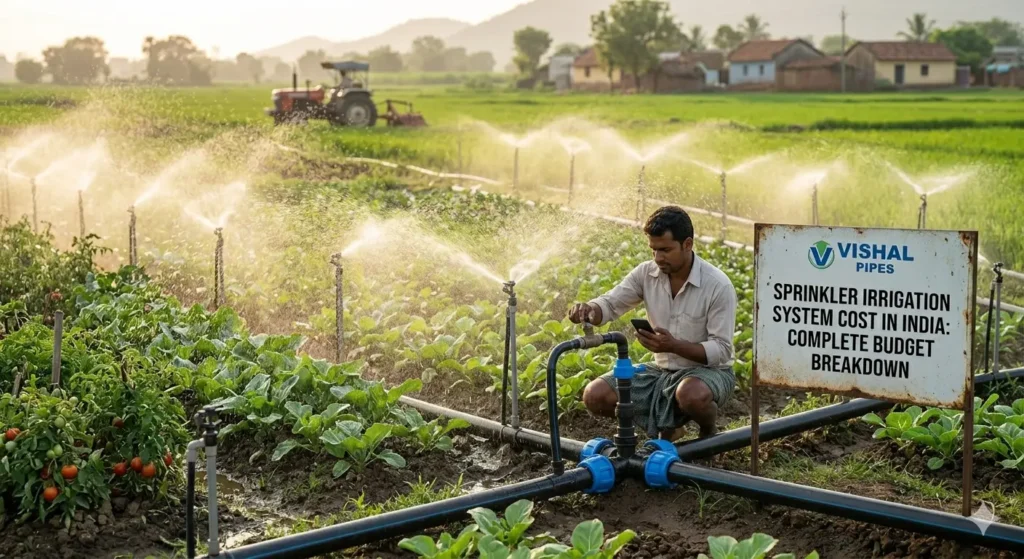
What is a Sprinkler Irrigation System and What Factors Dictate Its Cost?
Before looking at the raw numbers, it is essential to understand that a Sprinkler Irrigation System is not a one-size-fits-all product. The total setup budget depends on several interconnected variables:
- Farm Size and Topography: Larger farms require extended pipe networks and more powerful pumps. Sloped or uneven lands demand specialized pressure-regulating valves.
- Pipe Material and Quality: Your network is only as strong as your pipes. High-Density Polyethylene (HDPE) pipes are the gold standard for agricultural setups due to their flexibility, UV stabilization, and high impact resistance.
- Type of Sprinkler System: Portable systems (which you move manually across fields) cost less initially compared to permanent or semi-permanent systems with underground mainlines.
- Pump Capacity: The cost scales based on whether your water source requires a 3 HP, 5 HP, or 10 HP submersible or surface pump to maintain the operating pressure.
Step-by-Step Cost Breakdown per Acre
On average, setting up a Sprinkler Irrigation System in India ranges between ₹20,000 to ₹60,000 per acre. If you are looking at a multi-acre layout (2 to 5 acres), the cost stabilizes dynamically around ₹40,000 to ₹2.5 Lakhs depending on structural choices.
Here is where your hard-earned money goes:
1. Mainlines and Sub-Mainlines (The Backbone)
The pipes carrying water from your source to the field make up roughly 40-50% of your budget. High-quality HDPE sprinkler pipes (ranging from 32 mm to 110 mm in diameter) are essential to prevent leaks under pressure.
- Estimated Cost: ₹12,000 – ₹25,000 per acre.
2. Sprinkler Nozzles, Nozzle Stands, and Risers
These parts physically distribute the water. The choice between micro-sprinklers (for vegetables) and high-volume rain guns (for large fields) alters this segment significantly.
- Estimated Cost: ₹5,000 – ₹12,000 per acre.
3. Pumping Unit and Filtration System
To prevent clogging from groundwater debris, a reliable disc or screen filter unit paired with an efficient pump is mandatory.
- Estimated Cost: ₹15,000 – ₹35,000 (One-time investment, shared across multiple acres).
4. Couplers, Bends, and Control Valves
These vital fittings connect your pipe layout together and regulate water pressure across different zones.
- Estimated Cost: ₹3,000 – ₹7,000 per acre.
Lowering Capital Expenditures: Government Subsidies
The initial investment might feel steep, but Indian farmers rarely pay the full retail price. Under the Pradhan Mantri Krishi Sinchayee Yojana (PMKSY), the central and state governments actively incentivize water-saving technologies.
- Small and Marginal Farmers: Eligible for up to 75% to 90% subsidy on the total system cost, depending on the state guidelines.
- Large Farmers: Typically receive a 50% to 75% subsidy.
By registering through your regional state agriculture portal, the out-of-pocket setup cost can plummet to as low as ₹10,000 – ₹15,000 per acre.
Sourcing Wisely: Local Dealers and Strategic Procurement
The secret to keeping your setup costs low while ensuring maximum field durability is sourcing your equipment from reputable manufacturers through trusted, local distribution networks. Using substandard pipes leads to frequent bursts, pressure drops, and ruined crops.
When finalizing your layout design, finding reliable wholesale partners near your farm saves massive sums on transportation and guarantees rapid support during installation.
Finding the Right Partners in Central India & Beyond
For those coordinating agricultural logistics or setting up diverse commercial layouts, utilizing hyper-local lookups helps secure genuine factory rates. Keep an eye out for specialized distribution centers based on your exact needs:
| Requirement | What to Search For / Look For |
| Agricultural Pipes & Infrastructure | Search for a certified Plastic pipe dealer in indore to access bulk agricultural inventories at wholesale pricing. |
| Comprehensive Field Hardware | Consult a dedicated sprinkler system dealer in indore to get custom pressure mapping and exact layout designs for your farmland acreage. |
| Bulk Irrigation Tubing | Connect with an authorized Sprinkler irrigation pipe dealer in indore to source ISI-marked, UV-stabilized HDPE options built for heavy field use. |
| General Layout & Small-Plot Sourcing | For localized retail lookups or immediate replacements, utilizing broad phrases like Sprinkler pipe dealers near me or a Garden pipe dealer near me bridges the gap for instant delivery. |
Why Choose Vishal Pipes for Your Irrigation Network?
At Vishal Pipes Limited, we have spent four decades engineering high-performance piping infrastructure designed to withstand harsh tropical environments. Our VPL India brand manufactures premium HDPE Sprinkler Pipes and Fittings (conforming strictly to IS-14151 Part-2 standards) ranging from 32 mm to 110 mm.
Our polymer solutions offer:
- Exceptional Flexibility and Tensile Strength: Easy to reposition across rugged fields without cracking.
- Mirror-Smooth Inner Walls: Minimizes frictional pressure losses, ensuring your pump uses less electricity to run the sprinklers.
- High Corrosion & Chemical Resistance: Unaffected by liquid fertilizers or high-salinity groundwater.
Investing in a Sprinkler Irrigation System built with Vishal Pipes translates to a fast payback period (typically within 1–2 harvest seasons) through substantial labor reductions, lowered electricity bills, and superior crop yields. Don’t compromise on the veins of your farm. Reach out to an authorized dealer nearby to kickstart your automated, water-efficient future today.