Introduction: Before You Buy an HDPE Pipe, Understand Its Actual Cost
When a farmer plans a new irrigation pipeline, extends an existing water supply line or arranges water distribution across different parts of a field, pipe cost becomes an important part of the budget.
But there is one thing worth checking before comparing quotations: Are you comparing pipes with the same specifications?
Two HDPE pipes may look similar from the outside but have different prices. One may have a thicker wall, a different material grade or a higher-pressure classification. These differences affect the amount of material used and the pipe’s intended application.
For farmers in Indore, Dewas, Ujjain, Dhar, Mhow and other parts of Madhya Pradesh, this matters when planning a pipeline around a borewell, water pump, storage tank or irrigation system. Selecting a pipe only because it has a lower price per meter may not be a sensible decision if its specifications do not match the actual requirement.
At Vishal Pipes and Fittings, we believe a customer should understand what they are purchasing instead of comparing quotations only by their final amount. The right buying decision starts with the water requirement, pipeline length, operating pressure and installation conditions.
In this guide, we explain what determines HDPE pipe price per meter, how to calculate the approximate pipe budget, which specifications to check and how farmers can compare suppliers before placing an order.
1. What Is an HDPE Pipe?
HDPE stands for High-Density Polyethylene. It is a thermoplastic material used to manufacture pipes for suitable water transportation, irrigation and other applications.
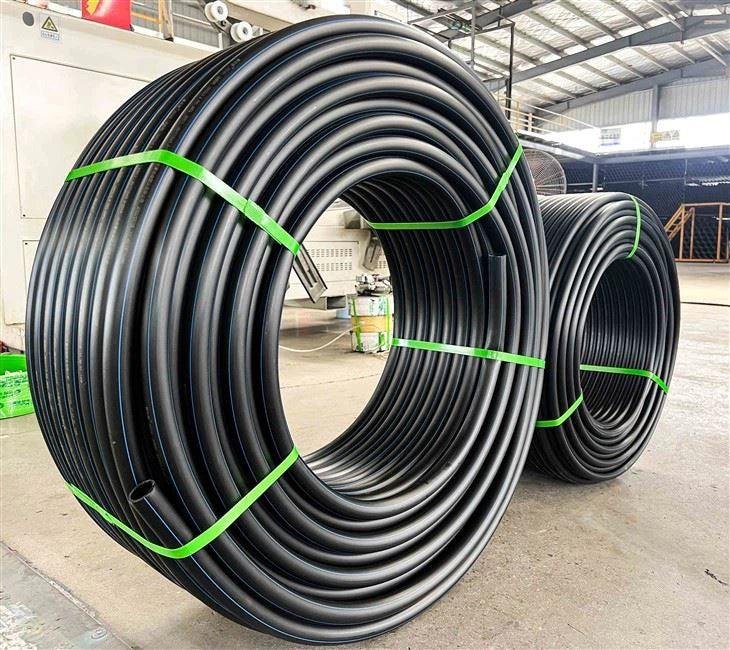
HDPE pipes are available in different diameters, wall thicknesses and pressure classes. Depending on the product specification and manufacturer, they may be supplied in coils or straight lengths.
For agricultural use, an HDPE pipeline may carry water from a borewell, pump, storage tank or another supply point towards the field. The pipe specification needs to match the pressure, flow and installation conditions of that particular system.
Why Do Farmers Consider HDPE Pipes?
A suitable HDPE pipe can offer several practical advantages:
- Corrosion resistance: Unlike conventional metal pipes, HDPE does not rust.
- Flexible handling: Certain sizes and specifications can be supplied in coils, which can be useful for suitable pipeline layouts.
- Different size options: Buyers can select from available diameters and pressure specifications.
- Water transportation: Suitable HDPE pipes can be used in agricultural and water-supply systems.
- Long-term service potential: Correct selection, installation and operation within specified limits are important for dependable service.
However, one point should be clear: not every HDPE pipe is suitable for every agricultural application. A pipe intended for one pressure condition should not automatically be used in a different pumping arrangement.
That is why checking the product specification is just as important as checking its price.
2. What Determines HDPE Pipe Price Per Meter?
There is no single price that applies to every HDPE pipe. The cost per meter depends on the product’s dimensions, material and manufacturing specifications, along with commercial factors such as quantity and delivery.
For example, two pipes may have the same outside diameter but different wall thicknesses. The pipe with a thicker wall generally uses more material and may have a different pressure classification. Their prices should not be compared as if they were identical products.
Before requesting an HDPE pipe price list, understand these major factors.
3. Eight Factors That Affect HDPE Pipe Cost
3.1 Pipe Diameter
The outside diameter is one of the main factors affecting the cost of an HDPE pipe.
A larger-diameter pipe generally requires more raw material than a smaller pipe with a comparable specification. This can increase its manufacturing cost.
However, choosing a diameter only according to its price can create problems for an irrigation system.
For example, a farmer transporting water from a pump to a distant section of the field may have different flow requirements from someone installing a short pipeline for a garden. The correct diameter depends on:
- Required water flow.
- Total pipeline length.
- Pump operating conditions.
- Available pressure.
- Number of outlets or distribution points.
- Expected water demand.
A smaller pipe is not automatically a cost-saving option if it cannot deliver the required flow. Similarly, an unnecessarily large pipe can increase the initial investment.
Practical advice: Share your water requirement and pipeline layout with the supplier before finalizing the diameter.
3.2 Wall Thickness
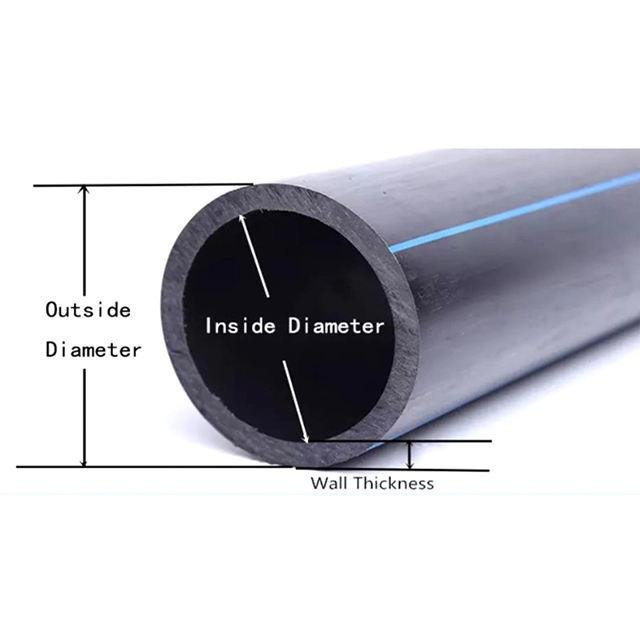
Wall thickness is the measurement of the pipe material between its inner and outer surfaces.
It affects the quantity of raw material used during production. Therefore, two pipes with the same outside diameter can have different prices if their wall thicknesses are different.
Wall thickness also forms part of the pipe’s pressure-design specification.
Before comparing quotations, check:
- Nominal outside diameter.
- Specified wall thickness.
- SDR classification, where applicable.
- Pressure rating.
- Material grade.
- Applicable product standard.
Do not judge a pipe only by how thick it looks. Confirm the stated dimensions and relevant product documentation.
3.3 Pressure Rating (PN)
PN is a pressure classification used in pipe specifications. It should be interpreted according to the applicable material, standard and reference conditions.
For agricultural systems, pressure selection is particularly important when a pipe is connected to a pump.
The system designer or qualified professional may need to consider:
- Normal operating pressure.
- Pump discharge conditions.
- Changes in elevation.
- Pressure fluctuations.
- Possible surge or water hammer.
- Operating temperature and design conditions.
A pipe with a higher-pressure classification may require a different wall thickness and material specification, affecting its price.
However, selecting the highest available pressure class without understanding the system can increase expenditure unnecessarily. The objective is to choose a specification suitable for the actual operating conditions.
3.4 Raw Material Grade
The polyethylene material used in manufacturing has an important effect on pipe properties and cost.
HDPE pipe specifications may refer to material designations such as PE 63, PE 80 and PE 100, depending on the relevant product standard and application.
These designations are not interchangeable marketing labels. Their performance characteristics and design implications need to be considered according to the applicable standard.
When comparing HDPE pipe manufacturers, ask about the material designation and supporting product information. Avoid relying only on verbal claims such as “premium quality” or “best material.”
For water-supply pipes covered by IS 4984, check the applicable edition and amendments of the standard. Do not assume that the same standard applies to every agricultural pipe or irrigation product.
3.5 Manufacturing Process and Quality Control
The manufacturing process also influences product consistency.
HDPE pipe production generally involves material preparation, extrusion, sizing, cooling, dimensional checks, marking and relevant inspection procedures.
Important product parameters may include:
- Outside diameter.
- Wall thickness.
- Surface finish.
- Material consistency.
- Length and product marking.
- Relevant performance-test results.
A buyer should ask what product documentation and quality information are available for the pipe being purchased.
A higher price alone does not prove that a pipe is better. Equally, a low price does not automatically mean the product is unsuitable. Compare the specifications and supporting information.
Manufacturer evidence to add: Insert a genuine photograph of Vishal Pipes and Fittings’ production process or inspection activity, with a caption explaining what is being checked. Only describe checks that are actually performed at the facility.
3.6 Order Quantity
The quantity required can affect the commercial quotation.
A farmer purchasing a smaller quantity for pipeline repair may receive different terms from a contractor ordering pipes for a larger agricultural project.
The quotation can depend on order quantity, product availability, manufacturing schedule, stock position and delivery arrangements.
Before placing an order, clarify whether the price is calculated for:
- Individual pipe lengths.
- A coil or bundle.
- A small repair requirement.
- A complete farm pipeline.
- A bulk project order.
Ask the supplier for the actual terms applicable to your quantity. Do not assume that every manufacturer or dealer follows the same bulk-pricing policy.
3.7 Transportation and Delivery Location
The purchase price is not always the complete delivered cost.
A farmer purchasing pipes in or around Indore may have different delivery expenses from someone ordering the same quantity for a distant location in Madhya Pradesh.
Transportation costs can depend on:
- Dispatch location.
- Delivery distance.
- Quantity and dimensions of pipes.
- Vehicle availability.
- Loading and unloading arrangements.
- Accessibility of the delivery site.
When comparing quotations, confirm whether transportation is included or charged separately.
A slightly lower basic pipe rate may not result in a lower final cost once delivery and handling are added.
3.8 Fittings and Other Accessories
An irrigation pipeline may require more than the pipe itself.
Depending on the layout, the project may need compatible bends, tees, reducers, couplers, valves, connectors and other accessories.
For example, a pipeline carrying water from a pump to multiple field sections may need several connections and control points. The number and type of fittings depend on the system design.
Prepare a list of the required components before estimating the total budget. This will give you a more realistic idea of the project cost than looking at the pipe price per meter alone.
4. Understanding HDPE Pipe Size, SDR and PN
When comparing quotations, buyers may come across three important terms: diameter, SDR and PN. Understanding their basic meaning makes it easier to identify differences between products.
What Is SDR?
SDR stands for Standard Dimension Ratio. It is the ratio of a pipe’s nominal outside diameter to its nominal wall thickness.
Formula:
SDR = Nominal Outside Diameter ÷ Nominal Wall Thickness
For example, consider a pipe with a nominal outside diameter of 110 mm and a nominal wall thickness of 10 mm.
SDR = 110 ÷ 10 = 11
The resulting SDR is 11.
For a given outside diameter, a lower SDR generally indicates a thicker wall. This is one reason two pipes of the same diameter can have different prices.
What Is the Difference Between SDR and PN?
SDR describes the dimensional relationship between outside diameter and wall thickness.
PN represents a pressure classification under specified reference conditions.
They are related to pipe design, but they do not mean the same thing. The pressure capability of an HDPE pipe also depends on the material grade, operating temperature, design conditions and applicable standard.
Do not select a pipe using SDR or PN in isolation. Confirm the complete specification for the intended application.
Why Does This Matter When Comparing Prices?
Suppose two suppliers quote a pipe with the same nominal outside diameter. One quotation specifies SDR 11 and the other specifies SDR 17.
These are not identical specifications. Their wall thicknesses differ, so their prices may also differ.
Before deciding which quotation is better, compare the diameter, wall thickness, material designation and pressure classification together.
5. How to Calculate HDPE Pipe Cost for Your Farm
Before requesting a quotation, estimate how much pipeline your farm actually requires. Measuring the route properly can help avoid unnecessary purchases and last-minute changes.
Step 1: Measure the Pipeline Route
Start from the water source and measure the route to the main distribution point. Then measure the branch lines separately.
For example, an illustrative farm layout may require:
- Main pipeline: 150 metres.
- First branch line: 60 metres.
- Second branch line: 45 metres.
Total pipe length:
150 + 60 + 45 = 255 metres
These figures are only an example. Your actual requirement will depend on the field layout and irrigation design.
Step 2: Confirm the Pipe Specification
Before asking for a price, identify the required:
- Diameter.
- Wall thickness.
- SDR, where applicable.
- Pressure classification.
- Material grade.
- Intended application.
If you are unsure about the technical requirements, ask a qualified irrigation professional or supplier to help assess the system.
Step 3: Calculate the Basic Pipe Cost
Use this formula:
Basic Pipe Cost = Required Pipe Length × Quoted Price Per Meter
For example, if a hypothetical quotation is ₹100 per meter and the requirement is 255 metres:
255 × ₹100 = ₹25,500
This is only an illustrative calculation. It is not a current market rate or a quotation from Vishal Pipes and Fittings.
Step 4: Add the Other Project Expenses
Your final project budget may also include:
- Fittings and connectors.
- Valves and accessories.
- Transportation.
- Loading and unloading.
- Installation labour.
- Excavation or trenching, where required.
- Applicable taxes.
Total Project Estimate = Basic Pipe Cost + Accessories + Delivery + Installation + Applicable Taxes
Ask the supplier to explain which items are included in the quotation and which will be charged separately.
6. Which HDPE Pipe Is Suitable for Agricultural Irrigation?
The right pipe depends on how water is collected, transported and distributed across the farm. There is no single diameter or pressure specification that suits every agricultural installation.
For Main Water Supply Lines
The main line carries water from the source towards the field or distribution area.
Its diameter and pressure specification should be considered according to flow demand, pipeline length, pump conditions and the number of connected outlets.
For Distribution Lines
Distribution lines carry water from the main pipeline to different parts of the farm.
Their requirements depend on the irrigation layout, outlet arrangement and operating conditions. The product selected should be suitable for the pressure and flow expected in that section.
For Pump-Based Irrigation
When a pipeline is connected to a pump, pressure selection deserves particular attention.
Do not rely on pump horsepower alone to select a pipe. Operating pressure, discharge conditions, elevation differences and the complete pipeline design also matter.
For Gardening and Smaller Water Systems
A small garden may have a different water demand from a large agricultural field. Even so, the pipe diameter and pressure specification should match the system.
Choosing an oversized pipe can increase the purchase cost without providing a useful benefit.
Before purchasing: Explain where the water comes from, how far it needs to travel, what pump is being used and how many outlets are planned. This information is more useful than asking for a pipe based only on its diameter.
7. Why the Cheapest HDPE Pipe May Not Be the Most Economical
Farmers have to manage several expenses throughout the growing season. Comparing quotations is sensible, but the lowest price should not be the only deciding factor.
Consider these common buying mistakes.
Comparing pipes with different wall thicknesses: A lower quotation may refer to a different specification. Check the actual dimensions before comparing prices.
Ignoring pressure requirements: A pipe that does not match the system’s operating conditions may be unsuitable for the installation.
Not checking product details: Ask for the material designation, dimensions, pressure classification and relevant documentation.
Forgetting fittings and delivery: The basic per-meter rate may not include the components and services needed to complete the pipeline.
Buying more than necessary: An unnecessarily large diameter or excessive quantity can increase the initial investment.
The objective is not to buy the most expensive pipe. It is to select a product whose specifications match the work it needs to perform.
8. HDPE Pipe vs PVC, Layflat and Rain Pipe
Farmers may compare HDPE pipes with PVC pipes, layflat pipes and rain pipes while planning an irrigation system. These products do not perform exactly the same role, so the choice should depend on the application.
HDPE Pipe
Suitable HDPE pipes are used in water transportation and irrigation arrangements. Their flexibility, corrosion resistance and available specifications make them useful for many pipeline layouts.
PVC Pipe
PVC pipes are also used in water-supply and agricultural systems. Their dimensions, pressure classes, joining methods and installation requirements differ from HDPE products.
Layflat Pipe
Layflat pipes are used in suitable water-distribution arrangements where a flexible pipe is required. Their application and operating limits should be checked before use.
Rain Pipe
Rain pipes are designed for particular irrigation and water-distribution applications. They should not be treated as a direct replacement for every main water-supply pipeline.
A farm may use different products in different parts of the same irrigation arrangement. For example, a main pipeline may transport water, while a separate distribution product delivers it to the crop area.
Choose each product according to its intended function, pressure conditions and irrigation layout.
9. How to Find Reliable HDPE Pipe Dealers Near Me
Searching online for hdpe pipe dealers near me is often a convenient starting point when a farmer needs pipes for a new installation or repair.
However, a nearby supplier is not automatically the right supplier for every requirement. Before placing an order, check whether the product information and commercial terms are clear.
1. Ask for Complete Specifications
A quotation should identify more than just the diameter. Ask about wall thickness, material designation, pressure classification and the applicable product standard.
2. Check the Product Marking
Where relevant to the product, inspect the pipe marking for manufacturer identification, dimensions, material designation, pressure information and standard details.
3. Confirm Available Sizes and Quantity
Check whether the required diameter and specification are available in the quantity you need.
4. Understand Delivery Terms
Ask whether delivery is available to your farm, warehouse or project site. Confirm the transportation and unloading charges.
5. Compare Equivalent Quotations
If you collect quotations from multiple suppliers, make sure each one refers to the same product specification and quantity.
6. Ask About Product Support
A supplier who can explain the intended application, dimensions and product limitations can make the purchasing process easier.
For farmers in Indore and nearby districts, comparing local suppliers with established HDPE pipe manufacturers can help clarify product availability, specifications and delivery options.
10. What Should Farmers Check Before Buying HDPE Pipe in Madhya Pradesh?
Agricultural requirements vary across locations and individual farms. A pipeline for a farm near Indore may have different requirements from one in Ujjain, Dewas, Dhar or another district.
Before purchasing an HDPE pipe in Madhya Pradesh, consider the following points.
Understand the water source: Identify whether water comes from a borewell, open well, storage tank, canal or another supply point.
Check the pump conditions: Consider the operating pressure and discharge requirements, not just the pump’s horsepower.
Measure the distance: A longer pipeline can experience greater friction losses. Pipe sizing should account for the required flow and complete system conditions.
Consider installation conditions: Identify whether the pipe will be installed underground, above ground or along the field boundary. Follow the product manufacturer’s installation guidance.
Plan the full irrigation arrangement: Depending on the system, you may need a main pipeline, distribution pipes, fittings, sprinkler pipes, layflat pipes or other products.
A little planning before purchasing can make it easier to estimate the actual requirement and avoid comparing unsuitable products.
11. HDPE Pipe Installation and Maintenance: Points Farmers Should Not Ignore
The selection of a suitable pipe is only one part of a reliable pipeline arrangement. Handling, installation, jointing and regular inspection also matter.
Handle Pipes Carefully
During transportation and installation, avoid unnecessary impact, dragging over sharp objects or improper stacking. Follow the manufacturer’s handling recommendations.
Use the Correct Jointing Method
HDPE pipes may use different joining methods depending on the product, diameter and system design. Butt fusion and electrofusion are used in suitable systems.
Jointing should be carried out by trained personnel using the appropriate procedure and equipment.
Inspect Joints and Fittings
Check connections, valves and fittings for visible leakage or damage. If a problem appears, identify the cause instead of making random adjustments.
Operate Within the Specified Limits
Do not operate the pipe beyond its specified pressure and temperature conditions. Pump operation and pressure fluctuations should be considered as part of the system design.
Protect Exposed Sections
Where pipes are installed above ground, consider sunlight exposure, machinery movement and accidental physical damage. Follow the manufacturer’s recommendations for outdoor installation.
Inspect Before the Irrigation Season
Before regular irrigation begins, inspect the pipeline, connections and valves. Identifying visible damage early may help avoid interruptions during important irrigation periods.
12. Choosing Between an HDPE Pipe Manufacturer and a Local Dealer
Many farmers prefer nearby suppliers because they want convenient purchasing and delivery. Buying through a local dealer can be suitable, depending on the product and project requirements.
It is also useful to understand who manufactures the pipe and what specifications are being supplied.
When comparing manufacturers and dealers, ask about:
- Available pipe sizes.
- Material designation.
- Wall thickness and pressure specifications.
- Product documentation.
- Order quantity and availability.
- Transportation and delivery arrangements.
- Technical information for the intended application.
If you are searching for an irrigation pipe manufacturer in Indore, do not make the decision on location or promotional claims alone. Check whether the supplier can clearly explain the product and provide the details relevant to your application.
Similarly, when comparing pipe manufacturers in Madhya Pradesh, look at product suitability, specification clarity and the information available about the company.
Vishal Pipes and Fittings: Agricultural Piping Information
At Vishal Pipes and Fittings, we provide information about our company and product range to help customers explore piping solutions.
Farmers, dealers and contractors can visit our product range to review the available categories and identify products relevant to their requirements.
When enquiries about an HDPE pipe, share the intended application, required diameter, estimated quantity and operating conditions. These details help make the discussion about product suitability more specific.
You can also visit our website to learn more about Vishal Pipes and Fittings.
13. Manufacturer’s Practical Note: What to Discuss Before Quoting a Pipe
One of the most useful steps in a pipe purchase is to discuss the application before discussing the final price.
A quotation based only on a diameter may leave important questions unanswered. The same diameter can be available in different wall thicknesses, material grades and pressure classifications.
When discussing an agricultural requirement, the following information is useful:
- Where will the water come from?
- Is the pipeline connected to a pump?
- What is the approximate pipeline length?
- What diameter and pressure specification are being considered?
- How many outlets or branches are required?
- Will the pipe be installed underground or above ground?
- What quantity is needed, and where should it be delivered?
At Vishal Pipes and Fittings, this section should reflect the actual questions your sales or technical team asks customers. Add a genuine example from a real enquiry only after confirming the details with the team.
A Farmer’s Buying Experience: Why the Right HDPE Pipe Matters
When Mahesh Solanki, a farmer from Dhar, Madhya Pradesh, was looking for an HDPE pipe for his agricultural field, his first concern was the price per meter.
Like many farmers, he wanted a good-quality pipe but also needed to keep his irrigation expenses under control.
During the discussion, we focused on a few basic things: how far the water needed to travel, which pump was being used and what kind of water flow was required in the field.
We explained that selecting an HDPE pipe only by its price can sometimes lead to the wrong purchase. Pipe diameter, wall thickness and pressure rating are equally important, especially when the pipeline is connected to a water pump.
We also discussed why comparing two pipes with different specifications simply because they have the same outside diameter is not the right way to judge their prices.
After understanding his requirement, we discussed the suitable pipe specifications instead of suggesting an option just because it was cheaper.
For us, these conversations matter. Farmers put considerable effort and money into preparing their fields, and even a small purchasing decision deserves proper attention.
At Vishal Pipes and Fittings, our customers are always satisfied. We believe that understanding their requirements, providing the right product information and helping them make informed purchasing decisions are important parts of building long-term relationships.
Our simple advice to farmers is this: Before asking how much an HDPE pipe costs per meter, first ask whether that pipe is suitable for your field and water supply requirement.
14. HDPE Pipe Buying Checklist for Farmers
Before confirming an order, use this checklist to review the important details.
Product Specifications
- Confirm the nominal outside diameter.
- Check the specified wall thickness.
- Verify SDR and pressure classification, where applicable.
- Confirm the material designation.
- Ask which product standard applies.
- Request available product documentation.
Agricultural Requirements
- Identify the water source.
- Check pump operating conditions.
- Estimate the total pipeline length.
- Consider the number of outlets and branches.
- Confirm the intended installation conditions.
- Check that the product is suitable for the application.
Quotation and Delivery
- Compare quotations for identical specifications.
- Confirm the total quantity.
- Ask whether fittings and accessories are included.
- Check transportation and unloading costs.
- Confirm applicable taxes and payment terms.
- Ask about availability and delivery timelines.
Keeping these details together makes it easier to compare quotations and understand the actual purchase cost.
15. Final Thoughts: Choose the Right HDPE Pipe, Not Just the Lowest Price
The HDPE pipe price per meter is important when planning an agricultural pipeline, but it is only one part of the buying decision.
Diameter, wall thickness, material grade, pressure classification, manufacturing specifications, order quantity and transportation can all affect the final quotation.
For farmers, gardeners and agricultural contractors, the first step should be understanding how water needs to move through the system. Once the application and operating conditions are clear, it becomes easier to compare suitable products.
Whether you are searching for HDPE pipe dealers near you, exploring HDPE pipe manufacturers or comparing suppliers across Madhya Pradesh, ask for complete specifications before deciding.
At Vishal Pipes and Fittings, we encourage customers to understand their requirements before making a purchase. A clear discussion about the application and product specifications can help make the buying process more transparent.
A sensible purchase is not simply about paying less per meter. It is about selecting a pipe that is suitable for the work your farm needs.
Frequently Asked Questions About HDPE Pipe Price
1. What is the price of HDPE pipe per meter?
The price depends on the diameter, wall thickness, material designation, pressure classification, manufacturing specification and order quantity. Transportation, fittings and applicable taxes may also affect the final cost. Request a current quotation for the exact specification.
2. Which factors affect HDPE pipe prices the most?
The main factors include raw material, pipe diameter, wall thickness, SDR, pressure classification, manufacturing specifications and order quantity. Delivery location and additional accessories can also affect the total purchase cost.
3. Why do HDPE pipes of the same diameter have different prices?
Pipes with the same outside diameter may have different wall thicknesses, material designations and pressure classifications. These differences affect the product specification and the amount of material used, which can result in different prices.
4. Which HDPE pipe is suitable for agricultural irrigation?
The suitable pipe depends on the water source, pump conditions, required flow, pipeline length and irrigation layout. Confirm the diameter, wall thickness and pressure specification before purchasing.
5. How do I calculate the total HDPE pipe cost for my farm?
Multiply the required pipe length by the quoted price per meter. Then add the cost of fittings, transportation, installation and applicable taxes.
Basic Pipe Cost = Required Length × Price Per Meter
6. What is the difference between SDR and PN in HDPE pipes?
SDR is the ratio of nominal outside diameter to nominal wall thickness. PN is a pressure classification under specified reference conditions. They describe different aspects of a pipe’s specification and should be checked together with the material grade and applicable standard.
7. Is a thicker HDPE pipe always better?
Not necessarily. A thicker wall may be required for particular pressure conditions, but the correct specification depends on the operating pressure, material grade, application and relevant standard. An unnecessarily high specification can increase the initial cost.
8. How can I find HDPE pipe dealers near me?
Search for local dealers and manufacturers, then compare their product specifications, available sizes, documentation and delivery arrangements. Request quotations based on the same diameter, wall thickness and pressure specification.
9. Can HDPE pipes be used for borewell water supply?
Suitable HDPE pipes can be used in appropriate water-supply systems. The pipe type, diameter and pressure specification should match the pump and pipeline design.
10. What should I check before buying HDPE pipes in Madhya Pradesh?
Check the diameter, wall thickness, material designation, pressure classification, applicable product standard, quantity and transportation cost. Also confirm that the pipe is suitable for your water source and intended application.
11. Are HDPE pipes suitable for underground installation?
Suitable HDPE pipes can be used in underground installations. Correct trench preparation, bedding, jointing, backfilling and protection against external loads are important. Follow the manufacturer’s installation instructions.
12. Which is better for agriculture: HDPE or PVC pipe?
Both materials have agricultural applications. HDPE offers flexibility and corrosion resistance, while PVC pipes are available in different sizes and pressure classes. The better choice depends on the pipeline layout, pressure requirements, installation conditions and budget.
13. Do HDPE pipe prices change over time?
Yes. Prices can change due to polyethylene raw material costs, manufacturing expenses, transportation and market conditions. Request a current quotation instead of relying on an old price list.
14. Why should I compare HDPE pipe manufacturers before purchasing?
Comparing manufacturers helps buyers understand product specifications, material information, documentation, availability and commercial terms. It also makes it easier to identify a supplier whose product matches the intended application.
15. Where can I find an HDPE pipe manufacturer in Indore?
You can research local manufacturers and suppliers, review their product range and request product specifications and quotations. Visit the Vishal Pipes and Fittings website to learn more about the company and its available products.
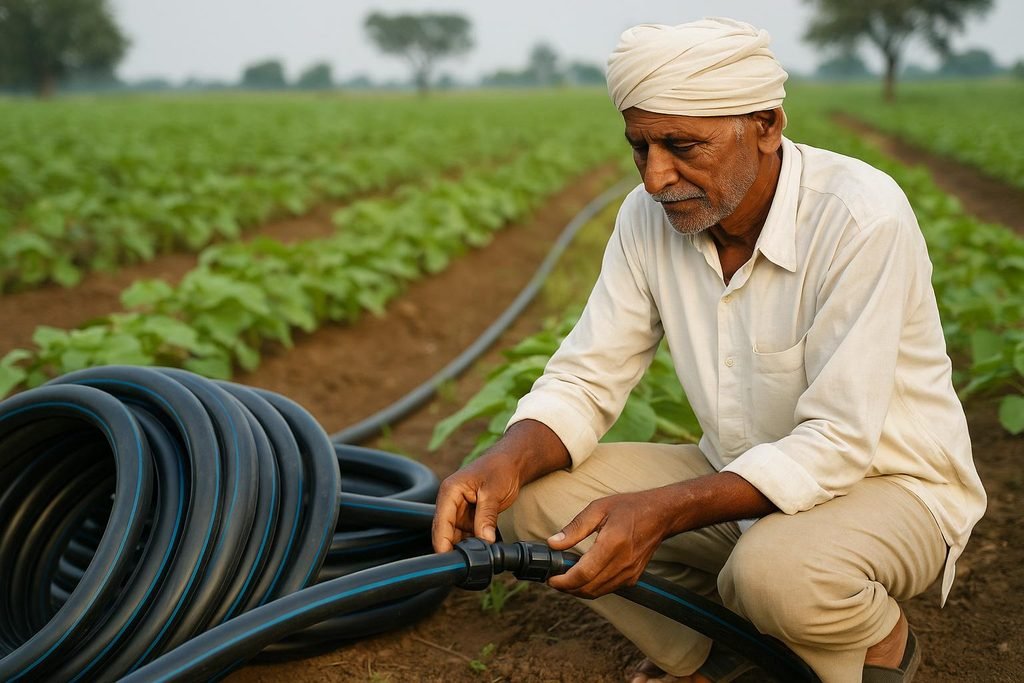
Need Help Choosing an HDPE Pipe for Your Farm?
Not sure which diameter or pressure specification is suitable for your agricultural pipeline?
Contact Vishal Pipes and Fittings with your intended application, estimated pipe length, required quantity and delivery location. Our team can discuss the available product information and help you understand the specifications to consider before requesting a quotation.
Explore: Vishal Pipes and Fittings | Our Products
About the Author
Komal Parmar – Agricultural & Piping Content Writer
Komal Parmar writes about HDPE pipes, mini sprinkler, agricultural piping, irrigation systems, pipe fittings and water-supply solutions. Her work focuses on explaining technical product and irrigation information in a practical way for farmers, contractors, dealers and businesses.
Last reviewed: November, 2026