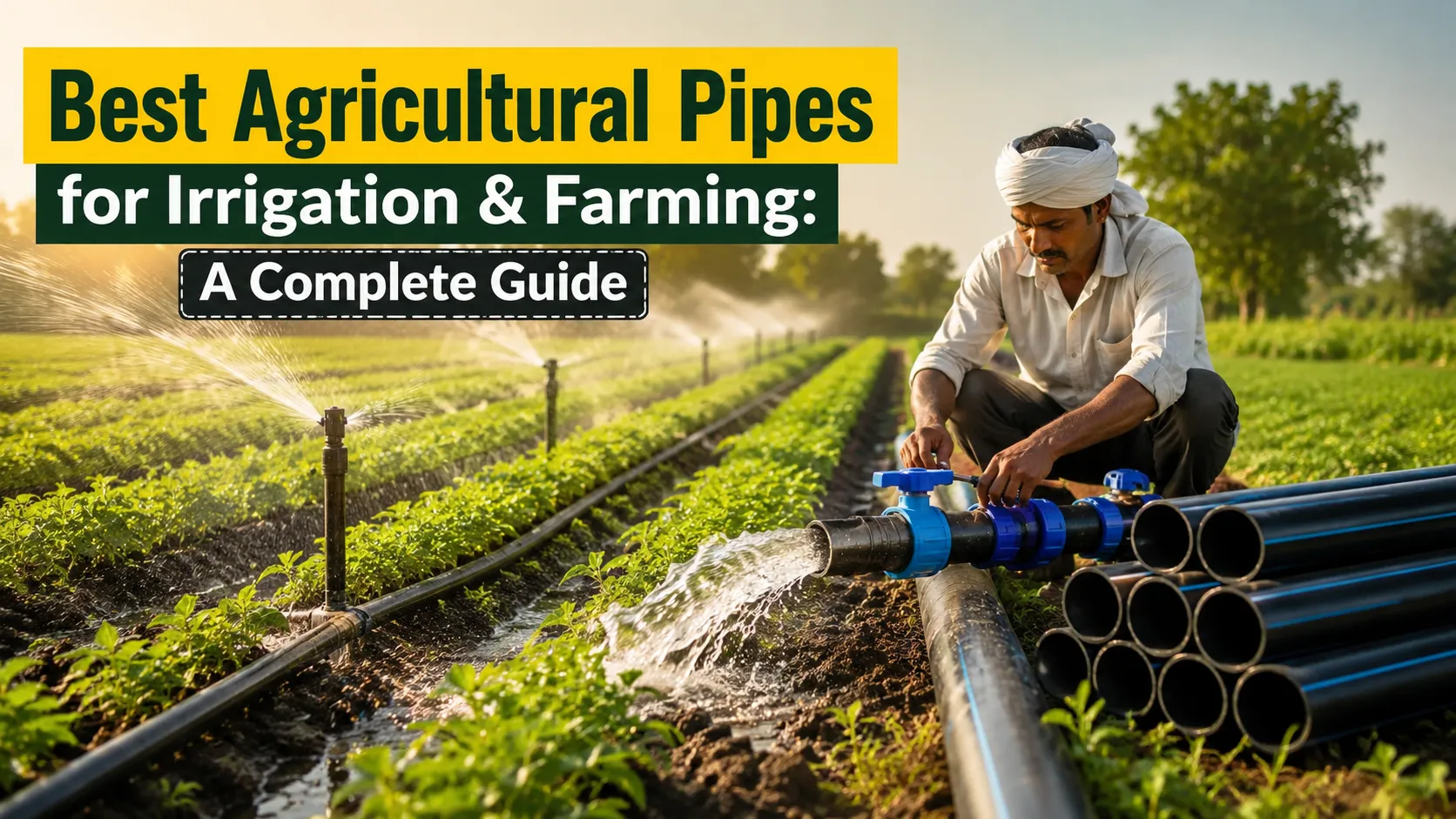
When Every Drop of Water Matters, the Right Pipe Matters Too
Agricultural Pipes may look like a simple part of a farm irrigation system, but the right pipe can make a noticeable difference in water distribution, maintenance, operating cost, and overall farming efficiency.
Imagine a farmer who has invested in a good pump and a modern sprinkler system. The pump is working well, but the water reaching the far end of the field is weak. There are frequent leaks, joints need repair, and water pressure keeps changing. The problem may not be the pump at all. It could be the wrong pipe, poor fittings, incorrect diameter, or an unsuitable irrigation layout.
This is why farmers, contractors, dealers, and infrastructure teams should look beyond the purchase price and select piping according to the actual application.
At Vishal Pipe, we understand that irrigation requirements are different for every farm and project. Our range includes HDPE pipes, sprinkler pipes, LLDPE flat pipes, and sprinkler fittings designed for agricultural and irrigation applications.
For buyers searching online for an HDPE Pipe Manufacturer in Indore, PVC Pipe Manufacturer in Indore, or a dependable Irrigation Pipe Manufacturer in Indore, the important question is not simply, “Which pipe is cheapest?” The better question is, “Which pipe will perform reliably for my water source, pressure, field size, and irrigation method?”
What Are Agricultural Pipes and Where Are They Used?
Agricultural piping carries water from a source such as a borewell, open well, reservoir, tank, canal, or pump to the required location in a field.
Depending on the irrigation system, pipes can act as mainlines, sub-mainlines, delivery lines, laterals, suction lines, or temporary field distribution lines.
They are commonly used for:
- Farm irrigation
- Sprinkler irrigation
- Drip irrigation
- Pump suction and delivery
- Horticulture
- Nursery irrigation
- Greenhouse and polyhouse applications
- Water transfer between tanks and fields
- Landscaping and garden irrigation
For a farmer, the choice affects water flow and ease of handling. contractor, it affects installation time and project reliability. For a dealer, product consistency and demand matter. Government and infrastructure projects also need dependable products that match technical specifications.
That is why buying from an experienced Pipe Manufacturer in Indore can be more useful than choosing a product only because it has a lower initial price.
Which Agricultural Pipes Are Best for Irrigation?
There is no single pipe that is best for every farm. The right choice depends on pressure, distance, irrigation method, soil conditions, mobility requirements, water source, and budget.
HDPE Pipes: Strong and Flexible for Long-Term Applications
HDPE is widely considered when durability, flexibility, and resistance to corrosion are important.
A good HDPE system can be suitable for water transportation, agricultural distribution networks, and demanding outdoor applications. Vishal Pipe describes its HDPE pipes as lightweight, flexible, corrosion and chemical resistant, with a focus on leak reduction.
This makes HDPE worth considering for farmers who want a reliable long-term network rather than frequently shifting and repairing rigid lines.
If you are comparing an HDPE Pipe Supplier in Indore, pay attention to pipe quality, dimensions, pressure requirements, fittings, installation support, and product consistency instead of comparing price alone.
PVC Pipes: Useful for Specific Agricultural Applications
PVC pipes are another common option in agricultural water systems, especially where rigid piping is appropriate.
They can be useful for suction and delivery applications when the product is designed and specified for that purpose. BIS lists IS 12235 for unplasticized PVC pipes used in suction and delivery lines of agricultural pump sets.
Farmers looking for a PVC Pipe Manufacturer in Indore should therefore discuss the actual application with the supplier before purchasing. A pipe intended for one purpose should not automatically be assumed suitable for every irrigation requirement.
Sprinkler Pipes: Designed for Flexible Field Irrigation
Sprinkler irrigation needs a pipe network that can deliver water under the required pressure and connect efficiently with sprinklers and fittings.
this is particularly useful where farmers need controlled water distribution across open fields, horticulture areas, nurseries, and similar applications.
If you are searching for Sprinkler Pipe Manufacturer in Indore, look for a supplier that understands not just the pipe but the complete sprinkler arrangement, including couplings, fittings, pressure requirements, and field layout.
BIS has a dedicated standard, IS 17425:2020, covering quick-coupled polyethylene pipes and fittings for sprinkler irrigation systems.
HDPE vs PVC vs Sprinkler Pipes: Which Should You Choose?
| Feature | HDPE | PVC | Sprinkler Pipe |
|---|---|---|---|
| Flexibility | High | Lower | High |
| Corrosion resistance | Excellent | Excellent | Excellent |
| Field shifting | Convenient | Less convenient | Very convenient |
| Typical use | Mainlines, water transfer, distribution | Rigid water systems, suction/delivery applications | Sprinkler irrigation |
| Installation | Relatively easy | Requires appropriate joints | Quick field connection |
| Best suited for | Long-term agricultural networks | Specific rigid applications | Mobile/seasonal irrigation |
The table is a starting point, not a replacement for technical selection. Pipe diameter and pressure rating should always be matched to the pump, distance, flow requirement, elevation, and irrigation equipment.
How to Select the Right Agricultural Pipes for Your Farm
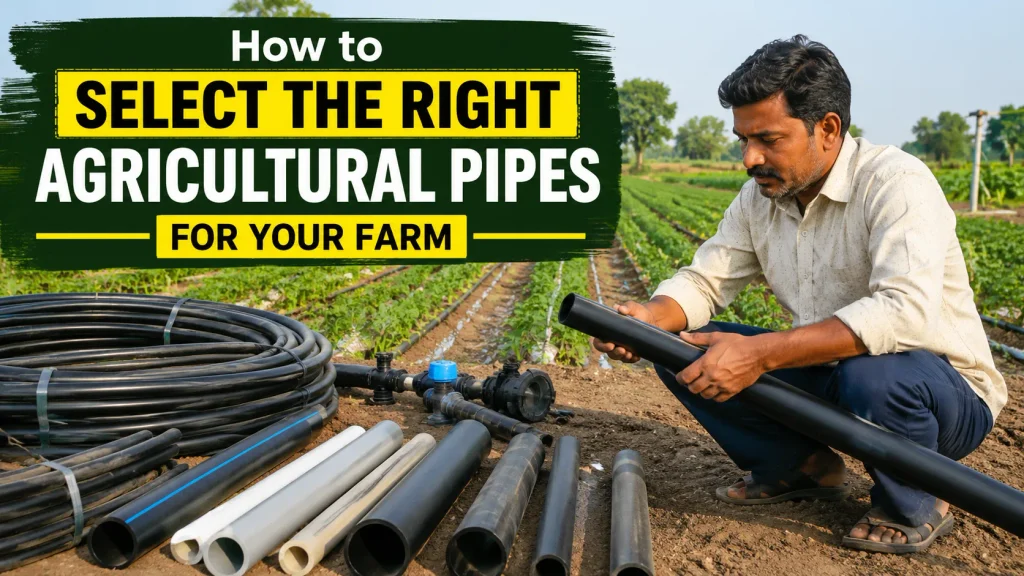
A farmer standing in front of several pipe options may naturally ask, “Which one should I buy?”
Start with these five questions.
1. What is your water source?
Is the water coming from a borewell, open well, pond, tank, canal, or another source? The source influences suction, delivery, filtration, and pipe selection.
2. How far must the water travel?
A short field connection and a long pipeline crossing several hundred metres do not necessarily require the same solution.
3. What is your operating pressure?
Pressure matters especially in sprinkler systems. A pipe that is unsuitable for the operating conditions can lead to poor performance or premature failure.
4. Will the pipe remain installed or be moved?
If pipes are moved regularly from one field section to another, flexibility and ease of handling become important.
5. What is the required water flow?
Choosing diameter only because it “looks suitable” can create pressure loss and uneven water delivery. Ask the supplier or irrigation professional to calculate the required flow and pipe size.
A professional Pipe Supplier Near Me can be useful when you need quick access to pipes and fittings, but technical guidance should remain the priority.
A Simple Example: Why Pipe Selection Can Change Farm Performance
Consider a farmer growing vegetables on a medium-sized field.
Initially, the farmer uses a basic arrangement without checking the total pipeline length, pressure loss, and fitting requirements. The sprinkler nearest to the pump works strongly while the sprinklers at the far end receive less water.
Instead of immediately replacing the pump, the farmer reviews the complete system.
The pipeline diameter is corrected. Suitable fittings are installed. The field is divided into manageable irrigation zones. The farmer also chooses a pipe appropriate for the pressure and mobility requirements.
The result is a more balanced irrigation system.
This example highlights an important lesson: good irrigation is not only about the pump. It is about how effectively the entire water delivery system works together.
Why Quality Matters More Than the Lowest Price
A cheaper pipe can appear attractive during purchase, but the actual cost of an irrigation system includes transportation, installation, fittings, labour, repairs, water losses, and replacement.
Suppose a pipe repeatedly develops leaks or joints fail during peak irrigation periods. The farmer may spend more on labour and downtime than expected.
For dealers and contractors, inconsistent product quality can create another problem: customer complaints and repeat service calls.
A reliable HDPE Pipe Dealer Near Me or local supplier should therefore be evaluated based on product range, technical understanding, consistency, availability, and after-sales support.
For larger projects, ask for product specifications and applicable standards rather than relying only on verbal claims.
What Do Indian Standards Say About Irrigation Pipes?
Standards are useful because they establish measurable requirements for products and testing.
BIS currently lists IS 12786:2024 for polyethylene pipes used for irrigation laterals. The standard covers areas such as material, dimensions, wall thickness, hydraulic characteristics, tensile strength, environmental stress cracking, marking, and conformity testing.
BIS also recognizes standards covering quick-coupled polyethylene sprinkler systems and HDPE laminated woven lay-flat tubes for irrigation applications.
This is especially important for civil contractors, irrigation contractors, builders, and government departments. Product selection should consider the technical specification written for the project.
Step-by-Step Guide to Planning an Irrigation Pipeline
Step 1: Map the Water Source
Mark the pump, borewell, reservoir, tank, or other water source.
Step 2: Measure the Distance
Estimate the mainline and branch-line lengths. Include elevation changes wherever possible.
Step 3: Identify the Irrigation Method
Decide whether the farm will use sprinklers, drip, flood irrigation, or a combination.
Step 4: Calculate Flow and Pressure
The required pipe diameter should be based on actual flow and pressure requirements.
Step 5: Select the Pipe Material
Choose HDPE, PVC, sprinkler pipe, flexible pipe, or another suitable product according to the application.
Step 6: Select Compatible Fittings
A good pipe connected with poor-quality fittings can still cause leakage. Couplers, bends, valves, clamps, and other accessories must match the system.
Step 7: Test Before Full Operation
Run the system and check joints, pressure, water distribution, and leakage before beginning regular irrigation.
If you need a complete irrigation solution, an experienced Sprinkler system dealer in Indore can help connect the pipe selection with the sprinkler layout.
Where Do Suction Pipes Fit Into Agricultural Irrigation?
Suction piping connects the water source to the pump and therefore works under different conditions from ordinary delivery piping.
Farmers should never select a suction pipe only by diameter. The pump type, suction lift, water source, operating conditions, and pipe construction all matter.
If you are searching for a Suction pipe delear in indore, discuss the pump specifications with the supplier before finalizing the product.
For agricultural pump applications, BIS specifically lists standards concerning unplasticized PVC pipes used in suction and delivery lines.
Common Mistakes Farmers Make When Buying Agricultural Pipes
One common mistake is choosing the pipe only according to price.
Another is selecting the wrong diameter. A pipe that is too small can increase friction losses and affect water delivery.
Some buyers also mix incompatible fittings or ignore the operating pressure of the system.
Another frequent mistake is buying from an unknown source without checking specifications. This may create problems when replacement pipes or matching fittings are needed later.
Farmers also sometimes leave flexible pipes exposed unnecessarily to harsh conditions or drag them over sharp surfaces. Proper handling can extend service life.
A simple rule works well: select the complete system, not just the pipe.
Practical Checklist Before Buying
Before placing your order, check:
Water source identified
Pump capacity known
Required flow estimated
Operating pressure checked
Pipeline length measured
Pipe diameter selected correctly
Application identified
Compatible fittings available
Product specifications checked
Installation method planned
Replacement availability confirmed
If you are buying locally, searches such as Sprinkler pipe dealers near me, Pipe hose shop near me, Garden pipe dealer near me, and High density pipe dealer in indore can help you find nearby options. But always compare specifications before making the final purchase.
Agricultural Irrigation Trends: What Is Changing?
Indian agriculture is increasingly focused on better water-use efficiency and modern irrigation.
The Government of India’s Per Drop More Crop programme promotes micro-irrigation, including drip and sprinkler systems. A government dataset reports that the programme has covered about 78 lakh hectares since 2015–16.
This growth points toward a broader shift: farmers are becoming more interested in systems that deliver water more precisely instead of simply increasing the quantity of water applied.
BIS is also continuing work around irrigation piping standards. In 2025, BIS conducted stakeholder consultation on a proposed revision related to quick-coupled polyethylene pipes and fittings for irrigation systems, with attention to durability, installation, water efficiency, and service life.
For farmers and contractors, this means pipe selection will increasingly be connected with efficient irrigation planning, better fittings, system compatibility, and long-term performance.
For Dealers, Contractors and Project Buyers
Agricultural piping is not only a farmer’s purchase.
A Plastic pipe manufacturer in indore can serve dealers who need dependable local supply. A Plastic pipe dealer in indore can support farmers and contractors who need multiple sizes and accessories.
Civil and irrigation contractors should consider product availability, technical specifications, installation requirements, and consistency across large quantities.
For project procurement, choosing an established Best Pipe Manufacturer in Indore can simplify sourcing when the project needs multiple pipe categories and fittings from one supplier.
If you are specifically comparing a Sprinkler irrigation pipe dealer in indore, ask about pipe compatibility, available sizes, couplings, fittings, and support for your irrigation layout.
Why Choose Vishal Pipe for Agricultural Applications?
Vishal Pipe positions itself as a sprinkler irrigation pipe manufacturer and dealer serving agricultural and industrial applications. The company states that it has more than 18 years of experience, 4,000+ projects, and 18,000+ satisfied clients.
Its product range includes Vishal HDPE Pipe, Vishal Sprinkler Pipe, Vishal LLDPE Flat Pipe, and sprinkler fittings.
For farmers in Madhya Pradesh, dealers, irrigation contractors, builders, and infrastructure buyers, local availability can also make procurement and support easier.
Vishal Pipe is based in Indore and operates manufacturing units in the Sanwer Road Industrial Area.
Frequently Asked Questions About Agricultural Pipes
Which pipe is best for farm irrigation?
The answer depends on the irrigation method, pressure, distance, water source, and whether the pipeline is permanent or movable. HDPE and sprinkler pipes are common choices for many agricultural applications, while PVC can be suitable for specific rigid and suction/delivery applications.
Are HDPE pipes good for agriculture?
Yes, HDPE is often considered for agricultural water transportation because of its flexibility, corrosion resistance, and suitability for various outdoor applications. However, the correct grade, size, pressure rating, and fittings should be selected for the intended use.
What is the difference between HDPE and PVC pipes?
HDPE generally offers greater flexibility, while PVC is more rigid. The better option depends on installation conditions, application, pressure, handling requirements, and project specifications.
Can sprinkler pipes be moved from one field to another?
Many sprinkler systems use quick-coupled or portable piping arrangements that can be shifted between field sections. The exact suitability depends on the pipe and fitting system.
How do I choose the right pipe size?
Consider pump capacity, required flow, pipeline length, elevation, pressure, and the number of outlets or sprinklers. For a large system, professional hydraulic calculations are recommended.
Where can I find agricultural pipes in Indore?
Farmers and contractors can compare local suppliers using searches such as HDPE pipe manufacturer in indore, Sprinkler Pipe Manufacturer in Indore, PVC Pipe Manufacturer in Indore, or Best column pipe dealer in indore. Always verify product specifications and application suitability before purchasing.
Final Takeaway: Buy for Performance, Not Just Price
The best irrigation pipeline is not necessarily the cheapest one sitting on a dealer’s shelf.
It is the pipe that matches your water source, pump, pressure, field size, irrigation method, handling requirements, and long-term plans.
For farmers, the right selection can make daily irrigation easier. dealers, reliable products can build customer confidence. contractors and builders, correct specifications can reduce installation problems. For government and infrastructure projects, standard-compliant products and dependable supply are essential.
So, before your next irrigation project, take a moment to ask:
What water flow do I need? What pressure will the system operate at? How far must the water travel? Will the pipe remain fixed or move? Which material is appropriate for this application?
Once these questions are answered, choosing the right piping solution becomes much easier.
If you are looking for dependable agricultural and irrigation piping solutions in Indore, explore the product range and speak with Vishal Pipe about your specific requirement.