When Every Drop Can Make a Difference
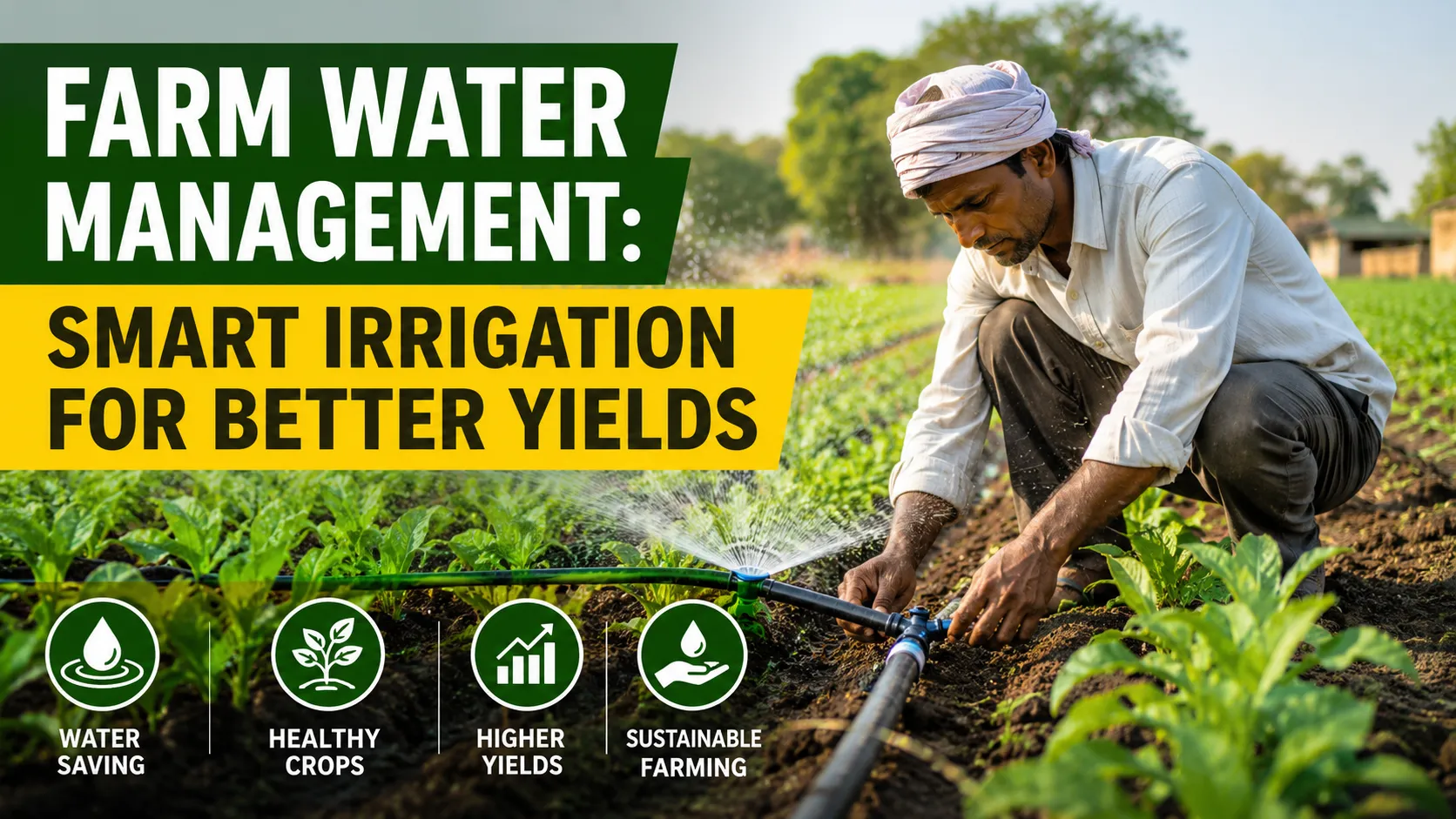
Farm Water Management is no longer just about giving crops enough water. It is about giving the right amount of water, at the right time, through the right irrigation system.
Imagine a farmer who spends hours pumping water into a field, only to see part of it disappear through runoff, evaporation, leakage, or uneven distribution. Some plants receive too much water while others remain dry. The pump consumes more electricity, labour costs increase, and the final harvest may still not improve.
Now imagine the same farm using a properly planned sprinkler or drip system, suitable pipes, controlled pressure, and a simple irrigation schedule. Water reaches the crop more evenly. Pumping becomes easier to manage. Soil moisture remains more stable. The farmer can spend less time worrying about whether every part of the field is receiving water.
This is the basic idea behind smart irrigation.
According to the Food and Agriculture Organization (FAO), agriculture accounts for about 72% of global freshwater withdrawals, making better agricultural water management increasingly important.
For Indian farmers, especially in areas where groundwater and rainfall can be uncertain, efficient water movement from the source to the crop is becoming an important part of modern farming.
Why Farm Water Management Matters More Than Ever
A farm irrigation system is only as good as the complete water-management plan behind it.
Water may start from a borewell, pond, canal, reservoir, or other source. From there, it travels through pumps, suction systems, mainlines, sub-mainlines, fittings, valves, and finally reaches sprinklers or drip points.
A weak link anywhere in this chain can reduce performance.
For example, a farmer may purchase an efficient sprinkler system but install an unsuitable pipe size. Pressure can then become uneven across the field. The result is poor water distribution even though the sprinkler heads themselves are good.
This is why Farm Water Management should begin before purchasing pipes or irrigation equipment.
The objective is simple: move water efficiently, distribute it evenly, and use only what the crop actually needs.
The Government of India’s PMKSY Micro Irrigation Fund guidelines note that micro-irrigation can provide water savings of up to 40% compared with conventional flood irrigation, while also helping reduce labour and other input costs.
What Does Smart Irrigation Actually Mean?
Smart irrigation does not always mean expensive automation or complicated technology.
At its basic level, smart irrigation means making better decisions about when, where, and how much water to apply.
A practical system can combine:
- Efficient water-source management
- Properly sized irrigation pipes
- Sprinkler or drip irrigation
- Pressure control
- Soil-moisture observation
- Irrigation scheduling
- Regular leakage checks
- Suitable fittings and valves
Modern systems can go further by using soil-moisture sensors, weather information, timers, flow meters, and automated controllers.
ICAR has reported technologies using soil-moisture sensing for irrigation scheduling that can save water compared with traditional scheduling.
The important point is that technology should solve a real farm problem. Buying a sensor without understanding the crop, soil, irrigation layout, and water source will not automatically create a better farm.
The Role of the Right Irrigation Pipe
Think of an irrigation pipe as the road that carries water to your crops.
A good road allows traffic to move smoothly. A poorly designed road creates delays and problems.
The same principle applies to agricultural water systems.
The pipe material, diameter, pressure rating, flexibility, fittings, installation method, and expected operating conditions should all be considered before making a decision.
For farms requiring flexible and durable water distribution, HDPE can be a suitable option in many applications. PVC can also be useful where a rigid, cost-effective pipeline layout fits the project requirements.
If you are comparing an HDPE Pipe Manufacturer in Indore with a PVC Pipe Manufacturer in Indore, do not compare only the price per pipe. Compare the complete system, including fittings, pressure requirements, installation, expected service conditions, and maintenance.
A reliable HDPE Pipe Supplier in Indore or PVC Pipe Supplier in Indore should help you select the product according to the application rather than simply recommending the cheapest option.
HDPE vs PVC for Farm Irrigation
Both materials can have a place in agricultural water systems. The right choice depends on the farm and application.
| Feature | HDPE Pipes | PVC Pipes |
|---|---|---|
| Flexibility | High | Lower |
| Corrosion Resistance | Excellent | Excellent |
| Uneven Terrain | Very suitable | Suitable with proper design |
| Handling | Flexible and convenient | Lightweight and rigid |
| Underground Use | Commonly used | Commonly used |
| Best Advantage | Flexibility and durability | Cost-effective rigid installation |
| Typical Application | Irrigation distribution | Water distribution and irrigation |
The best choice is not necessarily the same for every farm.
A professional Irrigation Pipe Manufacturer in Indore should first understand the water source, field size, pressure, crop requirements, distance, and installation conditions.
Sprinkler Irrigation: A Practical Choice for Many Farms
Sprinkler irrigation distributes water over the field in a controlled spray. It can be useful for crops and farm layouts where overhead application is suitable.
The major advantage is better control over water distribution compared with uncontrolled flooding.
A properly designed system can include a pump, suction arrangement, main pipeline, sub-mainline, sprinkler pipes, fittings, valves, and sprinkler heads.
This is where choosing the right supplier becomes important.
Farmers searching for Sprinkler pipe dealers near me or a Sprinkler irrigation pipe dealer in indore should look beyond availability. Check whether the dealer understands pressure requirements, pipe sizes, fittings, and the complete irrigation layout.
Similarly, a Sprinkler system dealer in indore should be able to guide you on the complete system rather than selling individual components without considering how they will work together.
A Simple Farm Water Management System
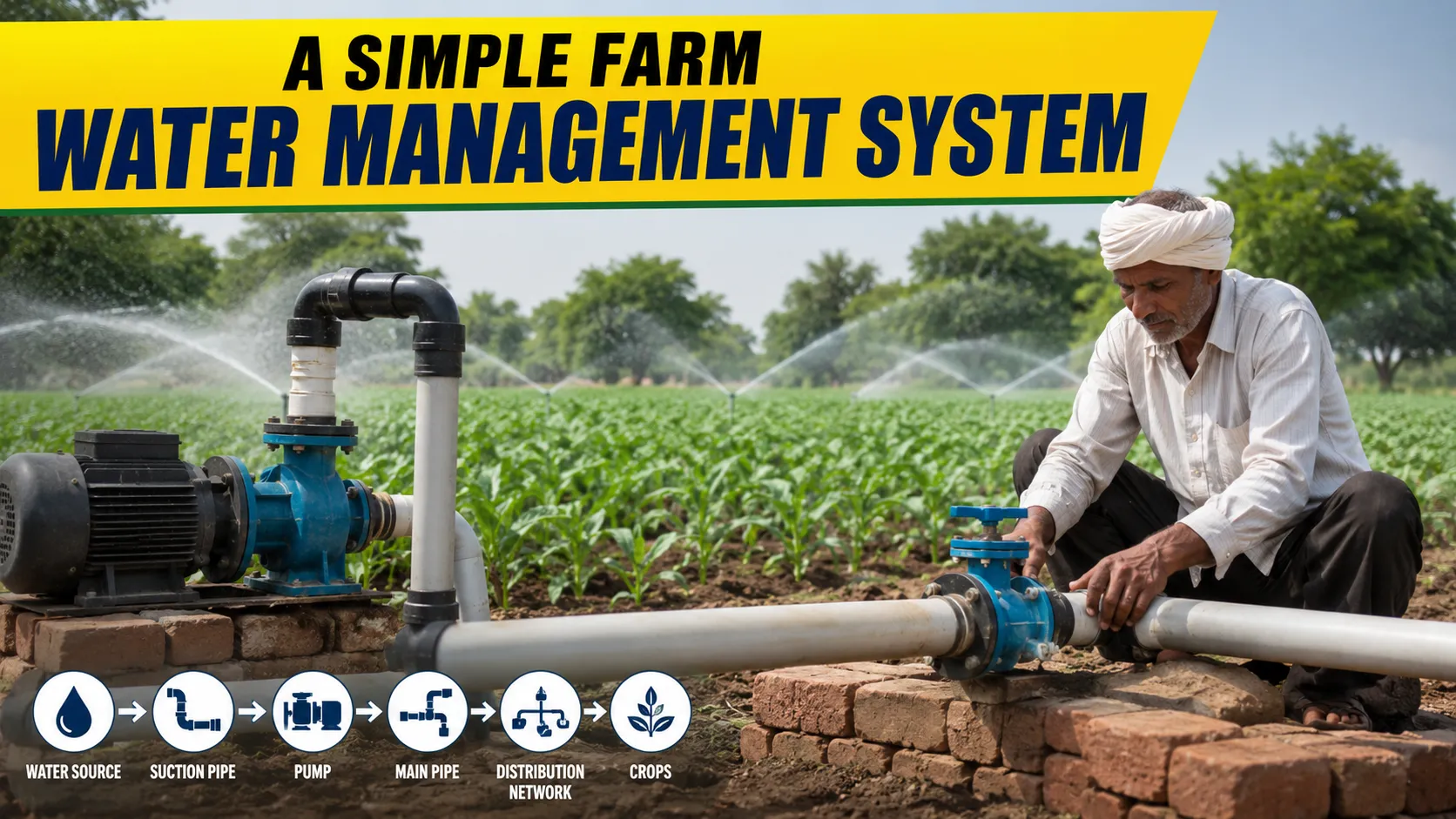
A well-planned irrigation system can be understood as a simple journey:
Water Source → Suction → Pump → Main Pipe → Distribution Lines → Sprinkler/Drip → Crop Root Zone
Each stage matters.
the suction side has a problem, the pump may not perform properly.
the main pipe is undersized, pressure can drop.
fittings are poor, leakage can increase.
sprinkler spacing is incorrect, some areas may receive too much water.
irrigation timing is wrong, even a good system can waste water.
This is why Farm Water Management should always consider the complete journey of water.
Step-by-Step Guide to Better Farm Water Management
Step 1: Understand Your Water Source
Start by identifying where your irrigation water comes from.
Is it a borewell, open well, pond, canal, reservoir, or another source?
Measure the available water and understand how consistently it can supply the farm.
Do not design the entire irrigation system around assumptions.
Step 2: Check Pump Capacity and Pressure
The pump must be suitable for the required flow and pressure.
A system with too many sprinklers operating at once may experience pressure problems.
Ask:
How much water is available, at what pressure, and for how long?
These three questions can prevent many irrigation mistakes.
Step 3: Divide the Farm Into Zones
Instead of trying to irrigate the entire farm simultaneously, consider dividing it into manageable zones.
This can help maintain more consistent pressure and make irrigation scheduling easier.
The exact number of zones depends on the crop, field size, water availability, pipe layout, and irrigation method.
Step 4: Select Suitable Pipes
Now select the mainline and distribution pipes.
An experienced Pipe Manufacturer in Indore can help evaluate the required pipe material, size, pressure rating, and fittings.
For larger farms or projects, working with an established HDPE Pipe Dealer Near Me can also make sourcing and replacement easier.
Step 5: Install Sprinklers or Drip Lines Correctly
Spacing matters.
Sprinklers should be positioned according to their operating range and crop requirements. Drip systems need appropriate emitter spacing and filtration.
Never assume that simply increasing the number of outlets will improve irrigation.
Step 6: Create an Irrigation Schedule
Irrigate according to crop requirements, soil condition, weather, and available water.
Avoid following the same schedule throughout the entire season.
A crop’s water requirement can change as it grows.
Step 7: Inspect the System Regularly
Walk through the farm while the system is operating.
Look for:
- Leaking joints
- Damaged pipes
- Blocked sprinklers
- Uneven spray
- Pressure changes
- Water pooling
- Dry patches
- Unusual pump behaviour
Small problems are easier and cheaper to fix when found early.
A Real Example: What Better Irrigation Can Achieve
ICAR has documented a field intervention in Odisha where introducing sprinkler irrigation during the rabi season increased groundnut yield by 28% while saving 32% irrigation water. Water productivity improved by 60% compared with traditional check-basin irrigation.
This example shows something important.
Smart irrigation is not simply about saving water.
It is about improving the amount of useful crop production obtained from the water available.
Another ICAR report highlights that drip fertigation schedules in selected crops have demonstrated water, energy, and fertilizer savings alongside yield improvements. Results naturally vary according to crop, soil, climate, system design, and management.
Choosing the Right Pipe Supplier for Your Farm
Price is important, but it should not be the only factor.
Suppose two suppliers offer similar-looking pipes. One provides only the product. The other helps you understand the correct diameter, pressure requirement, fittings, installation conditions, and maintenance.
The second supplier may provide much better long-term value.
When looking for a Best Pipe Manufacturer in Indore, check product suitability, quality consistency, technical support, availability, delivery capability, and after-sales assistance.
For farmers who need suction products, a search for Suction pipe delear in indore may lead to several options. Before buying, check whether the suction pipe is appropriate for your pump and water-source conditions.
Likewise, someone looking for a Pipe hose shop near me or Garden pipe dealer near me should consider the intended use instead of selecting a product only because it is inexpensive.
For borewell applications, the requirements are different. A buyer searching for the Best column pipe dealer in indore should confirm the pipe’s suitability for the pump, borewell depth, load, and operating conditions.
What About High-Density and Plastic Pipes?
The term “plastic pipe” covers different materials and applications.
HDPE, PVC, and other polymer-based piping products can have different characteristics.
If you are searching for a High density pipe dealer in indore, ask about the exact material, dimensions, pressure class, standards, and application.
A Plastic pipe manufacturer in indore should be able to provide product information that helps you match the pipe to the job.
Similarly, a Plastic pipe dealer in indore should be able to explain which product is appropriate for irrigation, water movement, suction, borewell, or other applications.
The right question is not simply, “Which pipe is cheapest?”
It is:
“Which pipe will perform reliably in my specific application?”
Common Farm Irrigation Mistakes to Avoid
Using the Wrong Pipe Size
An undersized pipeline can restrict flow and affect pressure.
Ignoring Pressure Variation
Sprinklers need suitable operating pressure. Uneven pressure can create uneven irrigation.
Overwatering the Field
More water does not automatically mean better crop growth.
Excess water can cause runoff, nutrient loss, waterlogging, and unnecessary pumping costs.
Ignoring Small Leaks
One small leak may look harmless. Multiple leaks across a farm can become a significant source of water loss.
Choosing Only on Price
Cheap components can become expensive if they require frequent replacement or cause poor system performance.
Forgetting Maintenance
Filters, sprinklers, valves, fittings, pumps, and pipelines all require periodic inspection.
Farm Water Management Checklist
Before starting or upgrading your irrigation system, ask yourself:
Have I measured my available water source?
Is the pump suitable for my requirement?
Have I checked operating pressure?
Is the pipe diameter appropriate?
Are the fittings compatible?
Is the field divided into practical irrigation zones?
Are sprinkler or drip outlets correctly positioned?
Do I have a regular irrigation schedule?
Have I checked the system for leakage?
Can I easily access replacement pipes and fittings?
Am I monitoring wet and dry areas in the field?
Is my irrigation system designed around crop requirements?
If several answers are “no”, your irrigation system may have room for improvement.
Smart Irrigation Trends Farmers Should Watch
Agriculture is moving toward more measured and controlled irrigation.
Some important trends include soil-moisture sensors, automated irrigation controllers, weather-based scheduling, flow monitoring, fertigation, water storage, remote monitoring, and improved pipeline systems.
But smart farming does not mean replacing practical farming knowledge with technology.
The strongest systems combine technology with field observation.
A farmer who understands the crop, soil, weather, water source, and irrigation behaviour can make better decisions when supported by reliable data.
Why the Complete System Matters
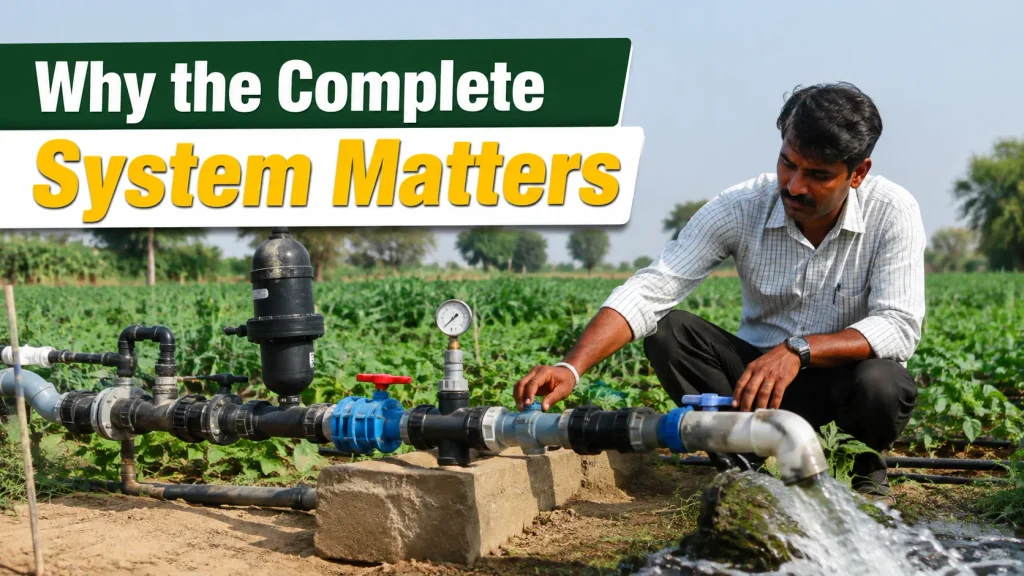
It is easy to focus on the sprinkler head because that is where we can see water coming out.
But the real performance starts much earlier.
Water must be lifted efficiently.
It must travel through a suitable suction arrangement.
The main pipeline must carry the required flow.
Distribution lines must maintain suitable pressure.
Fittings must remain secure.
Sprinklers or drip systems must distribute water correctly.
And finally, the crop must receive water when it actually needs it.
That is the real meaning of Farm Water Management.
Why Farmers, Dealers and Contractors Need Reliable Pipe Solutions
Farmers need systems that work during critical crop stages.
Pipe dealers and distributors need dependable products that their customers can trust.
Civil and irrigation contractors need consistent material, suitable specifications, and timely supply.
Builders and construction companies need piping products that fit project requirements.
Government and infrastructure departments need reliable solutions that can support large-scale water and irrigation projects.
Vishal Pipe presents itself as a sprinkler irrigation pipe manufacturer and dealer serving agriculture and industrial applications, with products including sprinkler pipes, HDPE pipes, suction hose, and column pipes.
For buyers in Indore, choosing a supplier with a broader agricultural piping range can simplify sourcing and help maintain consistency across irrigation projects.
A Practical Success Formula
You do not need to transform your entire farm in one day.
Start with the biggest source of water loss.
Then improve the pipeline.
Next, improve distribution.
After that, improve scheduling.
Finally, add monitoring or automation where it provides real value.
This step-by-step approach is often more practical than installing an expensive system without first understanding the farm.
The Simple Formula
Measure → Plan → Choose → Install → Monitor → Improve
That is a practical way to build a more efficient irrigation system.
Frequently Asked Questions About Farm Water Management
What is Farm Water Management?
It is the process of planning, distributing, monitoring, and using water efficiently for agricultural production. It includes the water source, pump, pipelines, irrigation equipment, scheduling, and maintenance.
Which irrigation method is best for farming?
There is no single method that is best for every farm. Drip and sprinkler irrigation can both be efficient when correctly designed. The right choice depends on crop, soil, terrain, water availability, farm size, and budget.
Is HDPE pipe good for farm irrigation?
HDPE can be a strong option for many irrigation applications because of its flexibility and durability. The correct specification should be selected according to pressure, diameter, installation method, and intended use.
Are PVC pipes suitable for agricultural irrigation?
Suitable PVC pipes can be used in agricultural water and irrigation applications. The correct product should be selected according to the application, pressure, dimensions, and relevant specifications.
How can farmers reduce irrigation water waste?
Start by checking leaks, improving pipeline design, selecting suitable irrigation methods, maintaining pressure, dividing fields into zones, and following crop-based irrigation schedules.
Does smart irrigation always require sensors?
No. Smart irrigation can begin with better planning, correct pipe sizing, pressure management, scheduling, and regular monitoring. Sensors and automation can be added later where they provide a clear benefit.
How do I choose an irrigation pipe supplier?
Look for product quality, suitable specifications, availability, technical guidance, delivery support, fittings, and after-sales service. A reliable supplier should help you select the product according to your actual application.
Final Thoughts: Make Every Drop Work Harder
Water is one of the most valuable inputs on a farm.
The goal is not simply to use less water. The goal is to use available water more intelligently so that more of it reaches the crop in a useful way.
Better pipelines, efficient sprinklers or drip systems, proper pressure, regular maintenance, and smarter scheduling can all contribute to better irrigation performance.
The evidence is encouraging. FAO emphasizes the need to modernize irrigation infrastructure and improve agricultural water management, while Indian research and field experience show that efficient irrigation can improve both water use and crop outcomes.
So before your next irrigation season, take a walk across the farm and ask one simple question:
“Am I giving my crops the water they need, or am I simply giving them more water?”
That question can be the beginning of a much smarter irrigation system.
If you are planning a new farm irrigation system, upgrading an existing pipeline, or looking for dependable agricultural piping solutions in Indore, speak with a trusted supplier and discuss your farm’s water source, crop, pressure, distance, and layout before purchasing.
Plan the water. Choose the right pipe. Improve the irrigation. Grow smarter.