
For a farmer, the first good monsoon shower can feel like a huge relief. After weeks of heat, dry soil and rising irrigation costs, rain brings fresh hope to the field. But experienced farmers also know that rainfall and irrigation are not always the same thing.
One part of a field may receive enough rain while another remains comparatively dry. A heavy shower may create runoff in one area, while the root zone in another still needs moisture. Then the weather may remain dry for several days.
This is where a Rain Pipe can support more controlled irrigation during the monsoon. Instead of depending entirely on uneven rainfall, farmers can use a Rain Pipe irrigation system to provide supplemental moisture where and when the crop needs it. One part of a field may receive enough rain while another remains comparatively dry. A heavy shower may
This is where rain pipe irrigation during monsoon can become useful.
A rain pipe does not replace rainfall. It gives the farmer another way to provide supplemental irrigation when natural rainfall is insufficient, uneven or poorly distributed.
For vegetable growers, horticulture farmers, nurseries and suitable small-to-medium agricultural plots, the right rain pipe irrigation system can make water application easier to control.
The important word is right.
A rain pipe is not automatically the best irrigation solution for every crop or every farm. Its performance depends on the crop, soil, field layout, water source, pump, pipe design, pressure, fittings and the way the farmer operates the system.
That is why, from a practical agricultural-pipe perspective, we recommend starting with the field requirement rather than the product catalogue.
Good irrigation planning begins with the field-not with the product catalogue.
Why Irrigation Still Matters During Monsoon
A common question during the rainy season is:
“If it has rained, why should I irrigate?”
It is a reasonable question.
The answer is that crops need adequate moisture around the effective root zone. Rainfall reaching the field does not automatically mean that every part of the root zone has received the amount of water the crop requires.
Actual field moisture can be influenced by:
- Rainfall intensity
- Duration of rainfall
- Soil type
- Field slope
- Drainage
- Crop canopy
- Surface runoff
- Infiltration
- Previous soil moisture
- Crop growth stage
For example, a short, intense rainfall event may generate runoff in some field conditions. A lighter but longer rainfall may infiltrate differently.
Sandy and heavier soils can also behave differently in terms of water movement and retention.
So during monsoon, the farmer’s decision should not simply be:
“It rained, so irrigation is unnecessary.”
Instead, it should be:
“Has the crop received enough usable moisture?”
That small change in thinking can make irrigation management much more practical.
Government agricultural programmed in India also emphasize improving on-farm water-use efficiency through better irrigation practices, including systems such as drip and sprinkler irrigation.
Rain pipe irrigation can fit into this broader approach where its application is suitable.
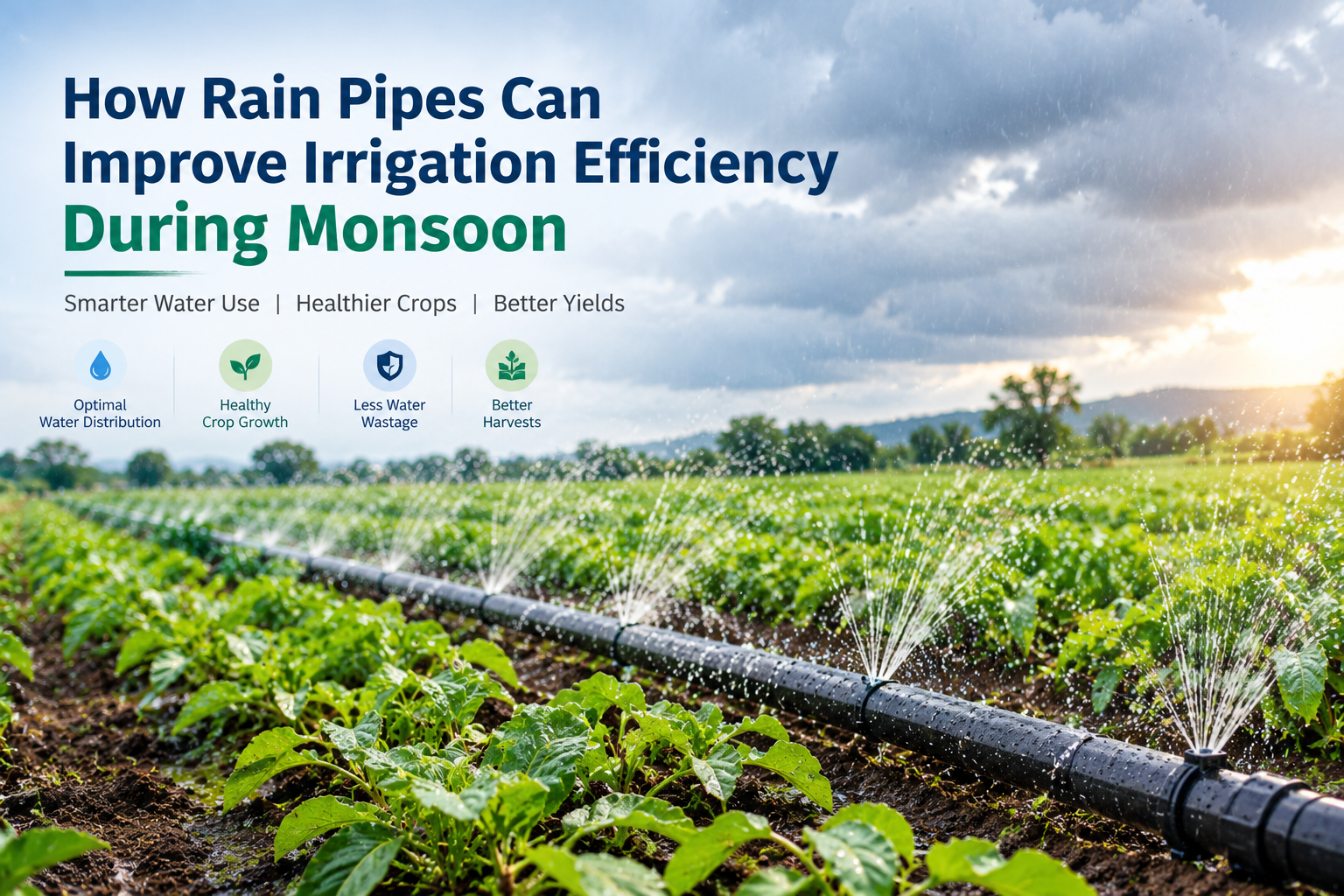
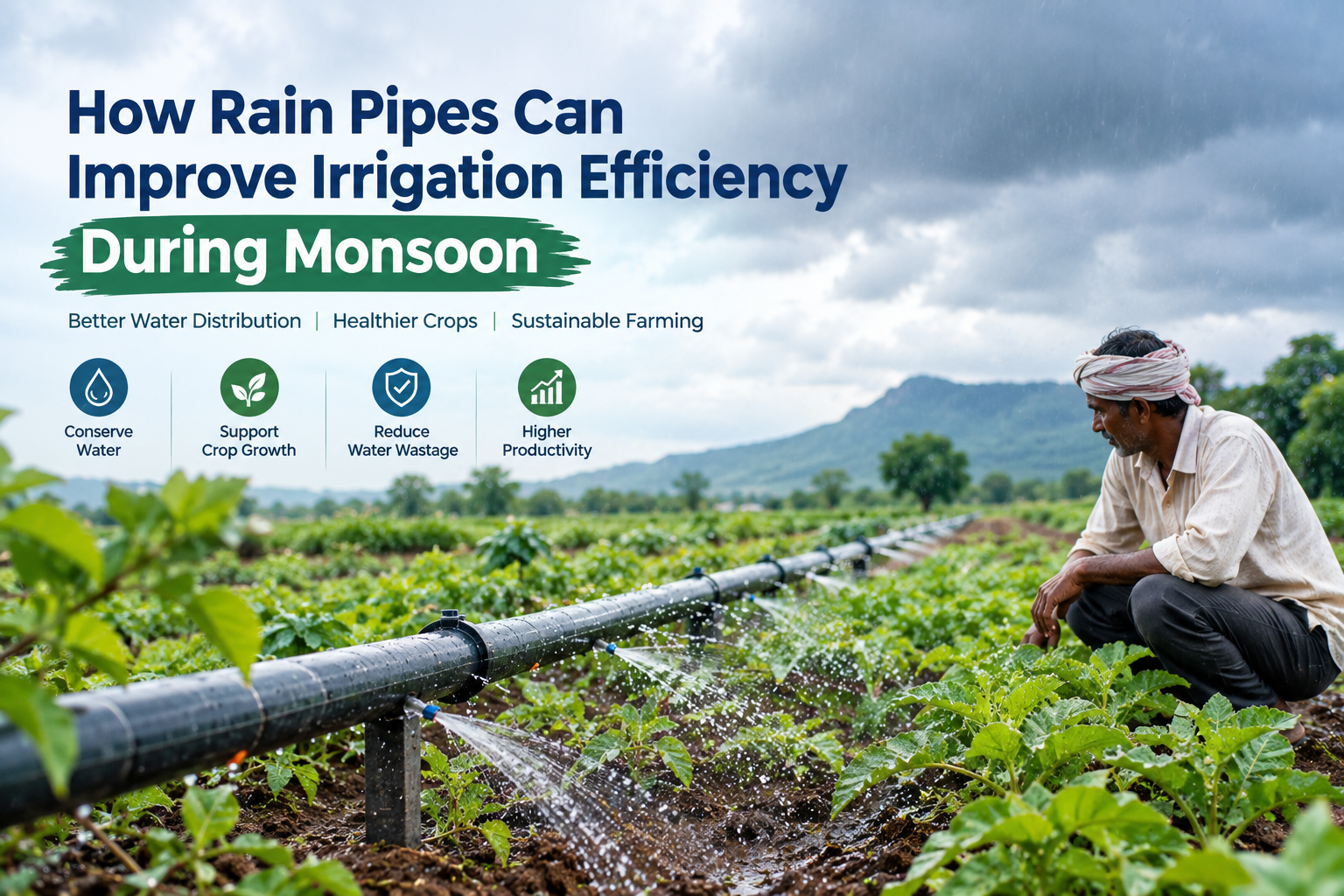
A rain pipe is an irrigation pipe designed with outlets or perforations through which pressurized water is distributed over the cultivated area.
When water enters the pipe under suitable operating conditions, it exits through the openings and falls over the soil and crop area in a pattern resembling rainfall.
This is where the term rain pipe comes from.
Compared with conventional flood irrigation, the purpose is to distribute water more progressively rather than allowing a large quantity of water to move uncontrolled across the field.
Rain pipes may be considered for applications such as:
- Vegetable farming
- Nursery irrigation
- Horticulture
- Flower cultivation
- Kitchen gardens
- Selected row crops
- Small agricultural plots
- Suitable open-field cultivation
However, there is no universal “best rain pipe.”
The correct selection depends on:
Crop + field size + water source + pump + pressure + pipe design + field layout + fittings + operating method
This is why a responsible pipe supplier should ask questions about the farm before recommending a product.
How Does Rain Pipe Irrigation Improve Efficiency During Monsoon?
The biggest practical advantage of a rain pipe during monsoon is control.
Farmers cannot control when clouds arrive.
They can, however, control when supplemental irrigation is applied.
1. Supplemental Irrigation Between Rainfall Events
Monsoon rainfall can be irregular.
A field may receive substantial rainfall and then experience several dry days. If the crop is at a sensitive growth stage, simply waiting for the next rainfall may not always be the best decision.
A rain pipe can provide an additional irrigation option.
The farmer can monitor soil and crop conditions and irrigate when additional moisture is actually required.
This is particularly relevant for crops where irrigation needs to be managed carefully, including many vegetable and horticultural crops.
2. More Controlled Water Distribution
With flood irrigation, water may move toward lower areas of the field.
That can result in uneven wetting.
A properly planned rain pipe arrangement can distribute water through multiple outlets across the cultivated area.
The objective should not be to apply maximum water.
The objective should be:
Apply sufficient water where the crop needs it, without unnecessary movement or over-irrigation.
3. Can Help Reduce Unnecessary Water Movement
Uncontrolled water movement can contribute to:
- Surface runoff
- Soil erosion
- Uneven wetting
- Water accumulation
- Wasted pumping effort
A properly selected and operated rain pipe can help manage water application more evenly.
But farmers should be careful with the word “water saving.”
A rain pipe does not automatically save water simply because it has perforations.
Actual water efficiency depends on:
- Operating pressure
- Pipe design
- Outlet arrangement
- Irrigation duration
- Field slope
- Soil condition
- Pump performance
- Maintenance
- Farmer operating practices
The pipe is a tool. Water efficiency comes from using that tool correctly.
Is Rain Pipe Useful for Vegetable Farming?
Vegetable farming is one area where practical irrigation management can make a significant difference.
Crops such as:
- Tomato
- Chilli
- Onion
- Cabbage
- Cauliflower
- Brinjal
- Cucumber
- Coriander
- Leafy vegetables
may have different irrigation requirements depending on crop stage, soil and cultivation method.
A rain pipe can be useful where the farmer wants distributed irrigation across the cultivated area.
However, farmers should not select a rain pipe simply because another farmer is using one successfully.
A tomato grower, onion grower and nursery owner may have very different irrigation requirements.
Before purchasing, consider:
How much area needs irrigation?
How is the crop planted?
How far apart are the rows?
What is the water source?
What pump is available?
What type of soil is present?
These questions are more important than simply asking for the cheapest pipe.
Rain Pipes for Gardens, Nurseries and Horticulture
Rain pipe irrigation is not limited to large farms.
Nursery owners, gardeners and horticulture growers may also consider this type of irrigation where a distributed watering pattern is appropriate.
For a nursery, manual watering can become repetitive, especially when plants are spread across a large growing area.
A properly designed irrigation arrangement can make watering more manageable.
The benefit is not simply “less labor.”
The bigger benefit can be more consistent and organized watering.
For small growers, that practicality can matter just as much as the pipe’s price.
Rainfall vs Irrigation During Monsoon: What Should Farmers Do?
This is one of the most important sections of the entire guide.
If there was heavy rainfall yesterday
Do not automatically start the pump today.
First check:
- Soil moisture
- Root-zone condition
- Drainage
- Crop condition
If rainfall was light
Check whether the moisture has actually reached the crop’s effective root zone.
If there have been several dry days
Inspect the field before deciding whether supplemental irrigation is required.
If the field is waterlogged
Do not add more water.
Address drainage first.
This point is easy to overlook.
More irrigation is not always better irrigation.
During monsoon, good farming often means knowing when not to operate the pump.
Farmer Experience: How a Farmer Uses Rain Pipe During an Uncertain Monsoon
Farmer: Ramesh Patidar
During a conversation about monsoon irrigation,
Ramesh Patidar explained that his main concern was not simply getting water onto the field.
His concern was knowing when additional irrigation was actually needed.
After rainfall, he would check the condition of different sections of the field instead of immediately starting the pump.
During periods when the rain stopped and the soil began drying, the rain pipe allowed him to irrigate the required section rather than treating the entire field in the same way.
What the Farmer Found Useful
According to the verified customer experience, the useful part of the system was:
- [Actual benefit]
- [Actual installation experience]
- [Actual crop response]
- [Actual labour or operating benefit]
- [Actual maintenance experience]
What Other Farmers Can Learn
The lesson is not that every farmer should purchase the same rain pipe.
The more useful lesson is this:
Understand your field first. Then select the irrigation system that matches it.
How a Rain Pipe Irrigation System Works
A basic agricultural irrigation arrangement may look like this:
Water Source → Pump → Mainline → Sub-main → Valve/Connector → Rain Pipe
Depending on the farm, the system may also include:
- Filters
- Valves
- Connectors
- End caps
- Pressure management
- Suitable fittings
- Distribution lines
The rain pipe is only one component.
This is important because farmers sometimes purchase the pipe first and think about the rest of the system later.
A good rain pipe connected to an unsuitable pump may not perform as expected.
Similarly, incorrect pressure, poor connections or blocked outlets can affect water distribution.
The irrigation system should be considered as a complete working arrangement, not just a pipe.
What Factors Affect Rain Pipe Performance?
Before recommending a rain pipe, an experienced agricultural pipe supplier should consider several practical factors.
Pipe Diameter
The diameter affects the flow characteristics of the system and should be matched to the irrigation arrangement.
Pipe Length
Longer irrigation sections can create different operating conditions from shorter sections.
Do not assume that one layout will perform identically at every length.
Operating Pressure
Pressure is particularly important.
Too little pressure may result in poor outlet performance.
Excessive pressure can also create problems depending on the pipe design.
Always follow the manufacturer’s specified operating range rather than using a universal pressure number.
Pump Capacity
The pump needs to provide the flow and pressure required by the irrigation arrangement.
A pipe cannot compensate for an incorrectly sized pump.
Field Slope
A level field and a sloping field may require different planning.
Soil Type
Water movement through sandy, loamy and heavier soils can differ.
Water Quality
Depending on the source, filtration or cleaning may be necessary to reduce the risk of blockage.
Fittings and Connections
Leaks at joints can reduce system performance even when the pipe itself is good quality.
HDPE Pipes for Agricultural Irrigation
HDPE pipes are used in many water-distribution applications because of characteristics including flexibility, corrosion resistance and ease of handling.
For agricultural mainlines and sub-mainlines, HDPE can be a suitable option depending on the system design.
A farm irrigation network may combine different components:
Water Source → HDPE Mainline → Sub-main → Irrigation/Rain Pipe
The exact configuration should be selected according to the field.
When comparing agricultural HDPE pipes, farmers should ask about:
| Factor | What to Check |
| Material | Material type and applicable specification |
| Diameter | Suitability for required flow |
| Pressure | Recommended operating conditions |
| Fittings | Compatibility with connectors and valves |
| UV Exposure | Suitability for intended outdoor use |
| Water Quality | Filtration/maintenance requirements |
| Installation | Manufacturer recommendations |
| Standards | Applicable Indian standards, where relevant |
| Application | Agricultural use intended for the product |
How to Choose the Right Rain Pipe for Your Farm
Before searching for “HDPE pipe dealers near me”, prepare these details.
1. Know Your Farm Size
An irrigation arrangement for one acre is not necessarily suitable for a 20-acre farm.
Field size can influence:
- Pipe length
- Mainline diameter
- Number of irrigation zones
- Pump requirement
- Pressure management
- Installation cost
2. Identify Your Water Source
Is the water coming from:
- Borewell?
- Open well?
- Farm pond?
- Canal?
- Storage tank?
The source can affect pump and filtration requirements.
3. Identify Your Crop
The irrigation system should suit the crop.
Do not select a rain pipe only because it is inexpensive or popular.
4. Check Pump Capacity
Ask whether the existing pump can provide the required flow and pressure.
5. Check the Fittings
Look beyond the pipe.
Ask about:
- Connectors
- Valves
- Joiners
- Clamps
- End arrangements
- Compatibility
A reliable irrigation system depends heavily on its connections.
Rain Pipe vs Sprinkler vs Drip Irrigation
Farmers often ask:
“Which one is best?”
There is no single answer.
| Irrigation Method | General Application |
| Rain Pipe | Distributed, rainfall-like watering over a suitable crop area |
| Sprinkler | Pressurized water application through sprinklers/nozzles |
| Drip | More targeted water delivery near individual plants or rows |
Rain Pipe
Can be useful where the farmer wants a distributed watering pattern.
Sprinkler
Can provide broad coverage using pressurized water and sprinkler/nozzle arrangements.
Drip
Can provide more targeted root-zone irrigation and may be preferable where precision around individual plants or rows is the priority.
The right choice depends on:
Crop + spacing + soil + field size + water availability + pump + budget + management practices
So the better question is not:
“Which irrigation system is the best?”
It is:
“Which irrigation system is appropriate for my farm?”
How to Use a Rain Pipe Efficiently During Monsoon
Step 1: Check Recent Rainfall
Do not irrigate simply because the normal irrigation schedule says it is time.
Step 2: Check Soil Moisture
Do not judge the whole field from the surface alone.
Inspect representative areas.
Step 3: Irrigate Only the Required Section
If one part of the farm is dry, consider whether the whole field really needs irrigation.
Step 4: Avoid Over-Irrigation
Excess water can contribute to waterlogging and other field-management problems.
Step 5: Check the Rain Pipe
Look for:
- Blocked outlets
- Leakage
- Damaged sections
- Loose connections
- Uneven discharge
Step 6: Clean and Store Correctly
At the end of the season, follow the manufacturer’s cleaning and storage recommendations.
Avoid unnecessary damage from sharp objects, poor handling or unsuitable storage conditions.
7 Common Rain Pipe Mistakes Farmers Should Avoid
1. Irrigating Immediately After Rainfall
Always consider actual soil moisture first.
2. Choosing Only on Price
The cheapest pipe is not necessarily the lowest-cost irrigation solution over time.
3. Ignoring Pressure
Pressure has a direct relationship with irrigation performance.
4. Buying Poor-Quality Fittings
A leakage problem at the connection can affect the entire arrangement.
5. Never Checking Outlets
Blocked or damaged outlets can produce uneven watering.
6. Treating Every Crop the Same
Different crops and growth stages can have different water requirements.
7. Ignoring Drainage
Especially during monsoon, drainage deserves as much attention as irrigation.
How to Choose Rain Pipe Manufacturers in Madhya Pradesh
For farmers searching for rain pipe manufacturers, pipe manufacturers in Madhya Pradesh or agricultural pipe suppliers, price should not be the only deciding factor.
Ask the supplier:
- What is the product designed for?
- What sizes are available?
- What material is used?
- What operating conditions are recommended?
- Which fittings are compatible?
- What installation method is recommended?
- Is technical guidance available?
- How should the product be maintained?
- What quality checks are performed?
- What warranty or replacement terms apply?
A trustworthy manufacturer or dealer should be able to explain why a particular product is suitable, rather than simply quoting a price per metre.
Looking for an Irrigation Pipe Manufacturer in Indore?
Farmers and agricultural buyers searching for an irrigation pipe manufacturer in Indore should compare suppliers on more than proximity.
Consider:
- Product specifications
- Agricultural applications
- Material quality
- Availability
- Fittings
- Technical guidance
- Delivery capability
- Replacement/support process
- Relevant product documentation
For local agricultural buyers, dealing with a manufacturer or established supplier can also make communication easier when technical questions arise.
Why Local Pipe Supply Can Be Useful in Madhya Pradesh
Madhya Pradesh has diverse agricultural conditions.
A farmer near Indore may have different soil, crop, water and field conditions from a farmer in another district.
Therefore, local knowledge can be valuable.
For someone searching for pipe manufacturers in Madhya Pradesh, the benefit of a local or regionally accessible supplier may include:
- Easier communication
- Faster product enquiry
- Easier inspection
- Availability of fittings
- More practical delivery
- Easier follow-up
- Understanding of regional agricultural requirements
But locality alone should never be treated as proof of quality.
Product suitability and technical support still matter.
Rain Pipe in Madhya Pradesh: What Farmers Should Consider
There is no single irrigation recommendation for the whole state.
When considering a rain pipe in Madhya Pradesh, farmers should look at:
- Local rainfall
- Soil condition
- Crop type
- Crop stage
- Farm size
- Water source
- Pump capacity
- Field slope
- Drainage
- Irrigation frequency
For farmers around Indore and other agricultural areas of Madhya Pradesh, rain pipe irrigation may be worth considering for suitable vegetable, horticulture and other crops where supplemental irrigation is required.
The correct system should be selected after understanding the farm—not simply because a product is marketed as a “water-saving” solution.
What Should You Ask Rain Pipe Manufacturers Before Buying?
Instead of asking only:
“What is the price?”
ask:
“Will this work for my farm?”
Then discuss:
- What crop are you growing?
- What is the field size?
- What water source do you use?
- What pump is available?
- What operating pressure is recommended?
- What pipe length is suitable?
- What fittings are required?
- How should the pipe be installed?
- How should it be cleaned?
- How should it be stored?
- Is it intended for repeated agricultural use?
These questions can help farmers make a performance-based purchasing decision.
Cost vs Long-Term Value
Farmers naturally care about price.
That is not something a manufacturer should ignore.
Agriculture involves uncertain rainfall, labour costs, electricity or diesel expenses, input costs and changing market conditions.
But purchase price and total cost are different things.
A low-priced irrigation pipe may become expensive if it causes:
- Frequent leakage
- Repeated replacement
- Poor water distribution
- Difficult installation
- More labour
- Unnecessary pumping
On the other hand, a suitable-quality system can offer better value when it makes irrigation easier to manage and reduces avoidable operating problems.
The better question is:
“Which irrigation solution gives my farm reliable performance at a reasonable total cost?”
That is more useful than simply asking:
“Which pipe is cheapest?”
At Vishal Pipes and Fittings, our approach should be presented around the practical requirement of the farmer rather than simply the product name.
When a farmer approaches us for an agricultural pipe, the useful conversation should begin with questions such as:
What crop are you growing?
How much area needs irrigation?
What is your water source?
What pump are you using?
How do you currently distribute water?
What problem are you trying to solve?
These details matter because the right irrigation pipe depends on the complete application.
Monsoon Rain Pipe Checklist for Farmers
Before starting your rain pipe system, check:
☐ Has the field received recent rainfall?
☐ Has the moisture reached the effective root zone?
☐ Is any part of the field noticeably drier?
☐ Does the crop actually need additional water?
☐ Is the pump working correctly?
☐ Is the water source adequate?
☐ Are the rain-pipe outlets clear?
☐ Are the connections leaking?
☐ Is the operating pressure appropriate?
☐ Is the field properly drained?
☐ Are you irrigating only the area that requires water?
If drainage is poor, solve the drainage problem before adding more irrigation.
Frequently Asked Questions About Rain Pipe Irrigation
What is a rain pipe used for in agriculture?
A rain pipe is used to distribute irrigation water through outlets or perforations so that water is applied over a suitable crop area in a rainfall-like pattern. It can be useful for supplemental irrigation where the application is appropriate.
Can rain pipes be used during monsoon?
Yes. A rain pipe can be used during monsoon when crops require supplemental irrigation between rainfall events or when rainfall has been insufficient or uneven.
However, farmers should check soil moisture before operating the system.
Does a rain pipe automatically save water?
No.
A rain pipe may help improve water management, but actual water efficiency depends on pipe design, pressure, field conditions, irrigation duration, pump performance and how the system is operated.
Is rain pipe better than drip irrigation?
Not universally.
Drip irrigation is designed for more targeted water delivery near plants or rows, while rain pipes distribute water across a broader area in a rainfall-like pattern.
The correct choice depends on the crop, soil, spacing, field layout, water availability and budget.
Can rain pipes be used for vegetable farming?
Yes, rain pipes can be suitable for certain vegetable-farming situations where distributed irrigation is appropriate.
The crop, row spacing, soil, field size and water source should be considered before selection.
How do I choose an agricultural irrigation pipe?
Consider:
- Crop
- Farm size
- Water source
- Pump capacity
- Pipe diameter
- Operating pressure
- Material
- Fittings
- Field conditions
- Intended application
How can I find HDPE pipe dealers near me?
You can search for “HDPE pipe dealers near me”, but do not select a dealer only because it is nearby.
Compare product specifications, agricultural suitability, fittings, technical guidance, availability and service.
How can I find an irrigation pipe manufacturer in Indore?
When searching for an irrigation pipe manufacturer in Indore, compare manufacturers based on product quality, application suitability, technical specifications, support, availability and delivery.
Are there rain pipe manufacturers serving Madhya Pradesh?
Farmers can find rain pipe manufacturers and agricultural pipe suppliers serving Madhya Pradesh. Before purchasing, verify the product specifications, intended application, fittings and manufacturer support.
What should I ask pipe manufacturers before buying?
Ask about:
- Material
- Diameter
- Pressure
- Intended application
- Fittings
- Installation
- Maintenance
- Quality checks
- Applicable standards
- Warranty, where applicable
Can a rain pipe replace rainfall?
No.
Rain pipes are an irrigation tool. They can provide supplemental water when rainfall is insufficient, irregular or uneven.
What is the biggest benefit of rain pipe irrigation during monsoon?
The biggest practical benefit is control.
Farmers cannot control when rain arrives, but they can decide whether supplemental irrigation is needed after considering rainfall, soil moisture, crop condition and drainage.
Why Farmers Should Think Beyond “Pipe Price”
A pipe is not just another item on a farm-input bill.
For a farmer, irrigation equipment connects directly with:
water + electricity/diesel + labour + crop health + time + investment
That is why selecting agricultural piping should not be based only on the lowest quotation.
The right question is:
Will this system work reliably for my field and make irrigation easier to manage?
That is where technical guidance becomes important.
Final Thoughts: During Monsoon, Better Irrigation Means Better Decisions
Monsoon remains one of the most important seasons for Indian agriculture.
But good rainfall does not remove the need for good irrigation management.
Sometimes the field has received enough water.
Sometimes only one section needs additional moisture.
Sometimes the soil surface looks wet while the crop still requires attention.
And sometimes the best irrigation decision is to keep the pump switched off.
That is the practical role of rain pipe irrigation during monsoon.
It gives farmers another option when rainfall does not perfectly match the crop’s requirement.
For farmers, gardeners and horticulture growers, the best irrigation system is not necessarily the most expensive one.
It is the system that matches:
your crop, your soil, your water source, your field and your farming routine.
If you are comparing rain pipe manufacturers, searching for pipe manufacturers in Madhya Pradesh, looking for an irrigation pipe manufacturer in Indore, or searching for HDPE pipe dealers near me, start by understanding your actual irrigation requirement.
Because good irrigation is not about using more water.
About the Author
Komal Parmar is an Agricultural & Piping Content Writer specializing in practical insights on HDPE pipes, agricultural piping, irrigation systems, pipe fittings, and water-supply solutions. She focuses on simplifying technical piping information into clear, useful guidance for farmers, contractors, dealers, and businesses.
Through her writing, Komal aims to help readers better understand pipe selection, irrigation applications, product specifications, and practical considerations for modern agricultural and water-management projects.
Last reviewed: October 2026
Sources & Technical References
Where technical values, standards or product specifications are stated, link to the applicable:
- [Relevant BIS/Indian Standard — VERIFY]
- [Relevant manufacturer technical documentation — VERIFY]
- [Agricultural/irrigation engineering reference — VERIFY]
- [Vishal Pipes and Fittings product specification — VERIFY]
