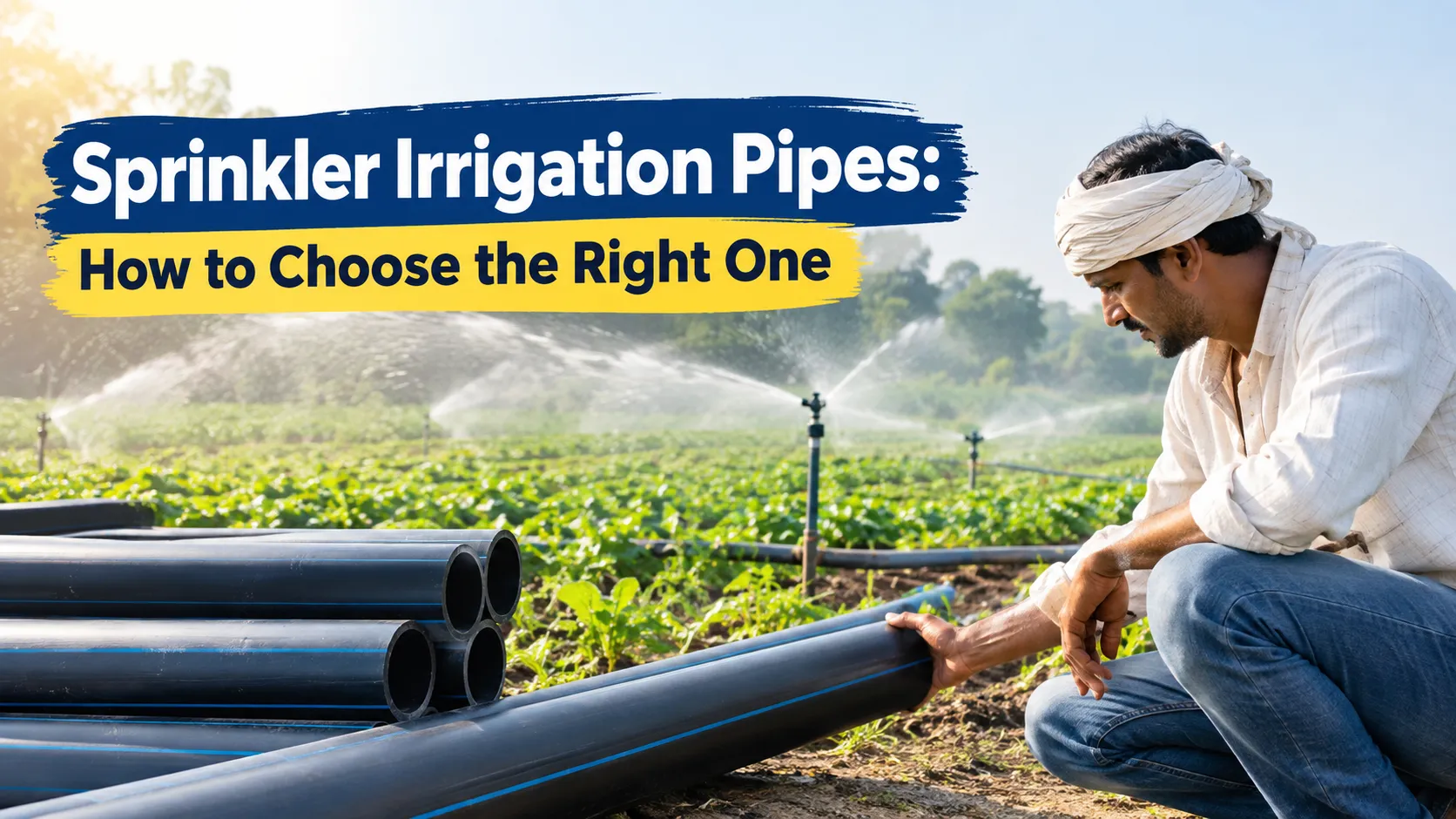
When the Right Pipe Can Make Every Drop Count
Sprinkler Irrigation Pipes play an important role in moving water from the source to sprinklers across a farm or landscaped area. A farmer may have a good pump and a modern sprinkler system, but if the pipeline is poorly selected, water pressure can fall, leakage can increase, and some parts of the field may receive less water than others.
Imagine a farmer preparing a large field for a new crop. The pump is working properly, the sprinklers are installed, and everything looks ready. After switching on the system, however, the sprinklers near the pump throw water strongly while those farther away produce a weak spray. The problem may not be the pump at all. The pipeline size, material, length, fittings, or layout could be affecting water delivery.
This is why choosing a pipe should not be based only on price.
The right selection depends on water pressure, distance, soil conditions, crop requirements, pipe diameter, installation method, and expected service life. For projects in and around Indore, buyers may compare options from an Irrigation Pipe Manufacturer in Indore before making a final decision.
This guide explains what to check before purchasing and how to select a practical pipeline for your irrigation project.
What Are Sprinkler Irrigation Pipes?
Sprinkler irrigation pipes carry pressurized water from a pump, storage tank, borewell, canal, or other water source to sprinkler heads.
Unlike simple gravity-based watering, sprinkler systems depend on controlled pressure. Water travels through the mainline and sub-main lines before reaching laterals and sprinkler points.
The pipe therefore needs to handle the working conditions of the complete system.
For example, a small farm may need a relatively simple movable pipeline. A large agricultural project may require a fixed mainline, multiple sub-main lines, valves, filters, fittings, and several sprinkler zones.
The same pipe may not be suitable for both applications.
A reliable Sprinkler Pipe Manufacturer in Indore can help buyers understand which material and diameter are appropriate for their operating conditions.
Why Choosing the Right Sprinkler Irrigation Pipes Matters
A pipeline is not simply a connection between the pump and sprinkler.
It directly affects water movement, pressure stability, maintenance, and operating costs.
A correctly selected system can provide more uniform water distribution. It can also reduce unnecessary pressure loss and help the pump operate more efficiently.
On the other hand, an undersized pipe can create excessive friction. A weak or unsuitable pipe may develop leaks or damage under difficult conditions.
For farmers, these issues can become expensive when they continue throughout an entire irrigation season.
For contractors and builders, incorrect pipe selection can also result in complaints, rework, and project delays.
That is why it is better to calculate the requirement before purchasing rather than replacing the pipeline later.
How to Choose the Right Sprinkler Irrigation Pipes
1. Understand Your Water Source
Start with the water source.
Is the water coming from a borewell, open well, reservoir, canal, tank, or municipal supply?
Next, determine the available flow rate and pressure. A sprinkler system needs sufficient pressure to operate its sprinkler heads properly.
If the available pressure is already limited, selecting a very small pipe can make the situation worse.
A professional HDPE Pipe Manufacturer in Indore or irrigation supplier can help you match the pipe size with the expected flow and pressure.
2. Calculate the Required Pipe Diameter
Pipe diameter is one of the most important decisions.
A common mistake is choosing a smaller pipe simply because it costs less. The initial saving may disappear if the system experiences high pressure loss.
Larger pipes generally offer lower resistance to water flow, but oversized pipes can also increase project costs.
The goal is to find a practical diameter for the required flow, distance, pressure, and layout.
For a small irrigation setup, one size may work perfectly. A long pipeline supplying several sprinkler zones may require a different arrangement.
Before buying, ask:
- How much water must move through the line?
- How long is the pipeline?
- How many sprinklers will operate together?
- What pressure does each sprinkler require?
- Will the line be permanent or temporary?
These answers make pipe selection much easier.
3. Compare HDPE and PVC Options
HDPE and PVC are both widely used in water distribution applications, but their characteristics differ.
| Feature | HDPE Pipes | PVC Pipes |
|---|---|---|
| Flexibility | High | Lower |
| Handling | Easy for many layouts | Relatively rigid |
| Corrosion resistance | Excellent | Excellent |
| Suitable for underground use | Yes | Yes |
| Long-distance applications | Often suitable | Suitable when properly designed |
| Installation style | Flexible options | More rigid installation |
| Resistance to ground movement | Good | More dependent on installation |
| Typical application | Agriculture, irrigation, water distribution | Water supply, irrigation, plumbing |
An HDPE Pipe Supplier in Indore may recommend HDPE when flexibility and resistance to movement are important. A PVC Pipe Supplier in Indore may be a better source when a project specification calls for PVC.
The important point is not to select a material simply because it is popular. Match it to the project.
4. Consider the Working Pressure
Every irrigation system operates under pressure.
The selected pipe should be suitable for the expected working pressure, including the conditions that may occur during starting and stopping of the pump.
Pressure surges can put additional stress on the pipeline.
This becomes particularly important in long pipelines, high-lift applications, and systems with frequent pump cycling.
A pipe should therefore be selected according to its pressure rating and actual operating conditions.
5. Think About Pipe Length and Pressure Loss
Water loses energy as it travels through a pipeline.
The longer the line, the more attention should be given to friction and pressure loss.
For instance, imagine two sprinkler points. The first is only 50 metres from the pump, while the second is several hundred metres away. If the pipeline is not properly designed, the second sprinkler may receive noticeably less pressure.
Pipe diameter, flow rate, internal surface, fittings, elevation changes, and total length can all affect the result.
For large farms, a simple hydraulic calculation before installation can prevent many problems later.
A Practical Example from the Field
Consider a farm using a sprinkler system across a long rectangular field.
Initially, the owner installs a relatively small pipeline because it is cheaper. The sprinklers close to the pump perform well. However, sprinklers at the far end have weaker coverage.
The farmer then increases pump pressure.
The result may improve temporarily, but energy consumption can rise and the system may still not provide uniform distribution.
A better solution is to review the complete pipeline design. Increasing the mainline diameter, dividing the field into zones, or reducing the number of sprinklers operating at one time can sometimes produce a better result.
This example shows an important lesson: pump capacity and pipe selection must be considered together.
Sprinkler Irrigation Pipes: HDPE vs PVC
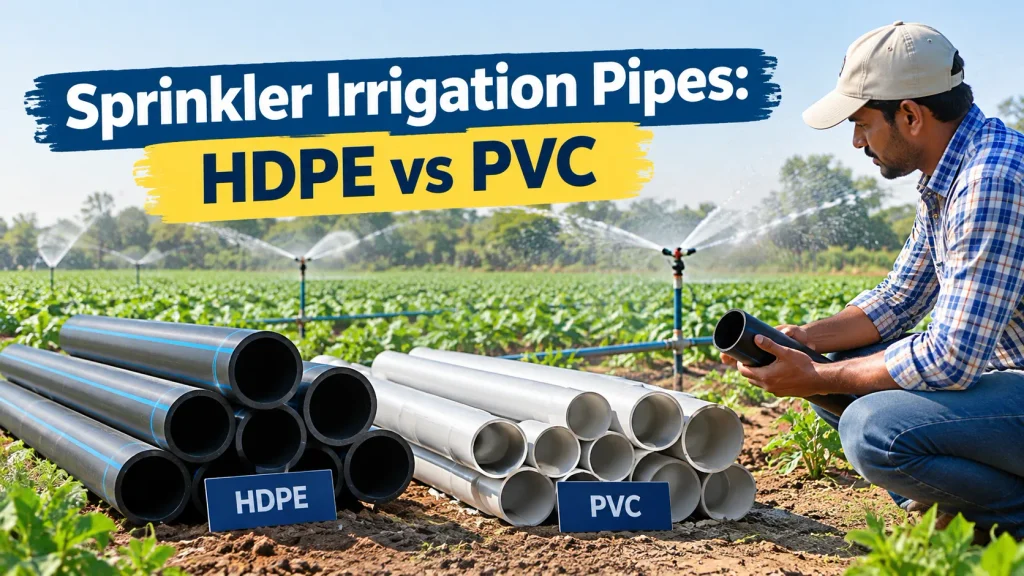
There is no universal winner between HDPE and PVC.
The better choice depends on the application.
HDPE is often attractive where flexibility, impact resistance, and easier handling are important. It can be useful for agricultural layouts where the pipeline may need to follow changing ground conditions.
PVC can be useful where rigid pipe sections are preferred and the installation design suits that material.
If you are comparing products, discuss the actual application with a Pipe Manufacturer in Indore rather than selecting based only on material name.
For agricultural projects, also consider whether the pipeline will be exposed to sunlight, buried underground, moved regularly, or subjected to mechanical loads.
What About Suction Pipes?
The pipeline from the water source to the pump needs separate attention.
This is where buyers often search for a Suction pipe delear in indore.
A suction line works under different conditions from a pressurized delivery line. Its diameter, flexibility, length, and construction can influence pump performance.
Using the wrong suction arrangement can create problems such as restricted water intake or poor pump operation.
Therefore, do not treat the suction pipe and sprinkler delivery pipe as interchangeable products.
For larger installations, the suction line should be selected according to pump requirements and the characteristics of the water source.
Choosing the Right Supplier
Finding a suitable product is only half the job.
The supplier should understand irrigation requirements and be able to provide appropriate specifications.
Someone searching for Sprinkler pipe dealers near me should compare more than just the quoted price.
Ask about pipe material, pressure rating, available diameters, fittings, installation requirements, and expected application.
A farmer may also search for a Sprinkler irrigation pipe dealer in indore when planning an agricultural system. Contractors may require larger quantities and consistent product specifications.
For buyers handling several pipe categories, a Plastic pipe manufacturer in indore can also provide useful information about available solutions.
Common Mistakes Buyers Should Avoid
Buying Only on Price
The cheapest pipe may not be the cheapest solution over its complete service life.
Frequent leakage, replacement, pressure problems, or difficult installation can increase the total cost.
Choosing the Wrong Diameter
A small diameter may restrict flow and increase pressure loss.
Always consider flow rate and pipeline length before finalizing the size.
Ignoring Fittings
Even a good pipe can perform poorly if fittings, valves, joints, and connections are unsuitable.
The complete system needs to work together.
Ignoring Elevation Changes
A farm with slopes or uneven terrain requires additional planning.
Water pressure can change as elevation changes, affecting sprinkler performance.
Operating Too Many Sprinklers Together
A pump and pipeline have a practical capacity.
Opening too many sprinkler points simultaneously may reduce pressure across the system.
Ignoring Maintenance
Filters, valves, joints, and sprinkler heads need periodic inspection.
A maintenance plan can prevent small problems from becoming expensive repairs.
Practical Solutions for Better Performance
A few simple practices can improve the reliability of an irrigation network.
First, divide a large field into manageable irrigation zones when necessary. This helps maintain more consistent pressure.
Second, inspect joints regularly. Small leaks can waste water and reduce pressure.
Third, clean filters and sprinkler components according to the water quality and operating conditions.
Fourth, avoid sharp bends wherever possible. A well-planned route can reduce unnecessary resistance.
Finally, record pressure and flow during the first few operating cycles. These readings provide useful information if performance changes later.
Industry Trend: Smarter and More Efficient Irrigation
Agriculture is moving toward better water management.
Farmers are increasingly looking at systems that provide controlled irrigation instead of applying large amounts of water without measuring field requirements.
Modern irrigation projects may combine sprinklers with pumps, filters, valves, pressure controls, timers, sensors, and automated controls.
This trend is especially relevant in areas where water availability and energy costs are major concerns.
The pipeline remains a basic part of the system, but its role becomes even more important as irrigation becomes more controlled.
For contractors and government infrastructure projects, the emphasis is also moving toward durable systems, predictable performance, easier maintenance, and efficient water distribution.
Quick Comparison Before You Buy
Use this simple checklist before placing an order.
| Question | What to Check |
|---|---|
| Water source | Borewell, tank, canal, well, etc. |
| Required flow | Total water needed |
| Working pressure | Pressure required by sprinklers |
| Pipeline length | Total mainline and sub-main distance |
| Pipe diameter | Based on flow and pressure loss |
| Material | HDPE, PVC, or another approved option |
| Installation | Above ground, underground, or movable |
| Terrain | Flat, sloped, or uneven |
| Fittings | Valves, connectors, bends and joints |
| Maintenance | Cleaning and inspection requirements |
If you are still unsure, speak with an experienced supplier before ordering.
A Pipe Supplier Near Me may provide quick access to products, but technical suitability should remain the first priority.
Questions to Ask Before Installation
Before finalizing your irrigation pipeline, ask yourself:
Will the same pressure reach the farthest sprinkler?
How many sprinklers will operate at one time?
Is the pipe diameter suitable for the required flow?
Will the pipe remain exposed or be buried?
Does the pipe have the required pressure rating?
Are the fittings compatible with the selected pipe?
Will the system need to be expanded later?
These questions can reveal problems before installation begins.
A Simple Step-by-Step Selection Process
1: Measure the total irrigation area.
2: Identify the water source and pump capacity.
3: Calculate the required flow rate.
4: Determine the pipeline length and elevation changes.
5: Estimate pressure loss.
6: Select an appropriate pipe diameter.
7: Compare HDPE and PVC according to the application.
8: Select compatible valves, joints, and fittings.
9: Test pressure and flow after installation.
10: Create a simple maintenance schedule.
This process is useful for farmers as well as irrigation contractors handling commercial or infrastructure projects.
Buying Checklist for Farmers, Dealers and Contractors
Before making the final purchase, confirm:
Correct pipe material
Correct diameter
Suitable pressure rating
Required quantity
Compatible fittings
Proper jointing method
Expected installation conditions
Availability of replacement components
Supplier technical support
Future expansion requirements
A buyer looking for a High density pipe dealer in indore should also verify whether the offered product is suitable for the intended pressure and application instead of relying only on the term “high density.”
Likewise, someone searching for a Plastic pipe dealer in indore should compare specifications before choosing a product.
Success Starts With the Pipeline Design
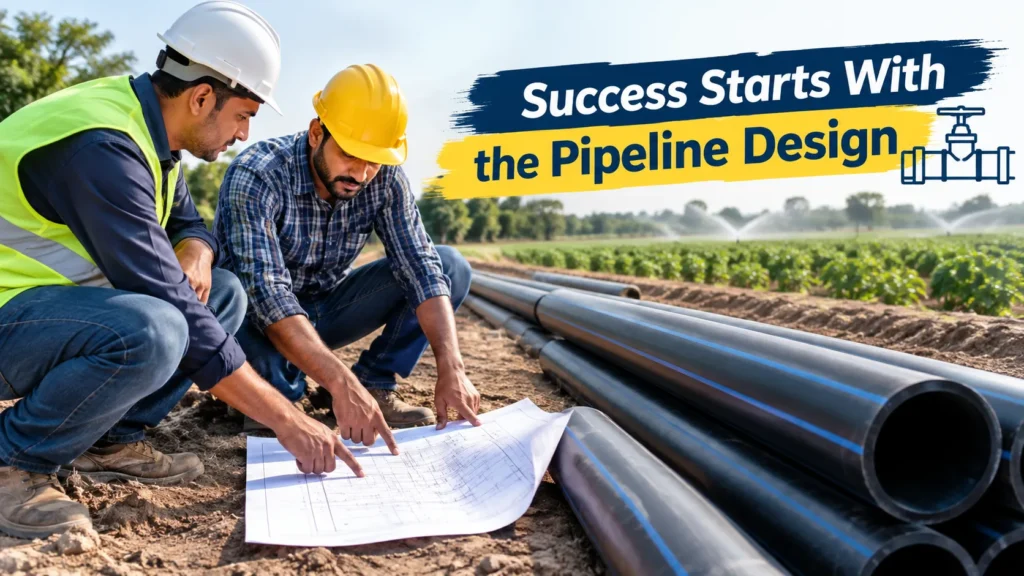
Good irrigation is not simply about putting sprinklers in a field and switching on the pump.
It starts with planning.
A properly designed pipeline can help deliver water more evenly, reduce avoidable pressure loss, simplify maintenance, and support efficient irrigation.
For farmers, that can mean a more dependable watering routine.
For irrigation contractors, it can mean fewer installation problems.
dealers and distributors, understanding these requirements helps them recommend products more confidently.
Builders and infrastructure departments can also benefit from selecting pipe systems according to project conditions rather than short-term purchase price.
When sourcing related products, buyers may also compare options from a Garden pipe dealer near me or look for a Best column pipe dealer in indore depending on the specific water-management requirement. These products serve different purposes, so the application should always guide the selection.
Frequently Asked Questions
Which material is better for sprinkler irrigation?
HDPE and PVC can both be suitable. The right choice depends on pressure, installation conditions, flexibility requirements, pipe length, budget, and project specifications.
What pipe size is suitable for a sprinkler system?
There is no single size for every system. The correct diameter depends on flow rate, pipeline length, pressure requirements, elevation, and the number of sprinklers operating together.
Can HDPE pipes be used for agricultural irrigation?
Yes. HDPE is widely considered for agricultural water distribution because of its flexibility and resistance to corrosion. The exact product should still be selected according to the project’s pressure and application requirements.
Can PVC pipes be used for sprinkler systems?
Yes, PVC can be used for suitable irrigation applications. Its suitability depends on the design, pressure rating, installation conditions, and project requirements.
How can pressure loss be reduced?
Using an appropriate pipe diameter, keeping the route efficient, reducing unnecessary bends and fittings, maintaining filters, and controlling the number of operating sprinkler points can help.
Should the suction pipe be the same as the delivery pipe?
Not necessarily. Suction and delivery lines perform different functions. The suction line should be selected according to the pump and water-source requirements.
Where can I buy irrigation pipes in Indore?
Farmers and contractors can compare local manufacturers, dealers, and suppliers based on product specifications, availability, technical support, and application suitability. Those searching for the Sprinkler system dealer in indore should explain their project requirements before purchasing.
Final Takeaway
Choosing Sprinkler Irrigation Pipes is an important decision because the pipeline affects how efficiently water reaches the field.
Do not choose only by price.
Check the water source, flow, pressure, distance, pipe diameter, material, terrain, fittings, and future requirements. A well-planned system can make irrigation easier to manage and help avoid unnecessary replacement costs.
For agricultural and commercial projects, buyers can evaluate options from an experienced Irrigation Pipe Manufacturer in Indore and compare specifications before making the final decision.
If your project needs dependable water distribution, start with the pipeline design. The right pipe does not just carry water—it helps the entire irrigation system perform better.
Ready to Plan Your Irrigation System?
Whether you are a farmer, dealer, irrigation contractor, builder, or infrastructure project manager, choose your pipeline according to actual site requirements.
Contact Vishal Pipe to discuss your irrigation pipe requirements and select a suitable solution for your project.