The Right Pipe Can Save You From Costly Problems
PVC Pipes are often chosen because they are affordable, lightweight, easy to install, and suitable for a wide range of water management applications. But choosing a pipe only because it looks strong or costs less can create problems later. Leakage, poor water flow, damaged joints, pressure failure, and frequent replacement can turn a small saving into a major expense.
Think about a farmer preparing an irrigation system before the crop season. The pump is ready, the field is prepared, and water is available. But if the pipeline is not selected according to pressure, distance, soil conditions, and required flow, the entire irrigation system can perform poorly.
The same applies to a contractor installing water lines, a builder planning plumbing infrastructure, or a government department working on a large water distribution project.
Vishal Pipe provides piping solutions for agriculture and industrial applications, including HDPE pipes, sprinkler pipes, suction hoses, column pipes, and related products. The company also highlights product customization, quality manufacturing, timely delivery, and after-sales support as part of its working process.
So, how do you decide whether this material is suitable for your project?
Let’s understand it in simple language.
What Are PVC Pipes?
PVC stands for Polyvinyl Chloride, a thermoplastic material widely used for piping applications. These pipes are manufactured in different sizes, wall thicknesses, and pressure classes to suit different requirements.
One reason they remain popular is their practical balance between cost, handling, and performance. Unlike conventional metal piping, PVC does not rust, which makes it useful for many water supply and drainage applications.
For a farmer, this can mean easier transportation around the field. a contractor, it can mean faster installation. For a dealer, it can mean a product category with applications across agriculture, construction, plumbing, and water management.
However, PVC should not automatically be treated as the best choice for every application. Pipe material needs to match the job.
For example, an irrigation line exposed to repeated movement may require a different solution from a fixed underground water line. Similarly, hot-water plumbing requires a material designed for elevated temperatures rather than standard PVC.
Types of PVC Pipes You Should Know
Not every pipe carrying the PVC label performs the same job. The correct selection depends on application, pressure, diameter, installation method, and required service life.
1. PVC Pipes for Water Supply
These are commonly used for cold-water distribution in residential, commercial, and selected agricultural applications.
Their smooth internal surface can support efficient water movement, while their resistance to corrosion makes them useful where rust could otherwise become a concern.
Before purchasing, check the required diameter and pressure rating instead of selecting a pipe simply because it is inexpensive.
2. PVC Pipes for Drainage
Drainage applications have different requirements from pressurized water systems.
The pipe needs to provide reliable flow, withstand the installation environment, and maintain properly connected joints. Correct slope and installation are just as important as pipe quality.
3. PVC Tubing and Flexible Applications
Flexible PVC tubing is useful where some movement or easier handling is required. Vishal Pipe’s product range includes several PVC tubing products and garden pipe options, alongside HDPE, sprinkler, suction, and other piping solutions.
This makes it important to distinguish between rigid pipe and flexible tubing when planning a project.
4. PVC Options for Agriculture
Agricultural piping must be selected according to the irrigation method.
A farmer using a fixed water distribution network may have different requirements from someone operating a sprinkler irrigation system. In many cases, HDPE or specialized sprinkler piping may be more suitable because of flexibility and field-handling requirements.
Vishal Pipe specifically offers sprinkler pipes and HDPE pipes for agricultural applications.
Why Are PVC Pipes So Popular?
There is no single reason behind their popularity. Their value comes from several practical advantages working together.
Corrosion Resistance
PVC does not rust like traditional metal pipes. This is particularly useful for water-related applications where corrosion can gradually affect the pipe and water flow.
Lightweight Handling
Moving long lengths of heavy metal pipe across a construction site or farm can be difficult.
PVC is comparatively lightweight, making transportation, cutting, handling, and installation easier when the application is appropriate.
Low Maintenance
A properly selected and installed system can require relatively little routine maintenance.
The important word here is properly. Good pipe material cannot compensate for poor jointing, incorrect pressure selection, inadequate support, or careless installation.
Smooth Water Flow
The internal surface of a well-made pipe is relatively smooth. This can help reduce resistance to water movement compared with rougher internal surfaces.
For irrigation and water distribution, maintaining the required flow is essential because poor flow can affect the performance of sprinklers, outlets, tanks, and other equipment.
Cost-Effective Installation
For many projects, the overall cost is not only the price of the pipe. Labour, transportation, fittings, installation time, repairs, and maintenance all matter.
A pipe that is easy to handle and install can contribute to better project efficiency.
PVC Pipes vs HDPE: Which One Should You Choose?
This is one of the most common questions asked by farmers, contractors, and project managers.
| Factor | PVC | HDPE |
|---|---|---|
| Weight | Lightweight | Lightweight |
| Flexibility | Lower | Higher |
| Corrosion resistance | Excellent | Excellent |
| Field movement | Better for fixed applications | Very suitable for flexible layouts |
| Jointing | Depends on pipe system | Commonly uses specialized joining methods |
| Agriculture | Suitable for selected systems | Widely used for irrigation |
| Underground applications | Suitable when correctly specified | Suitable for many demanding applications |
| Best selection | Depends on project | Depends on project |
There is no universal winner.
For example, a fixed pipeline with predictable routing may make PVC a practical option. A farm requiring long flexible runs, changes in direction, or greater resistance to movement may benefit from HDPE.
That is why experienced suppliers ask about the project before recommending a product.
If your project requires HDPE, you may also compare products from an HDPE pipe manufacturer in indore or an HDPE Pipe Manufacturer in Indore based on pressure requirements, quality, availability, and technical support.
How to Choose the Right PVC Pipes: Step-by-Step Guide
Choosing the correct pipe becomes much easier when you follow a simple process.
Step 1: Define the Application
Start by asking one question:
Where will the pipe be used?
Is it for irrigation, drainage, building water supply, construction, industrial use, or another application?
Never select the pipe before answering this question.
Step 2: Calculate Your Water Requirement
A small garden line does not require the same capacity as a large agricultural pipeline.
Consider the required flow rate, number of outlets, pump capacity, pipeline length, and elevation difference.
For irrigation projects, also consider whether the system will feed sprinklers, drip lines, tanks, or other outlets.
Step 3: Select the Correct Diameter
Pipe diameter directly affects water movement.
A pipe that is too small can restrict flow and increase pressure losses. A pipe that is unnecessarily large can increase material and installation costs.
Ask the supplier to recommend the diameter according to the actual water requirement rather than choosing based on guesswork.
Step 4: Check Pressure Requirements
Pressure is one of the most important factors.
A pipeline connected to a high-pressure pump needs to be suitable for the operating conditions. The pipe, fittings, valves, and joints should be considered as one complete system.
Do not confuse nominal size with pressure capability.
Step 5: Consider the Installation Environment
Will the pipe be installed underground?
Will it remain exposed to sunlight?
machinery pass over the installation area?
Will the pipe need to be moved regularly?
the soil contain stones or other conditions that could affect the installation?
These questions can change the best material choice.
Step 6: Choose Compatible Fittings
Even a good pipe can develop problems when connected with poor-quality or incompatible fittings.
Use suitable elbows, tees, couplers, valves, connectors, and other accessories.
A reliable PVC Pipe Manufacturer in Indore or PVC pipe manufacturer in indore can help you match the pipe with compatible components.
Step 7: Compare Total Cost
Don’t compare only the per-metre price.
Consider:
- Pipe cost
- Fittings
- Transportation
- Installation labour
- Maintenance
- Expected service life
- Replacement risk
This gives you a more realistic project cost.
A Real-World Example: Why Correct Selection Matters
Imagine a farmer has a large field located several hundred metres from the water source.
He initially chooses a smaller pipe because it is cheaper. Once the irrigation system starts operating, the water reaching the far end is weaker than expected.
The farmer then increases pump pressure, but the problem does not disappear completely. Energy consumption rises, and some sections of the field still receive insufficient water.
Now imagine the same project being planned correctly from the beginning.
The farmer calculates the required flow, checks the pipeline length, considers elevation and pressure loss, chooses an appropriate diameter, and selects suitable fittings.
The initial pipe cost may be slightly higher, but the complete system can operate more efficiently.
The lesson is simple: the cheapest pipe is not always the cheapest solution.
PVC Pipes for Farmers: What Should You Check?
Farmers should look beyond the product name.
Before purchasing, check the pipe diameter, pressure requirement, irrigation method, installation conditions, and expected usage.
If the project involves sprinklers, compare your requirements with specialized sprinkler products rather than assuming every general-purpose pipe will perform the same way.
If you are looking for Sprinkler pipe dealers near me, Sprinkler irrigation pipe dealer in indore, or a Sprinkler system dealer in indore, ask about the complete system rather than buying only the pipe.
The same principle applies when searching for a Garden pipe dealer near me. Explain whether you need the product for household gardening, farm use, commercial landscaping, or another application.
What Contractors and Builders Should Consider
Contractors usually have one additional concern: consistency.
Imagine installing pipes across a large project and discovering that different batches have inconsistent dimensions or that compatible fittings are difficult to obtain.
The resulting delays can affect labour schedules and project completion.
For larger projects, work with a supplier that can support:
Consistent product availability, appropriate specifications, bulk requirements, fittings, delivery coordination, and technical guidance.
A contractor comparing a Pipe Manufacturer in Indore should therefore evaluate more than price.
Similarly, organizations searching for a Pipe Supplier Near Me should consider product range, stock availability, quality assurance, and service support.
What Dealers and Distributors Should Look For
Dealers need products that their customers can trust and that they can source consistently.
A good distributor should understand the difference between agriculture, plumbing, construction, borewell, sprinkler, and industrial requirements.
For example, customers may approach a Plastic pipe dealer in indore looking for a general water pipe, while another customer may specifically need a High density pipe dealer in indore for an irrigation project.
The dealer should be able to identify the application and guide the customer toward the appropriate product.
This is where a reliable Plastic pipe manufacturer in indore can become an important long-term supply partner.
Common Mistakes When Buying PVC Pipes
Choosing Only by Price
A low initial price can become expensive if the pipe fails prematurely.
Better approach: compare specifications, quality, application suitability, and complete installation cost.
Ignoring Pressure
A pipe may look strong but still be unsuitable for the system pressure.
Better approach: calculate operating conditions before purchase.
Using the Wrong Diameter
An undersized pipeline can restrict flow.
Better approach: determine the required flow before selecting the diameter.
Mixing Incompatible Components
Poor fittings can create leakage even when the pipe itself is good.
Better approach: select compatible pipes and fittings together.
Not Considering Installation Conditions
A product suitable for one environment may not be ideal for another.
Better approach: discuss whether the pipe will be buried, exposed, moved, or subjected to mechanical loads.
Quick Buying Checklist
Before placing your order, ask yourself:
- What is the exact application?
- What water flow is required?
- What pipe diameter is appropriate?
- What operating pressure will the system have?
- Is the pipeline fixed or flexible?
- Will it be installed underground or above ground?
- Are compatible fittings available?
- Is the supplier able to provide the required quantity?
- Does the supplier offer technical guidance?
- Have you compared total project cost rather than only pipe price?
If you can answer these questions clearly, you are already much closer to making the right purchase.
Choosing a Reliable Pipe Supplier in Indore
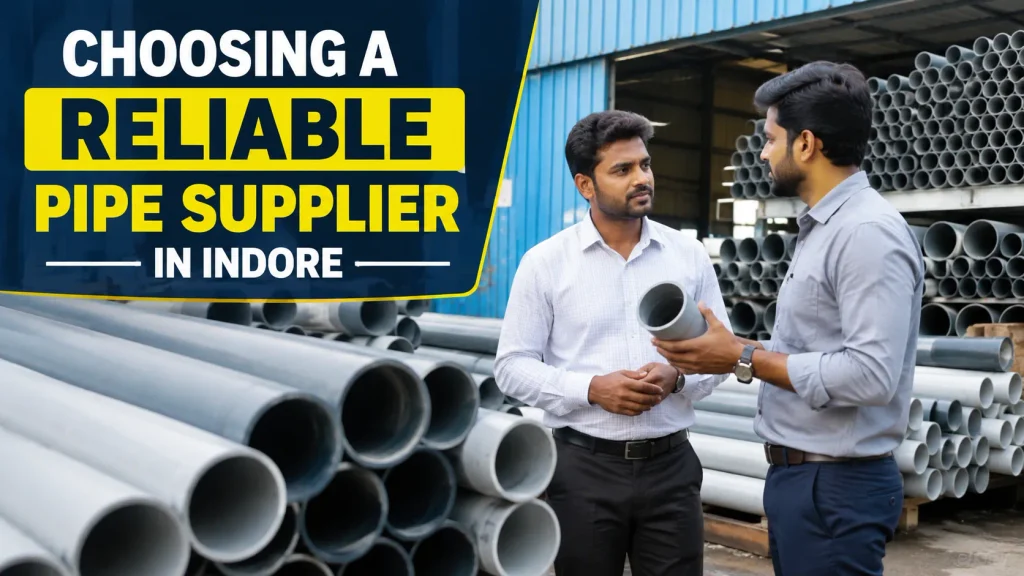
The supplier you choose can influence the overall success of your project.
Vishal Pipe’s current product range includes HDPE pipes, sprinkler pipes and fittings, suction hoses, column pipes, PVC tubing products, garden pipes, casing pipes, and other agricultural and industrial solutions.
The company states that it serves agriculture and industrial applications and focuses on product customization, quality manufacturing, timely delivery, and after-sales support.
Vishal Pipe’s website also features feedback from dealers and customers who describe long-term relationships with the brand. Some testimonials mention working with the company for many years and appreciating product quality and customer acceptance.
For buyers comparing a Best Pipe Manufacturer in Indore, these factors are worth considering alongside product specifications and pricing.
Vishal Pipe’s listed corporate office is in New Siyaganj, Indore, with manufacturing units on Sanwer Road Industrial Area.
A Broader View: Selecting the Right Pipe for the Whole System
One useful industry trend is that buyers are moving away from selecting individual pipes only on price.
Farmers and contractors increasingly look at the complete water-management system: pump, mainline, sub-main, fittings, valves, sprinklers, storage, pressure, and water distribution.
This approach makes sense.
A good pipe working with poorly selected fittings can still create problems. Likewise, an excellent pump cannot compensate for an incorrectly designed pipeline.
That is why product selection should start with the system requirement, not the product name.
For example, a customer searching for Suction pipe delear in indore may actually need guidance on pump connection, suction requirements, pipe size, and operating conditions.
Someone searching for a Pipe hose shop near me may need a flexible hose for a specific application rather than a standard rigid pipeline.
Similarly, someone searching for a Best column pipe dealer in indore should discuss borewell depth, pump arrangement, diameter, load, and installation conditions before buying.
Frequently Asked Questions About PVC Pipes
Are PVC Pipes suitable for agriculture?
They can be suitable for selected agricultural water and irrigation applications when the pipe specification matches the pressure, flow, installation conditions, and system design. For flexible field irrigation, HDPE or dedicated sprinkler solutions may also be considered.
Are PVC Pipes better than HDPE?
Not in every situation. PVC can be a practical choice for suitable fixed applications, while HDPE offers greater flexibility and is widely used in irrigation. The correct choice depends on the project.
How do I select the correct pipe size?
Start with required flow, pipeline length, pressure, pump capacity, elevation, and number of outlets. A qualified supplier can help calculate the appropriate size.
Can PVC be used for hot water?
Standard PVC is generally not the preferred choice for hot-water applications. Temperature requirements should be checked before selecting the material.
How can farmers avoid irrigation pipe failure?
Use the correct pressure rating, diameter, fittings, installation method, and pipe material. Avoid dragging pipes unnecessarily and inspect joints regularly.
Should I buy pipe and fittings from the same supplier?
It is often helpful because the supplier can match components and reduce compatibility problems.
What should contractors ask a pipe supplier?
Ask about specifications, pressure ratings, available sizes, fittings, bulk supply, delivery timelines, quality consistency, and technical support.
Final Takeaway: Buy for Performance, Not Just Price
Choosing the right piping material may seem like a small decision, but it can influence water flow, installation cost, maintenance, and project reliability for years.
PVC Pipes can be a practical solution for many water, drainage, plumbing, and selected irrigation applications. But the best result comes when the material, size, pressure rating, fittings, and installation conditions are considered together.
For farmers, the priority should be dependable water distribution. contractors and builders, it should be reliable installation and project efficiency. For dealers, consistent quality and supply matter. infrastructure departments, long-term performance and specification compliance are critical.
If you are comparing PVC Pipe Supplier in Indore, HDPE Pipe Supplier in Indore, or other piping solutions, start by explaining your actual application and system requirements.
Vishal Pipe offers a broad range of agricultural and industrial piping products and supports customers with product selection and project requirements.
Have a piping requirement in Indore? Contact Vishal Pipe to discuss your application, required size, pressure, quantity, and delivery needs before making your purchase.
Quick Action Point
Before ordering your next pipe, don’t ask only, “What is the price?”
Ask:
“Which pipe is right for my application, and why?”
That one question can help you avoid expensive mistakes and build a more dependable water system.