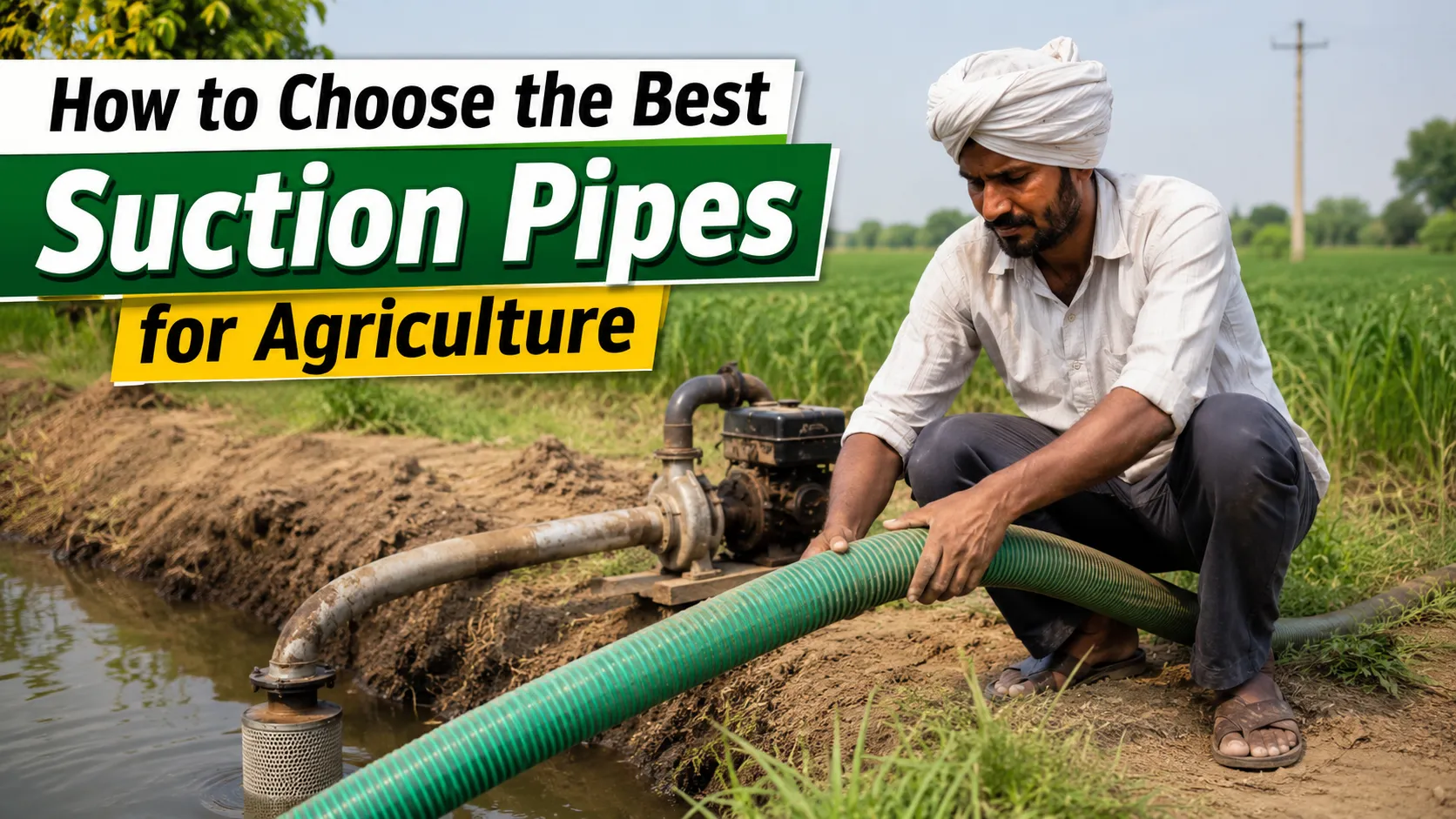
The Right Pipe Can Save Your Irrigation System
Imagine a farmer starting the pump early in the morning, expecting water to reach the field before the sun becomes too strong. The motor starts, but the water flow is weak. After checking the pump, the farmer discovers that the real problem is the suction line. The pipe is either too small, poorly fitted, or unable to handle the vacuum created by the pump.
This is why choosing the right Suction Pipes is not a small purchasing decision. A suitable pipe can help maintain steady water flow, reduce interruptions, and support the overall performance of an agricultural pumping system.
Agriculture depends heavily on reliable water management. The Food and Agriculture Organization (FAO) reports that agriculture accounts for about 72% of global freshwater withdrawals, making efficient water management increasingly important.
For farmers, irrigation contractors, dealers, builders, and infrastructure teams, the goal should not be to buy the cheapest pipe available. The better approach is to match the pipe with the pump, water source, required flow, installation conditions, and expected working pressure.
In this guide, you will learn how to select the right option, what specifications to check, common mistakes to avoid, and how a reliable supplier can make the buying process easier.
Why Choosing the Right Suction Pipes Matters
A suction line works differently from an ordinary water delivery line. When a pump draws water from a pond, tank, well, or other source, the pipe experiences suction and vacuum conditions. If the pipe is unsuitable, it may collapse, restrict water movement, develop leaks, or reduce pump efficiency.
A farmer may initially blame the pump for low water output. However, the real issue can be an undersized pipe or a loose connection.
The correct product should provide a good balance of flexibility, strength, internal smoothness, size, and resistance to the operating conditions.
For buyers comparing options from an HDPE Pipe Manufacturer in Indore, PVC supplier, or irrigation dealer, the first question should always be: “Does this pipe match my application?”
That simple question can prevent many expensive mistakes.
How to Choose the Best Suction Pipes for Agriculture
1. Understand Your Water Source
Start by identifying where the water is coming from.
Is it a farm pond, open well, storage tank, canal, borewell-related setup, or another water source?
The distance between the pump and water source also matters. A longer suction line can create additional resistance, so selecting the correct diameter and maintaining a sensible layout becomes important.
For example, a small farm pump drawing water from a nearby tank may have very different requirements from a high-capacity irrigation pump drawing water from a distant open source.
Before visiting a Suction pipe delear in indore, note the water source, approximate suction length, pump capacity, pipe size, and expected operating conditions.
This information allows the supplier to recommend a product based on actual use instead of simply showing the most popular size.
2. Match the Pipe Diameter With the Pump
Pipe diameter directly affects water movement.
If the suction pipe is too narrow for the pump, the system can experience unnecessary flow resistance. If the diameter is selected correctly, water can move toward the pump more effectively.
Do not select the diameter only because it is cheaper or commonly available.
Check the pump manufacturer’s recommended suction connection size and consider the total suction arrangement. A qualified irrigation professional can help calculate the appropriate size when the installation is more complex.
This is especially important for contractors sourcing products from an Irrigation Pipe Manufacturer in Indore for multiple farm projects.
3. Check Flexibility and Strength
Agricultural installations are rarely perfectly neat. Pipes may need to be moved, connected, disconnected, or positioned around tanks and pumps.
A flexible product can make handling and installation easier. At the same time, excessive flexibility without adequate structural strength can become a problem under suction.
The ideal product should remain flexible enough for practical handling while maintaining its shape during operation.
Vishal Pipe lists its suction hose range with features such as lightweight construction, flexibility, smooth bore, weather resistance, and easy transportation. Its listed suction hose range covers sizes from 19 mm to 200 mm for domestic and agricultural water suction and supply applications.
4. Consider Vacuum Resistance
This is one of the most important points that inexperienced buyers often overlook.
A delivery pipe mainly handles positive pressure from the pump. A suction pipe must also withstand the negative pressure created when the pump draws water.
If the pipe wall is not suitable for the application, it can deform or collapse.
Ask the supplier about vacuum resistance and suitability for pump suction service. For demanding agricultural or industrial applications, specifications should be checked rather than relying only on appearance.
BIS lists standards specifically covering flexible PVC pipes or polymer-reinforced thermoplastic hoses for suction and delivery lines of agricultural pumps, including IS 15265.
5. Look at the Internal Bore
The inside surface of the pipe affects water movement.
A smooth internal bore can help reduce unnecessary resistance compared with a rough or damaged interior. This becomes more important as the pipe length increases or the required flow rate becomes higher.
Before installation, inspect the pipe for cuts, cracks, excessive deformation, or internal obstruction.
A good supplier should also help you select compatible connectors, clamps, strainers, and other accessories.
This is where working with an experienced Pipe Manufacturer in Indore can provide more value than purchasing an unknown product based only on price.
Suction Pipes: PVC, Flexible and Other Options
Different applications require different construction materials and designs.
Flexible PVC suction hoses are widely used for agricultural pump applications because they are relatively lightweight and easier to handle than many rigid alternatives. BIS specifically recognizes flexible PVC and polymer-reinforced thermoplastic hoses for agricultural pump suction and delivery applications.
For other parts of an irrigation network, HDPE and PVC pipes can serve different purposes.
| Pipe Type | Common Application | Main Advantage | Important Consideration |
|---|---|---|---|
| Flexible PVC suction hose | Pump suction and water transfer | Flexible and easy to handle | Must suit suction/vacuum conditions |
| HDPE pipe | Mainlines and water distribution | Durable and flexible | Select correct pressure class and size |
| PVC pipe | Surface water supply and irrigation | Lightweight and economical | Proper support and fittings are important |
| Column pipe | Borewell pump installations | Designed for pump support | Must match pump and borewell requirements |
| Garden tubing | Gardening and light water movement | Easy handling | Generally not intended for pump suction |
The correct material depends on where the pipe will be installed and what job it needs to perform.
How Pump Type Changes Your Selection
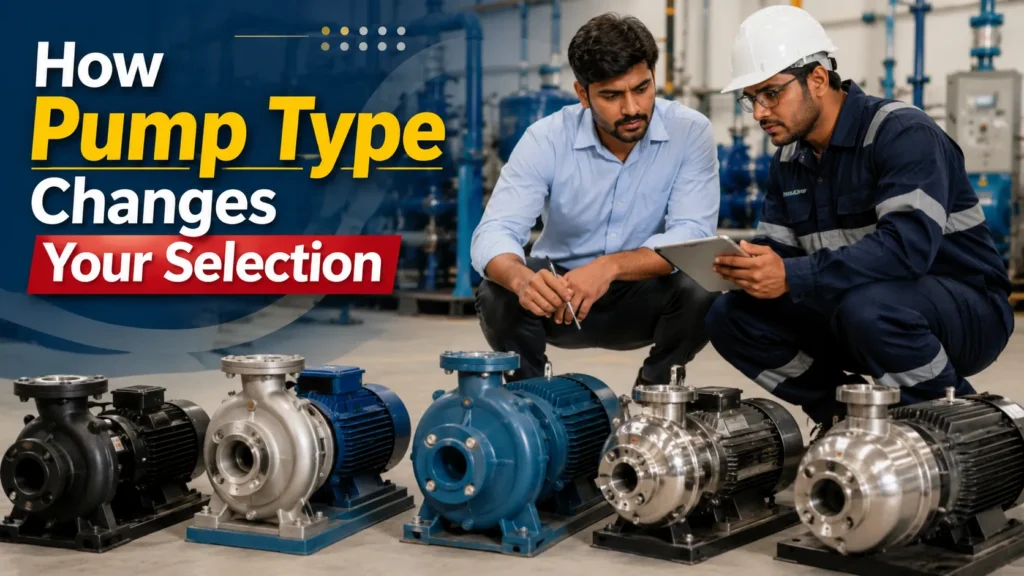
A small agricultural pump and a high-capacity irrigation pump do not necessarily require the same suction arrangement.
Before buying, check:
- Pump inlet size
- Pump capacity
- Suction lift
- Distance from water source
- Required flow rate
- Water temperature
- Water quality
- Installation environment
- Expected operating hours
For example, a contractor installing an irrigation system for a large farm should not choose the suction line in isolation. The complete system should be considered, including the pump, suction line, mainline, valves, filters, fittings, and irrigation outlets.
A reliable HDPE Pipe Supplier in Indore or irrigation supplier can help coordinate the pipe requirements with the rest of the system.
A Simple Step-by-Step Buying Guide
Step 1: Record the Pump Details
Write down the pump inlet diameter, capacity, manufacturer recommendation, and operating conditions.
Step 2: Measure the Suction Distance
Measure the approximate distance from the water source to the pump. Also consider vertical lift.
Step 3: Identify the Water
Clean water, muddy water, fertilizer-containing water, and other liquids can place different demands on the pipe.
Step 4: Select the Correct Diameter
Do not automatically choose the smallest pipe that fits the pump connection. Discuss flow requirements and suction conditions with a qualified supplier.
Step 5: Check Construction Quality
Look at wall construction, reinforcement, flexibility, bore smoothness, fittings, and overall finish.
Step 6: Verify Standards and Specifications
Where applicable, ask for relevant specifications or certification. BIS maintains standards covering agricultural irrigation products, including suction and delivery hoses.
Step 7: Confirm Fittings
A good pipe can still perform poorly when the connector, clamp, strainer, or joint is unsuitable.
Step 8: Compare Total Value
Compare durability, expected service, installation requirements, availability, technical support, and replacement costs instead of comparing price alone.
A Practical Farm Example
Consider a farmer using a pump to move water from a farm pond to an irrigation network.
The farmer initially purchases a low-cost hose without checking its suitability for suction. During operation, the hose begins deforming when the pump runs at higher capacity. Water flow becomes inconsistent, and irrigation takes longer.
The farmer replaces it with a properly selected reinforced suction hose, checks the fittings, places a suitable strainer at the water inlet, and keeps the suction route as short and direct as practical.
The important lesson is not that one particular product solves every problem. It is that Suction Pipes must be selected according to pump conditions rather than appearance or price.
Illustrative Success Story: From Repeated Repairs to Better Planning
A small vegetable farm regularly faced interruptions during irrigation. The owner replaced hoses several times but continued experiencing weak water flow.
Instead of replacing the pump again, an irrigation technician inspected the complete suction arrangement. The main issues were an unsuitable hose size, poor connection, and an unnecessarily long suction route.
After correcting the layout and selecting a suitable product, the system operated more consistently.
This example shows why diagnosis should come before replacement. A new pump cannot always solve a problem created by the suction line.
What Dealers and Contractors Should Check
For dealers and distributors, product selection is only one part of the job.
Customers may walk into a store asking for “a pipe for my pump.” A good dealer should ask a few questions before making a recommendation.
Ask about the pump size, water source, suction length, required diameter, application, and expected usage.
Businesses searching for HDPE pipe manufacturer in indore may also need different products for mainlines, while customers searching for Sprinkler pipe dealers near me may require complete irrigation-related solutions.
Likewise, a contractor may search for a Sprinkler irrigation pipe dealer in indore for field irrigation, while a homeowner could be looking for a Pipe hose shop near me for a smaller water-transfer requirement.
Understanding the application helps prevent wrong product recommendations.
How the Right Supplier Makes a Difference
Price matters, but it should not be the only deciding factor.
A reliable supplier should provide clear product information, suitable sizes, compatible fittings, consistent quality, and guidance based on the application.
For large requirements, buyers may compare an HDPE Pipe Manufacturer in Indore with a PVC Pipe Manufacturer in Indore. The better choice depends on the project rather than a general claim that one material is always superior.
Farmers may also need irrigation products from a Sprinkler Pipe Manufacturer in Indore, while construction companies may require different piping solutions.
For buyers looking for a Plastic pipe manufacturer in indore or Plastic pipe dealer in indore, ask about product specifications, availability, application suitability, and after-sales support.
Common Mistakes to Avoid When Buying Suction Pipes
Buying Only on Price
A cheaper pipe can become expensive if it fails during irrigation and requires repeated replacement.
Choosing the Wrong Diameter
The pipe should be selected according to the pump and flow requirements, not simply based on what is available in the shop.
Ignoring Vacuum Conditions
A suction application needs a product designed to handle suction conditions.
Using Poor-Quality Fittings
A strong hose cannot compensate for an unreliable connector or loose clamp.
Making the Suction Route Too Long
Long and poorly planned suction lines can increase resistance and make pump operation more difficult.
Ignoring the Water Source
Mud, debris, and other particles can affect the system. A suitable strainer and proper maintenance are important.
Mixing Incompatible Components
Pipe, fittings, clamps, valves, and connectors should work together as a complete system.
Maintenance Tips for Longer Service
Even good-quality products require proper handling.
Keep the pipe away from sharp edges and unnecessary abrasion. Avoid dragging it across rough surfaces when possible. Inspect the hose regularly for cracks, cuts, deformation, and loose connections.
Clean the inlet strainer when required, especially when drawing water from ponds or open sources.
At the end of the irrigation season, store flexible products properly instead of leaving them exposed to unnecessary damage.
Simple maintenance can help identify small problems before they become major irrigation failures.
What Farmers Should Ask Before Buying
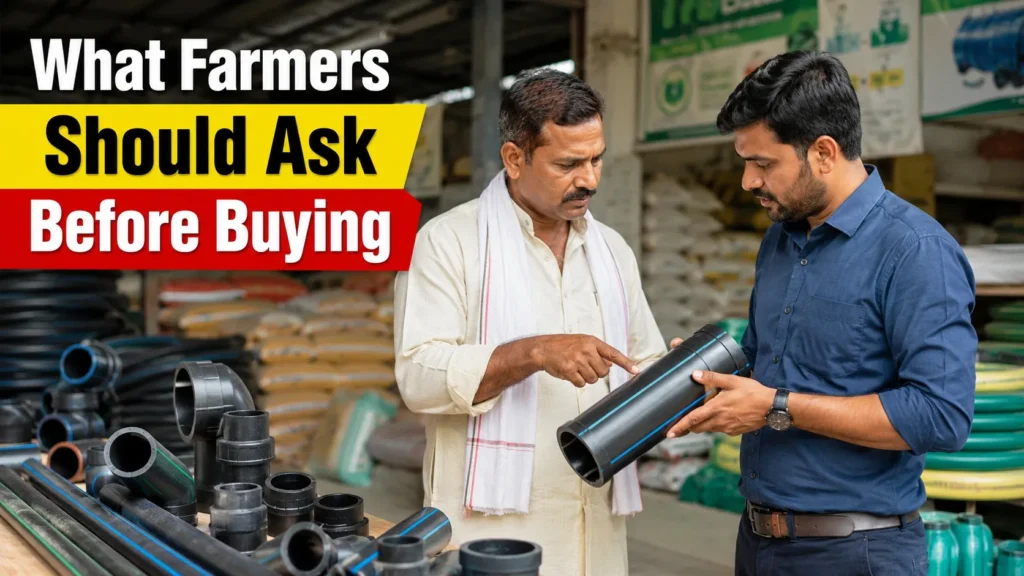
Before finalizing your purchase, ask:
- Is the product suitable for pump suction?
- What diameter is recommended for my pump?
- Can it handle the expected vacuum conditions?
- What material and reinforcement are used?
- What fittings are compatible?
- Is the product suitable for my water source?
- Is the product available in the required length?
- Are relevant specifications or standards available?
- What support is available if I need installation guidance?
If you are comparing a High density pipe dealer in indore with other suppliers, make sure you are comparing products for the same application. A high-density pipe used in a mainline is not automatically the right solution for every suction requirement.
Industry Trends: Where Agricultural Piping Is Heading
Agriculture is moving toward better water management, efficient irrigation, and systems that reduce unnecessary maintenance.
FAO highlights the growing pressure to produce more food while managing limited freshwater resources more efficiently.
In India, irrigation equipment is also becoming more specification-driven. BIS maintains standards covering various agricultural irrigation products and has updated standards for some polyethylene irrigation applications.
This means buyers are increasingly looking beyond basic price comparisons.
They want reliable materials, better water management, compatible fittings, easier installation, and longer service.
For irrigation contractors and government infrastructure departments, documentation and specification compliance can become especially important when projects involve defined technical requirements.
Quick Buying Checklist for Suction Pipes
- Identify the pump type and inlet size.
- Measure suction distance and lift.
- Estimate required water flow.
- Select the correct diameter.
- Confirm vacuum and suction suitability.
- Check flexibility and reinforcement.
- Inspect the internal bore.
- Select compatible fittings and clamps.
- Consider the water source and debris level.
- Check relevant product specifications.
- Compare quality and service, not only price.
- Buy from a dependable supplier.
Which Supplier Should You Choose in Indore?
If you are searching for the Best Pipe Manufacturer in Indore, look for a supplier that understands different applications rather than simply selling one product.
Farmers need practical irrigation solutions. Dealers need consistent product availability. Contractors need specifications and dependable supply. Builders require products suitable for their project requirements. Government and infrastructure departments may need products that meet defined technical standards.
Vishal Pipe offers a range of irrigation and piping products, including HDPE pipes, sprinkler pipes, suction hoses, column pipes, and related products. The company lists its corporate office in New Siyaganj, Indore, with manufacturing units in the Sanwer Road Industrial Area.
Customers looking for a Garden pipe dealer near me may have completely different requirements from a farmer installing a high-capacity pump. Similarly, someone searching for the Best column pipe dealer in indore is dealing with a borewell application rather than a conventional suction setup.
The best supplier is therefore the one that first understands the job and then recommends the product.
Frequently Asked Questions
1. What are Suction Pipes used for in agriculture?
They are commonly used to draw water from sources such as ponds, tanks, wells, and other water bodies toward agricultural pumps. The product must be suitable for the vacuum conditions created during pumping.
2. How do I select the right suction pipe size?
Start with the pump inlet size, required flow, suction distance, and manufacturer’s recommendations. A qualified supplier can help confirm the appropriate diameter.
3. Are flexible PVC suction hoses suitable for agriculture?
Yes, flexible PVC and polymer-reinforced thermoplastic hoses are covered by Indian standards for agricultural pump suction and delivery applications.
4. Can I use an ordinary water hose for pump suction?
It is better not to assume that a normal water hose is suitable. Pump suction creates vacuum conditions, so the hose should be specifically designed and rated for the intended application.
5. Are HDPE pipes suitable for agricultural irrigation?
HDPE pipes are widely used for agricultural water distribution and irrigation applications. Their flexibility and durability can make them useful for many farm layouts, but the correct specification must be selected for the application.
6. What causes a suction hose to collapse?
Possible causes include unsuitable construction, excessive suction demand, poor sizing, excessive suction lift, or restrictions in the system. The complete pump and suction arrangement should be inspected.
7. Where can I find agricultural piping products in Indore?
Farmers and contractors can compare local manufacturers and suppliers based on product range, specifications, availability, technical guidance, and service support rather than price alone.
Final Thoughts: Choose for Performance, Not Just Price
The best irrigation system is not necessarily the one with the cheapest components. It is the system where the pump, suction line, mainline, fittings, and irrigation equipment work together properly.
Before purchasing, understand your water source, pump capacity, suction distance, pipe diameter, operating conditions, and maintenance requirements.
Whether you are a farmer, dealer, irrigation contractor, builder, or infrastructure buyer, choosing the right product can help reduce avoidable interruptions and improve the reliability of your water-management system.
If you are planning an agricultural irrigation project and need help selecting the right pipe solution, explore the product range at Vishal Pipe or contact the team to discuss your requirement. A few minutes spent checking specifications before purchase can save much more time and money after installation.
