How to Select HDPE Pipe Fittings for Irrigation
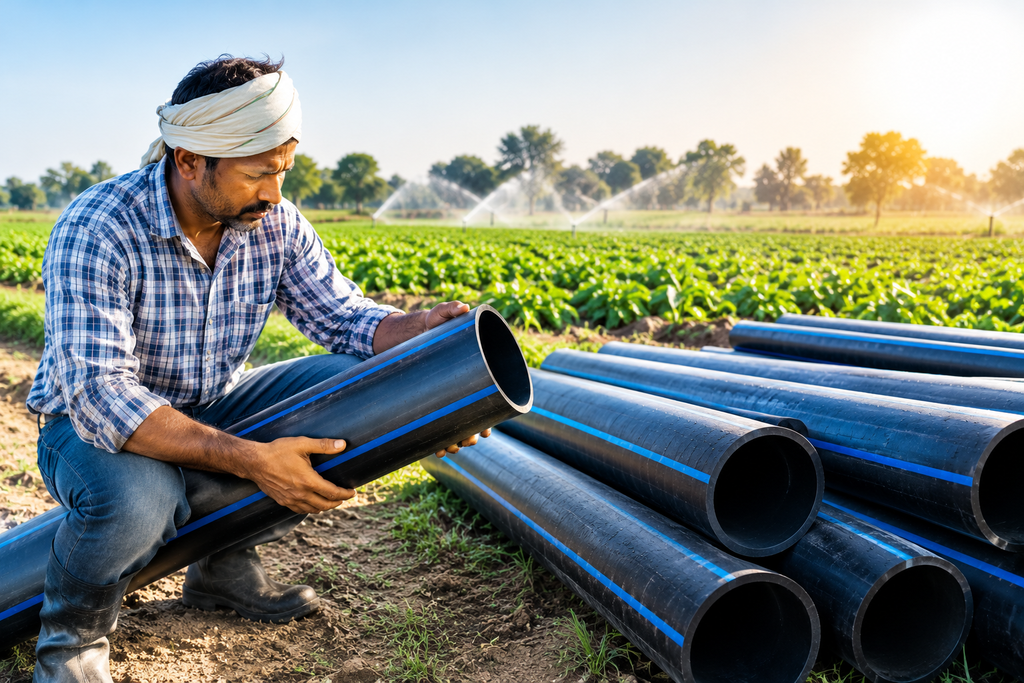
Choosing the right HDPE pipe for a farm is not simply about finding the lowest price per metre. The pipe needs to match the irrigation system, operating pressure, water flow, installation conditions and the farmer’s actual requirements.
Two HDPE pipes can look almost identical but have different material grades, pressure ratings, dimensions, manufacturing consistency and performance characteristics. That is why farmers should look beyond color, thickness and price before placing a large order.
For agricultural buyers, the better question is not:
“Which HDPE pipe is cheapest?”
It is:
“Which HDPE pipe is correctly specified for my irrigation system and manufactured to a reliable quality standard?”
This guide explains the practical checks farmers, agricultural contractors and irrigation buyers can make before purchasing HDPE pipes. It also explains what to ask a manufacturer or dealer, how to evaluate quality beyond appearance, and what information you should have ready before requesting a quotation.
Quick Answer: What Should You Check Before Buying an HDPE Pipe?
Before buying an HDPE pipe for agriculture, check these key points:
- Material grade
- Pipe diameter
- Pressure rating
- SDR and wall thickness
- Manufacturer markings
- Surface and dimensional quality
- Applicable product standard
- Quality-control and testing information
- Suitability for outdoor exposure
- Fittings and joining method
- Installation conditions
- Manufacturer or dealer support
Most importantly, do not select an agricultural HDPE pipe based on thickness or price alone. The complete specification has to match the irrigation application.
Why HDPE Pipe Quality Matters in Agriculture
Irrigation pipelines are an important part of a farm’s water-management system. Depending on the installation, a pipeline may transport water from a borewell, open source, reservoir or pump to different parts of the field.
Agricultural pipelines can also be exposed to:
- Sunlight
- Uneven ground
- Mechanical handling
- Changing water pressure
- Bends and turns
- Pump starting and stopping
- Agricultural equipment
- Different installation depths
- Long periods of outdoor use
HDPE pipes are used in a range of water-distribution and irrigation applications because polyethylene pipes can provide properties such as flexibility and corrosion resistance. However, HDPE is not one single specification. The correct product depends on its material, dimensions, pressure capability and intended application.
Under IS 4984, polyethylene pipes are classified using material designations including PE 63, PE 80 and PE 100, with dimensional and pressure classifications associated with the pipe specification. Always verify the applicable standard and current product documentation for the particular pipe being purchased.
The word “HDPE” by itself does not tell a farmer everything they need to know about a pipe.
1. Check the HDPE Pipe Material Grade
One of the first questions to ask a manufacturer or dealer is:
“What material grade is this pipe made from?”
For pipes covered by IS 4984:2016, material designations include PE 63, PE 80 and PE 100.
The important point for a farmer is not simply memorizing these names. What matters is understanding that different material classifications can be associated with different pressure and dimensional requirements.
When requesting a quotation, ask the supplier to provide:
- Material grade
- Nominal diameter
- Pressure rating
- SDR or applicable dimensional classification
- Applicable product standard
- Intended application
Do not rely on phrases such as “premium quality”, “heavy duty” or “extra strong” without asking for the actual specification.
A trustworthy manufacturer should be able to explain what the pipe is designed for.
2. Verify the Pipe’s Pressure Rating
Pressure is one of the most important factors when selecting an irrigation pipe.
A farm pipeline may experience different operating conditions depending on:
- Pump capacity
- Water source
- Pipeline length
- Elevation difference
- Sprinkler requirements
- Number of outlets
- Valves and fittings
- Terrain
- Pump starting and stopping
- Overall system design
A pipe suitable for one farm may not be suitable for another.
For example, simply knowing that a farmer needs a particular pipe diameter does not tell you whether that pipe has the appropriate pressure capability for the entire system.
Diameter and pressure rating should be considered together.
If you are unsure about the appropriate specification, provide the manufacturer or dealer with your pump details, approximate pipeline length, irrigation method and installation conditions.
A competent supplier should help you identify the appropriate product specification rather than simply selling whichever pipe is immediately available.
3. Understand SDR and Wall Thickness
Many buyers assume:
“A thicker pipe must always be a better pipe.”
That is not necessarily the right way to compare HDPE pipes.
Wall thickness is important, but it should be evaluated together with:
- Pipe diameter
- Material grade
- SDR
- Pressure classification
- Application requirements
SDR, or Standard Dimension Ratio, is a useful way of relating the outside diameter of a pipe to its wall thickness.
This is why two pipes with different diameters can have different wall thicknesses while still being designed according to their respective specifications.
When comparing products, don’t ask only:
“How many millimeters thick is the pipe?”
Also ask:
“What is the material grade, pressure classification, diameter and SDR?”
This gives you a much more meaningful basis for comparison.
4. Check the Markings on the Pipe
A good-quality pipe should have identifiable product markings appropriate to the applicable specification.
Depending on the product, markings may identify information such as:
- Manufacturer or brand
- Nominal size
- Material designation
- Pressure/classification information
- Applicable standard
- Production or batch information
These markings help connect the physical pipe with its declared specifications.
Don’t buy an agricultural HDPE pipe simply because it looks good.
Before accepting a large quantity, inspect the markings and ask the supplier to explain them.
If a supplier cannot clearly tell you what the markings mean or what specification the product follows, take the time to clarify the issue before purchasing.
5. Inspect the Pipe’s Surface Before Installation
Visual inspection cannot prove every aspect of pipe quality, but it can identify obvious physical problems.
Before accepting or installing the material, check for:
- Deep scratches
- Cracks
- Cuts
- Surface bubbles
- Significant deformation
- Damaged pipe ends
- Uneven appearance
- Visible contamination
- Excessive ovality
- Other unusual defects
A minor handling mark does not automatically mean that a pipe is defective. However, serious cuts, cracks or deformation should never be ignored simply because the pipe was purchased at a low price.
For larger agricultural projects, inspect the material before distributing it throughout the farm.
It is much easier to identify a damaged batch before installation than after a pipeline has been laid and connected.
6. Check Dimensional Consistency
Manufacturing consistency matters because the pipe needs to work with compatible fittings and joining systems.
If multiple pipes are supplied under the same specification, they should be reasonably consistent in their dimensions and appearance.
Dimensional problems can create difficulties during:
- Joining
- Fitting installation
- Coupling
- Valve connection
- Pipeline assembly
For larger projects, ask the supplier about its dimensional quality-control procedures.
BIS documentation for IS 4984 includes a range of product and material tests, including tests associated with density, melt flow rate, elongation, longitudinal reversion, internal pressure performance and slow crack growth.
This demonstrates an important principle:
Visual inspection is only one part of quality checking. Reliable pipe quality also depends on material and performance testing.
7. Ask the Manufacturer About Quality Testing
If you are purchasing hundreds or thousands of metres of pipe for an agricultural project, don’t hesitate to ask:
“What quality checks are performed on this pipe?”
Depending on the applicable product specification, quality evaluation can involve characteristics related to:
- Material properties
- Density
- Melt flow behaviour
- Tensile performance
- Elongation
- Dimensions
- Internal pressure performance
- Long-term performance characteristics
- Slow crack growth
- Joint performance
The exact requirements depend on the relevant standard and product.
A professional manufacturer should be able to explain its quality-control process in understandable language.
You don’t need to be a polymer specialist.
You simply need enough information to understand what you are buying and why that specification is appropriate for your farm.
8. Don’t Confuse Flexibility With Weakness
Flexibility is one of the useful characteristics of HDPE pipes in many agricultural applications.
Farm pipelines are not always installed on perfectly straight routes. Fields may contain:
- Turns
- Slopes
- Uneven ground
- Access paths
- Different elevations
Appropriately specified HDPE pipes can make handling and installation practical in many such conditions.
However:
Flexible does not mean soft or weak.
The pipe still needs to provide the strength and pressure performance required by the application.
If a pipe feels unusually soft or inconsistent with the declared specification, don’t make a quality decision based solely on touch. Ask the supplier for the relevant product specification and quality information.
9. Consider Sunlight and Outdoor Exposure
Agricultural irrigation pipes are often used outdoors, sometimes for extended periods.
Therefore, farmers should ask:
“Is this particular pipe suitable for the way I plan to install and use it?”
Outdoor suitability can depend on the product design, exposure conditions and manufacturer’s recommendations.
Do not assume that every polyethylene product has exactly the same outdoor performance.
If the pipe will remain exposed to sunlight, ask the manufacturer about the product’s suitability for that application.
Storage and handling also matter.
Before installation, protect pipes from unnecessary damage during:
- Transportation
- Unloading
- Stacking
- Movement around the farm
- Installation
A good product can still be damaged by careless handling.
10. Check the Inner Surface and Hydraulic Requirement
The inside of the pipeline is where water travels, so internal condition matters.
A smooth internal surface can help reduce friction compared with rougher pipe materials, but actual water flow depends on much more than pipe material.
Farmers should also consider:
- Pipe diameter
- Pipeline length
- Flow requirement
- Elevation
- Pressure
- Bends
- Valves
- Fittings
- Number of outlets
- Pump characteristics
Therefore:
A larger pipe is not automatically the right pipe.
The objective is to select a pipe that is appropriate for the hydraulic requirements of the irrigation system.
For a larger agricultural installation, professional guidance can be useful before finalising the pipe diameter and pressure specification.
11. Don’t Choose an HDPE Pipe Based Only on Price
Price per metre is naturally important to farmers.
But it should not be the only number considered.
For a large installation, the overall cost can include:
Pipe + fittings + transportation + installation + maintenance + replacement + downtime
A cheaper product may not represent better value if it is unsuitable for the application or creates avoidable installation and maintenance problems.
At the same time, the most expensive product is not automatically the best choice.
A more useful comparison includes:
- Material specification
- Pressure rating
- Dimensions
- Manufacturing consistency
- Quality testing
- Application suitability
- Fittings
- Installation requirements
- Manufacturer support
- Warranty/replacement terms where applicable
Compare value, not just the price printed on the quotation.
12. How to Choose HDPE Pipe Dealers Near You
Farmers often search online for “hdpe pipe dealers near me“ when they need a product quickly.
Local availability can be useful, particularly when irrigation work needs to be completed within a specific season.
A reliable local dealer may provide:
- Product availability
- Transportation assistance
- Access to fittings
- Local technical guidance
- Replacement/support assistance
- Faster communication
But being nearby does not automatically mean being the right supplier.
Before purchasing, ask the dealer:
- Who manufactures this pipe?
- What material grade is used?
- What pressure rating is available?
- What standard does it follow?
- What is the pipe’s SDR?
- Is batch/product information available?
- Which fittings are compatible?
- What technical support is available?
- What should I check before installation?
Local convenience should support quality verification—not replace it.
13. Choose an Experienced Irrigation Pipe Manufacturer in Indore
Agricultural irrigation has different practical requirements from many general piping applications.
An experienced irrigation pipe manufacturer in Indore should understand that farmers may have different:
- Pump capacities
- Field sizes
- Water sources
- Irrigation methods
- Pipeline lengths
- Pressure requirements
- Installation conditions
The conversation should therefore begin with the application, not simply the quantity.
A useful manufacturer or technical representative may ask:
- What crop are you irrigating?
- What is your water source?
- What pump are you using?
- How far must the water travel?
- Is there an elevation difference?
- Are you using sprinklers or another irrigation method?
- What diameter are you considering?
- Will the pipe be above ground or buried?
- What pressure does the system operate at?
These questions help connect the product specification with the actual farm requirement.
14. Compare Pipe Manufacturers in Madhya Pradesh on More Than Price
If you are comparing pipe manufacturers in Madhya Pradesh, look at the complete picture.
Consider whether the manufacturer provides clear information about:
- Product specifications
- Applications
- Manufacturing capabilities
- Quality-control practices
- Testing
- Product markings
- Dealer network
- Technical assistance
- Customer support
A manufacturer that explains its product clearly gives a buyer more useful information than one that relies only on claims such as “best quality” or “premium pipe.”
Specific evidence is more useful than generic marketing language.
Before placing a major order, ask for the technical information relevant to your application.
15. Make Sure Your Fittings Match the Pipe
A pipeline is a system, not just a length of pipe.
Agricultural installations may require:
- Couplers
- Elbows
- Tees
- Valves
- Reducers
- Flanges
- Sprinkler connections
- Other specialised fittings
The pipe, fittings and joining method need to be compatible.
Poor connections can result in leakage, pressure loss and unnecessary maintenance.
Therefore, plan the pipeline as a complete system.
Do not purchase the pipe first and think about fittings later.
Ask the supplier which fittings and joining methods are appropriate for the selected pipe.
16. Installation Quality Can Affect Pipe Performance
Even a correctly specified HDPE pipe can be damaged through poor installation.
During handling and installation, avoid:
- Dragging the pipe over sharp surfaces
- Excessive bending
- Improper joint preparation
- Incorrect fittings
- Poor trench preparation
- Leaving seriously damaged sections in service
- Ignoring manufacturer instructions
For buried pipelines, trench, bedding and backfilling conditions can matter.
For above-ground installations, movement, support, environmental exposure and handling should be considered.
Good pipe + poor installation is still a poor pipeline system.
Ask the manufacturer or dealer for the recommended installation and handling procedure for the particular product.
A Practical HDPE Pipe Buying Checklist for Farmers
Before finalising your purchase, save or print this checklist.
Product specification
☐ Correct pipe diameter
☐ Correct material grade
☐ Suitable pressure rating
☐ Appropriate SDR/dimensional classification
☐ Applicable product standard verified
☐ Manufacturer markings visible
☐ Suitable for the intended application
Physical inspection
☐ Surface appears consistent
☐ No serious cracks or cuts
☐ No significant deformation
☐ Pipe ends are in good condition
☐ Dimensions are consistent
Manufacturer/dealer
☐ Manufacturer identified
☐ Quality-control information available
☐ Product documentation available
☐ Compatible fittings available
☐ Technical guidance available
☐ Support/replacement process understood
Irrigation system
☐ Pump pressure considered
☐ Water source considered
☐ Pipeline length considered
☐ Elevation considered
☐ Flow requirement considered
☐ Fittings selected
☐ Installation method planned
☐ Outdoor exposure considered
If you cannot answer these questions, don’t rush into a large purchase.
Real Farm Case Study: How a Farmer Selected an HDPE Irrigation Pipeline
Important: This section should be completed using a genuine Vishal Pipes customer before publication. Do not publish invented farm size, crop, savings, pipe specifications or performance results.
Customer Profile
Farmer: [Customer name, with permission]
Location: [Village/City, District, Madhya Pradesh]
Farm size: [Verified acreage]
Crop: [Verified crop]
Irrigation method: [Verified method]
Water source: [Verified source]
The Challenge
Before choosing the new pipeline, the farmer was experiencing:
[Describe the actual problem—e.g. leakage, repeated repairs, unsuitable pressure performance, difficult handling, replacement frequency or another verified issue.]
The farmer needed a pipeline solution that would be suitable for:
- [Verified requirement]
- [Verified pressure/application]
- [Verified field conditions]
- [Verified pipeline distance]
Why HDPE Was Considered
The customer discussed the irrigation requirement with the Vishal Pipes team and provided information about the farm, water source, pump and pipeline layout.
Based on the actual project requirements, the selected product was:
Pipe: [Actual Vishal product]
Diameter: [Actual specification]
Material grade: [Actual specification]
Pressure rating: [Actual specification]
SDR: [Actual specification, if applicable]
Approximate length: [Actual quantity]
Installation
The pipeline was installed using:
[Verified installation method]
Photographs should be included here showing:
- The farm before installation
- Vishal HDPE pipe at the site
- Installation/jointing
- Completed pipeline
- Irrigation operation, if available
Observed Result
After installation, the customer reported:
“[Insert a genuine customer statement here.]”
If measurable results are available, include only verified figures:
- Previous maintenance frequency: [verified]
- Current maintenance frequency: [verified]
- Installation period: [verified]
- Operational observation: [verified]
- Other measurable result: [verified]
What Farmers Can Learn From This Case
The most important lesson is not that one pipe specification is suitable for every farm.
The lesson is that pipe selection should begin with the actual irrigation requirement.
The farmer, dealer and manufacturer should consider the water source, pressure, pipeline length, irrigation method, installation conditions and compatible fittings before selecting the product.
Real customer experience should support technical information—not replace it.
What We Recommend Checking Before Supplying an Agricultural HDPE Pipe
At Vishal Pipes, this section should be based on the company’s actual internal process.
A strong first-party section can explain:
1. Customer requirement
What information does the technical/sales team collect?
2. Application
How is the intended agricultural use understood?
3. Pipe specification
Which product specifications are checked before recommendation?
4. Quality control
What manufacturing and testing checks are actually performed?
5. Fittings
How are compatible fittings selected?
6. Installation guidance
What information is provided to the customer or dealer?
Editor requirement: Only include processes that Vishal Pipes can substantiate with actual company information, photographs, technical documents or staff interviews.
This section is important because it adds something competitors cannot easily reproduce: first-party knowledge from the manufacturer itself.
Common HDPE Pipe Buying Mistakes Farmers Should Avoid
Mistake 1: Choosing Only by Price
The lowest price does not automatically mean the lowest overall cost.
Mistake 2: Assuming Thicker Means Better
Wall thickness should be considered together with material grade, diameter, SDR and pressure requirements.
Mistake 3: Ignoring Pressure
Pump and system pressure should be considered before selecting the pipe.
Mistake 4: Treating Every HDPE Pipe as the Same
HDPE products can differ in material classification, dimensions, pressure capability and intended application.
Mistake 5: Buying Without Checking Markings
Product identification and specification information should be verified.
Mistake 6: Ignoring Fittings
The pipe and fittings should be treated as one system.
Mistake 7: Poor Handling During Installation
Sharp objects, excessive bending and improper installation can damage piping.
Mistake 8: Buying Without Asking Questions
A good supplier should be willing to explain what you are buying.
How Vishal Pipes Helps Farmers Select the Right HDPE Pipe
Vishal Pipes can make this section more authoritative by explaining its actual manufacturing experience, product range, quality-control process and agricultural customer base.
For farmers, the most useful approach is to start with the irrigation application.
When contacting the company, keep the following information ready:
- Water source
- Pump details
- Approximate pipeline length
- Required water flow
- Field conditions
- Irrigation method
- Above-ground or underground installation
- Approximate pipe quantity
- Required delivery location
This information helps the technical or sales team understand the application before discussing the appropriate product.
The goal should not be to sell the thickest or most expensive pipe. The goal should be to identify a pipe specification appropriate for the customer’s actual requirement.
Final Takeaway: Good HDPE Pipe Quality Is More Than Appearance
A good-quality HDPE pipe should not be selected simply because it looks thick, feels flexible or has the lowest price.
For agricultural applications, consider the complete picture:
Material grade + pressure rating + dimensions + SDR + markings + testing + application suitability + fittings + installation + supplier support
Farmers searching for hdpe pipe dealers near me should compare more than location and price.
Those looking for an irrigation pipe manufacturer in Indore should ask questions about product specifications, irrigation applications and technical support.
And buyers comparing pipe manufacturers in Madhya Pradesh should evaluate manufacturing capability, quality practices, documentation, customer experience and after-sales support.
The right irrigation pipe is the one that is correctly specified for the job, consistently manufactured, properly installed and supported by a supplier you can trust.
Before placing a large order, ask questions, check the specification and make sure the product is suitable for your irrigation system.
A few minutes spent verifying the pipe can help you make a much more informed agricultural investment.
Frequently Asked Questions About HDPE Pipes for Agriculture
How can I check the quality of an HDPE pipe?
Start by checking the material grade, diameter, pressure rating, SDR, markings, applicable standard and physical condition. For larger projects, ask the manufacturer about quality-control and testing procedures.
Is a thicker HDPE pipe always better?
No. Thickness should not be considered by itself. The appropriate pipe depends on material grade, diameter, SDR, pressure requirements and intended application.
Which HDPE pipe is best for agricultural irrigation?
There is no single HDPE pipe that is best for every farm. The correct selection depends on factors such as water source, pump pressure, flow, pipeline length, irrigation method and installation conditions.
What should I ask an HDPE pipe dealer before buying?
Ask about material grade, diameter, pressure rating, SDR, applicable standard, testing, markings, compatible fittings and installation recommendations.
Why is pressure rating important in agricultural irrigation?
The pipe needs to be suitable for the operating conditions of the irrigation system. Pump pressure, elevation and system design can affect the pressure requirements.
Can HDPE pipes be used outdoors?
Many HDPE products are used in outdoor applications, but suitability depends on the specific product and installation conditions. Ask the manufacturer about the intended application and exposure conditions.
Is HDPE suitable for farm irrigation?
HDPE can be used for various agricultural water-distribution and irrigation applications when the pipe is correctly specified for the operating conditions.
Should I choose an HDPE pipe only by price?
No. Compare product specification, pressure capability, manufacturing quality, testing, fittings, installation requirements and supplier support along with price.
Author Box
Komal Parmar is an Agricultural & Piping Content Writer specializing in practical insights on HDPE pipes, agricultural piping, irrigation systems, pipe fittings, and water-supply solutions. She focuses on simplifying technical piping information into clear, useful guidance for farmers, contractors, dealers, and businesses.
Through her writing, Komal aims to help readers better understand pipe selection, irrigation applications, product specifications, and practical considerations for modern agricultural and water-management projects.
Last reviewed: October 2026
How this guide was prepared
This guide should be reviewed by Vishal Pipes’ technical/product team before publication. Product specifications, standards, testing information and company-specific claims should be checked against current technical documentation.
Where this article describes customer experience, Vishal Pipes should use only verified customer information and approved quotations.
Where photographs are used, prefer original Vishal Pipes factory, product, installation or customer-site photographs with accurate captions.
The purpose of this guide is to help farmers make a more informed purchasing decision—not simply to promote a particular product.