When Every Drop Matters: Why Better Irrigation Is the Need of Today
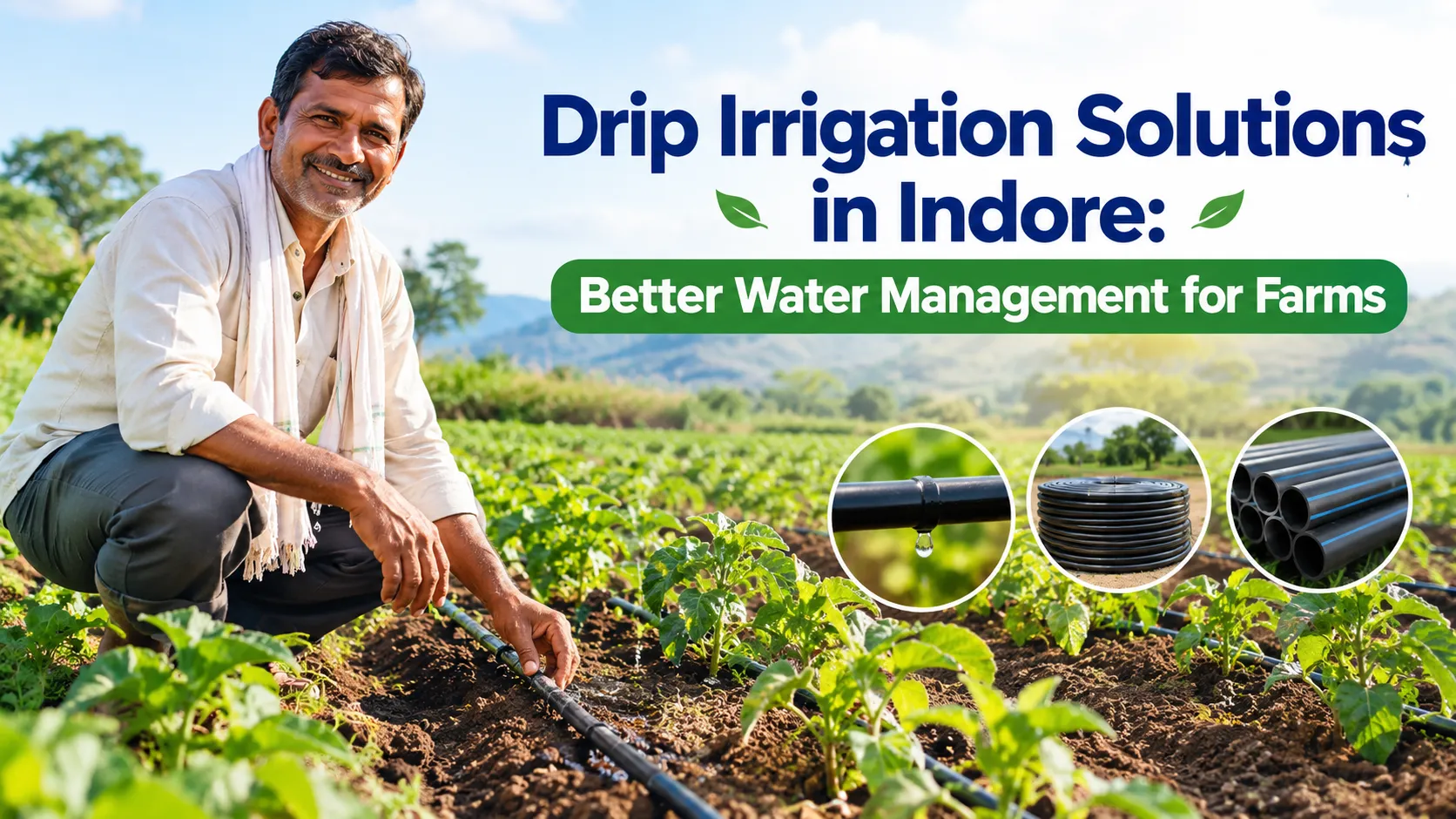
A farmer can have good soil, quality seeds and the right fertilizer, yet water management can still decide the final result. Drip Irrigation offers a practical way to deliver water closer to the root zone instead of depending only on traditional flood irrigation.
For farmers around Indore and nearby agricultural areas, efficient irrigation is becoming increasingly important. Water availability can vary from season to season, while the cost of electricity, labour and farm inputs continues to affect farming decisions. A properly planned irrigation network can help farmers use available water more carefully while maintaining consistent moisture around crops.
The idea is simple: instead of sending a large amount of water across the entire field, an irrigation system delivers controlled quantities where plants need them. The result can be better water management, less unnecessary wetting and more control over the irrigation schedule.
But there is one important point that is often overlooked. A good irrigation system is not only about choosing emitters or installing pipes. The quality, size, strength and suitability of the complete pipe network also matter.
This is where choosing the right irrigation pipe supplier and understanding your farm requirements becomes important.
What Is Drip Irrigation and How Does It Work?
Drip Irrigation is a method of supplying water slowly and directly to the area around a plant’s roots. Water generally travels from a source through a mainline, sub-mainline and smaller distribution lines before reaching the crop through emitters or drippers.
Think about watering 1,000 plants individually with a bucket. It would take enormous time and effort. A properly designed system performs this task through a connected network, allowing water to reach many plants in a controlled manner.
A typical setup may include:
- Water source or storage tank
- Pumping arrangement
- Filtration unit
- Main pipe
- Sub-main pipes
- Distribution or lateral lines
- Drippers or emitters
- Valves and fittings
The actual design depends on crop type, field size, water source, terrain and required flow rate.
For example, a vegetable farmer may require a different arrangement from an orchard owner. A large agricultural project may need a stronger mainline network compared with a small farm.
That is why simply buying the cheapest pipe is not always the best decision.
Why Drip Irrigation Is Useful for Indore Farms
Water efficiency is one of the biggest reasons farmers consider modern irrigation methods. Traditional surface irrigation can distribute water unevenly, especially when fields have different slopes or soil conditions.
With Drip Irrigation, water can be applied closer to the root zone in smaller and more controlled quantities.
This can provide several practical benefits.
Better Water Management
Instead of flooding an entire area, water can be delivered according to crop requirements. Farmers can therefore plan irrigation more systematically.
Reduced Water Wastage
Water that moves away from the root zone or evaporates from exposed soil does not contribute as effectively to plant growth. Targeted application can reduce such losses.
More Consistent Crop Growth
When plants receive a more consistent supply of moisture, uneven irrigation-related stress can potentially be reduced.
Easier Fertilizer Application
Fertigation can allow suitable soluble fertilizers to be supplied through an irrigation network when the system is designed for it and the fertilizer is compatible.
Lower Manual Effort
Once installed and properly managed, irrigation can become easier to schedule compared with manually moving hoses or opening field channels.
For farmers, the real value is not simply “using less water.” It is gaining greater control over how, when and where water reaches the crop.
Choosing the Right Pipes for Drip Irrigation
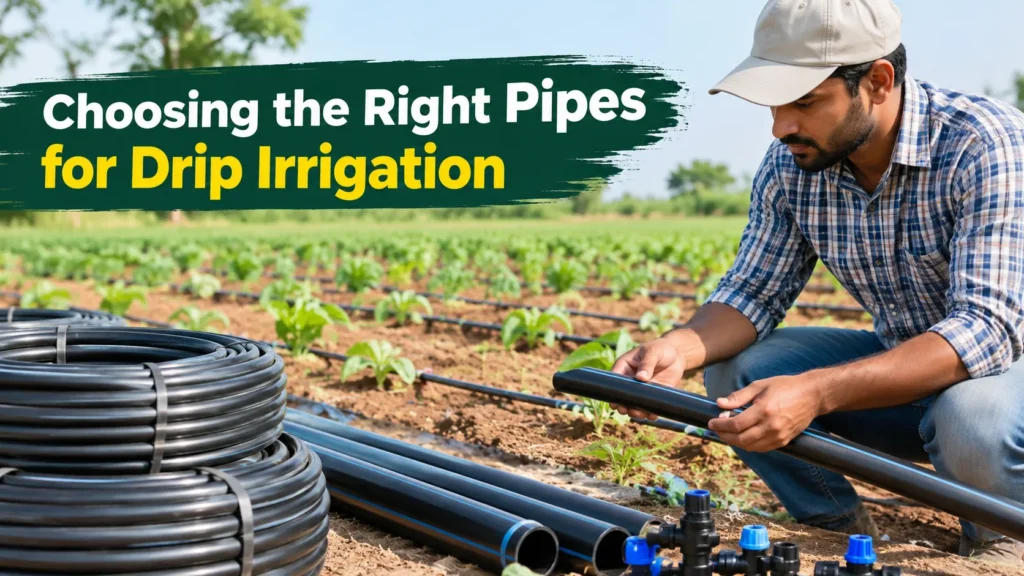
The pipe network forms the backbone of an irrigation setup. If the mainline or distribution network is poorly selected, even good-quality irrigation components may not perform as expected.
Farmers should consider pipe diameter, pressure requirements, water flow, installation conditions, soil environment and expected service life before making a decision.
For larger agricultural applications, an HDPE Pipe Manufacturer in Indore can be a useful source for understanding suitable polyethylene pipe solutions.
HDPE pipes are widely used in irrigation because of their flexibility, durability and resistance to many common environmental conditions. The correct grade and specification should always be selected according to the actual application.
Similarly, a PVC Pipe Manufacturer in Indore can provide options for applications where rigid piping is more suitable.
The important point is that there is no single “best pipe” for every farm. The correct choice depends on the complete irrigation design.
HDPE vs PVC: Which Pipe Is Better?
Farmers and contractors often compare HDPE and PVC before planning an irrigation project.
| Factor | HDPE Pipes | PVC Pipes |
|---|---|---|
| Flexibility | High | Lower |
| Handling | Relatively easy | Easy for rigid installations |
| Underground use | Suitable for many applications | Suitable for many applications |
| Resistance to corrosion | Good | Good |
| Installation requirements | Depends on joining method | Depends on fittings/joints |
| Typical application | Irrigation networks and water distribution | Water distribution and irrigation |
| Best choice | Depends on project design | Depends on project design |
The decision should not be based only on price per metre. Flow requirements, pressure, installation method, field conditions and expected operating life should also be considered.
A reliable HDPE Pipe Supplier in Indore or PVC Pipe Supplier in Indore can help dealers, contractors and project managers match pipe specifications with the intended application.
A Practical Example: From Uneven Watering to Better Control
Imagine a farmer managing an orchard where some plants receive excess water while plants farther from the water source receive less.
The farmer may respond by running the pump for longer. However, this does not necessarily solve the distribution problem. Some areas may become excessively wet while others still remain under-irrigated.
A properly planned Drip Irrigation network changes the approach.
Instead of asking, “How long should I run the pump?” the farmer can start asking, “How much water does this crop require, and how can I distribute it consistently?”
The mainline carries water through the field. Sub-lines distribute it to different sections, while emitters deliver controlled quantities close to plants.
This example illustrates why irrigation planning matters as much as the individual components.
Step-by-Step Guide to Planning Drip Irrigation
Step 1: Understand Your Water Source
Start with the source. It could be a borewell, open well, storage tank, canal-fed arrangement or another approved water source.
Check the available water quantity and pumping capacity before designing the system.
Step 2: Measure the Field
Know the field’s total area, length, width and slope. Also identify different crop sections.
A proper field map makes pipe planning much easier.
Step 3: Identify the Crop
Different crops have different spacing and water requirements.
Vegetables, row crops, orchards and plantations should not automatically receive the same irrigation layout.
Step 4: Calculate Flow Requirements
The required flow depends on the number of plants, emitters, operating pressure and irrigation sections.
This calculation helps determine appropriate pipe sizes.
Step 5: Select the Mainline
The mainline should be selected according to the expected flow, pressure and distance.
For many irrigation applications, polyethylene solutions can be considered through an experienced Irrigation Pipe Manufacturer in Indore.
Step 6: Plan Sub-Mains and Laterals
The distribution network should be designed so that different crop zones can be managed efficiently.
Valves can help divide a larger farm into manageable irrigation sections.
Step 7: Install Filtration
Clean water is important for systems containing small emitters. Filtration can help reduce the risk of clogging caused by suspended particles.
Step 8: Test Before Full Operation
Check connections, pressure, flow and possible leakage before using the system across the entire farm.
A small problem discovered during testing is usually easier to fix than a problem discovered after the entire crop cycle has begun.
What Farmers Should Check Before Buying Irrigation Pipes
Before purchasing pipes, ask yourself a few practical questions.
What is the total field area?
How far is the water source from the field?
What pump capacity is available?
What pressure will the system operate at?
Is the installation temporary or long-term?
Will the pipes be above ground or underground?
What crop will be irrigated?
Will the system be expanded later?
These answers can make the buying decision much clearer.
Farmers searching online for a Pipe Supplier Near Me should look beyond proximity and compare specifications, product suitability, consistency and technical support.
The same applies when searching for an HDPE Pipe Dealer Near Me. A nearby dealer is convenient, but the product should still match the irrigation requirement.
Where Do Sprinkler Pipes Fit Into Modern Irrigation?
Not every farm requires drip irrigation alone.
Sprinkler systems can be useful for crops and field conditions where water needs to be distributed over a broader surface area. The choice between drip and sprinkler irrigation depends on crop, soil, terrain, water availability and the desired irrigation method.
For farmers looking for sprinkler components, searching for Sprinkler pipe dealers near me can help identify nearby sources.
A specialised Sprinkler Pipe Manufacturer in Indore can also be relevant for dealers, contractors and agricultural projects requiring sprinkler pipe solutions.
Farmers can also compare products from a Sprinkler irrigation pipe dealer in Indore when planning a new irrigation installation.
The goal should not be to choose a system simply because it is popular. The right system is the one that fits the field.
Drip Irrigation vs Sprinkler Irrigation
| Feature | Drip Irrigation | Sprinkler Irrigation |
|---|---|---|
| Water delivery | Near plant/root zone | Distributed over crop area |
| Suitable for | Orchards, vegetables, row crops and many high-value crops | Field crops, lawns and various agricultural applications |
| Water control | Highly targeted | Broader coverage |
| Wind impact | Generally lower | Can affect spray distribution |
| Initial planning | Requires careful layout | Requires suitable sprinkler spacing |
| Best application | Where targeted watering is preferred | Where wider-area watering is required |
There is no universal winner. A farm’s crop, soil and water conditions should guide the decision.
How Dealers and Contractors Can Benefit From Better Pipe Selection
The demand for efficient irrigation is not relevant only to farmers.
Pipe dealers and distributors need dependable products that can serve different agricultural requirements. Contractors need pipes that fit project specifications and installation conditions. Builders and infrastructure teams may need solutions for landscaping, water distribution and other applications.
A Pipe Manufacturer in Indore serving different application requirements can therefore be valuable for local project networks.
For dealers, having access to products such as HDPE, PVC, irrigation and sprinkler pipes can make it easier to serve different customers.
A High density pipe dealer in Indore may be relevant when customers are specifically looking for HDPE solutions.
Similarly, a Plastic pipe manufacturer in Indore can support requirements across agricultural and water distribution applications.
For local customers, a Plastic pipe dealer in Indore can provide convenient access to different pipe categories, fittings and related products.
What About Hose and Garden Irrigation?
Not every water-management project is a large agricultural installation.
Nurseries, gardens, landscaping projects, residential green areas and small farms may require flexible hose solutions instead.
Someone searching for a Pipe hose shop near me may be looking for a practical solution for a smaller watering application.
Likewise, people searching for a Garden pipe dealer near me may need pipes or hoses for gardens, nurseries and landscaping rather than a complete agricultural irrigation network.
The key is matching the product to the job instead of purchasing based only on the lowest price.
Common Mistakes Farmers Should Avoid
Choosing Pipes Only by Price
A lower initial price can become expensive if the product is unsuitable for pressure, flow or installation conditions.
Ignoring Pipe Diameter
Using an inappropriate diameter can affect flow and pressure throughout the network.
Skipping Filtration
Small irrigation outlets can be vulnerable to clogging when water quality is not properly managed.
Poor Jointing
Improperly made joints can result in leakage and pressure loss.
Not Checking the Pump
The irrigation network and pump should work together. A pipe system cannot compensate for an unsuitable pumping arrangement.
Over-Irrigating
More water does not automatically mean better crop growth. Excessive irrigation can create its own problems.
Forgetting Maintenance
Filters, valves, emitters and pipelines should be inspected regularly.
A Simple Maintenance Checklist
Use this checklist during routine inspection:
Check for visible leakage.
Inspect pipe joints and fittings.
Clean filtration equipment as required.
Check emitters for clogging.
Look for damaged pipes.
Monitor pressure changes.
Inspect valves.
Flush suitable sections when required.
Check whether water is reaching all crop zones evenly.
Record unusual flow or pressure changes.
Regular inspection can help identify small problems before they affect a larger part of the farm.
What Is Changing in Agricultural Irrigation?
Agriculture is moving toward more controlled and measurable water management.
Farmers are increasingly interested in irrigation systems that provide better control over water application. Automation, pressure monitoring, fertigation, filtration improvements and zone-based irrigation are becoming more relevant as farms look for practical ways to manage resources.
Another important trend is the growing focus on durable infrastructure. Instead of repeatedly replacing unsuitable pipes, farmers and project managers are looking at total value, expected service life and maintenance requirements.
This shift also creates opportunities for local pipe manufacturers, distributors and irrigation contractors who can provide application-specific solutions.
For projects requiring borewell-related water movement, customers may also research options such as a Best column pipe dealer in Indore based on their specific pumping requirements.
A Note for Government and Infrastructure Projects

Large irrigation and water-management projects require more than individual product selection.
Government departments, infrastructure agencies and contractors need consistency across procurement, specifications, installation and maintenance. Pipe dimensions, pressure ratings, material specifications, project standards and quality requirements should be verified according to the project’s technical documents.
For such applications, working with an experienced HDPE Pipe Manufacturer in Indore or PVC Pipe Manufacturer in Indore can simplify sourcing and coordination.
The same approach applies to contractors working on agricultural estates, public landscaping, irrigation projects and institutional developments.
How to Choose the Right Pipe Partner in Indore
Before finalising a supplier, consider five things.
First, check whether the supplier understands your application rather than simply selling a product.
Second, ask about available sizes and specifications.
Third, confirm whether the product is suitable for the expected pressure and flow.
Fourth, compare quality and expected service life instead of looking only at the purchase price.
Finally, consider whether the supplier can support your requirements as the project grows.
This matters whether you are a farmer, contractor, dealer or infrastructure project manager.
A good supplier relationship can make future repairs, expansion and replacement much easier.
Frequently Asked Questions About Drip Irrigation
Is Drip Irrigation suitable for all crops?
It can be used for many crops, but the layout and components need to match crop spacing, water requirements and soil conditions. Some crops may be better suited to sprinkler or other irrigation methods.
Does Drip Irrigation completely eliminate water wastage?
No irrigation system can guarantee zero water loss. However, targeted water application can help improve efficiency when the system is properly designed, operated and maintained.
Are HDPE pipes suitable for agricultural irrigation?
HDPE pipes are widely used in agricultural and water-distribution applications. The correct specification should be selected according to pressure, flow, installation and project requirements.
Is PVC suitable for irrigation?
PVC pipes can be suitable for many irrigation and water-distribution applications. The right product depends on the system design and operating conditions.
How often should an irrigation system be checked?
Routine inspection is recommended. Filters, emitters, valves, joints and pipelines should be checked according to water quality, system usage and manufacturer recommendations.
Should farmers choose drip or sprinkler irrigation?
It depends on the crop, field size, soil, terrain, water availability and irrigation objective. A professional assessment can help determine the more suitable approach.
The Bigger Picture: Every Drop Needs a Plan
The future of farming is not simply about using more water or installing more equipment. It is about using available resources intelligently.
Drip Irrigation can give farmers greater control over where and when water is delivered. However, that benefit depends on the complete system working together.
The pipe network, pump, filtration, fittings, valves, emitters and maintenance routine all have a role to play.
For farmers in Indore, the first step is to understand the actual requirement of the field. dealers and distributors, it is about offering products suited to different applications. For contractors and builders, it is about selecting dependable infrastructure that matches project specifications.
Vishal Pipe can be considered when exploring irrigation and pipe solutions for agricultural and water-management requirements in the region. Whether you are comparing an Irrigation Pipe Manufacturer in Indore, looking for a Sprinkler Pipe Manufacturer in Indore, or evaluating an HDPE Pipe Supplier in Indore, make the decision based on application, specifications and long-term value.
When water becomes more valuable, better planning becomes more important.
Have you reviewed your farm’s irrigation network recently? Start by checking your water source, field size, crop requirements, pipe condition and current water distribution. The right improvement could begin with something as simple as choosing a better-designed pipe network.