
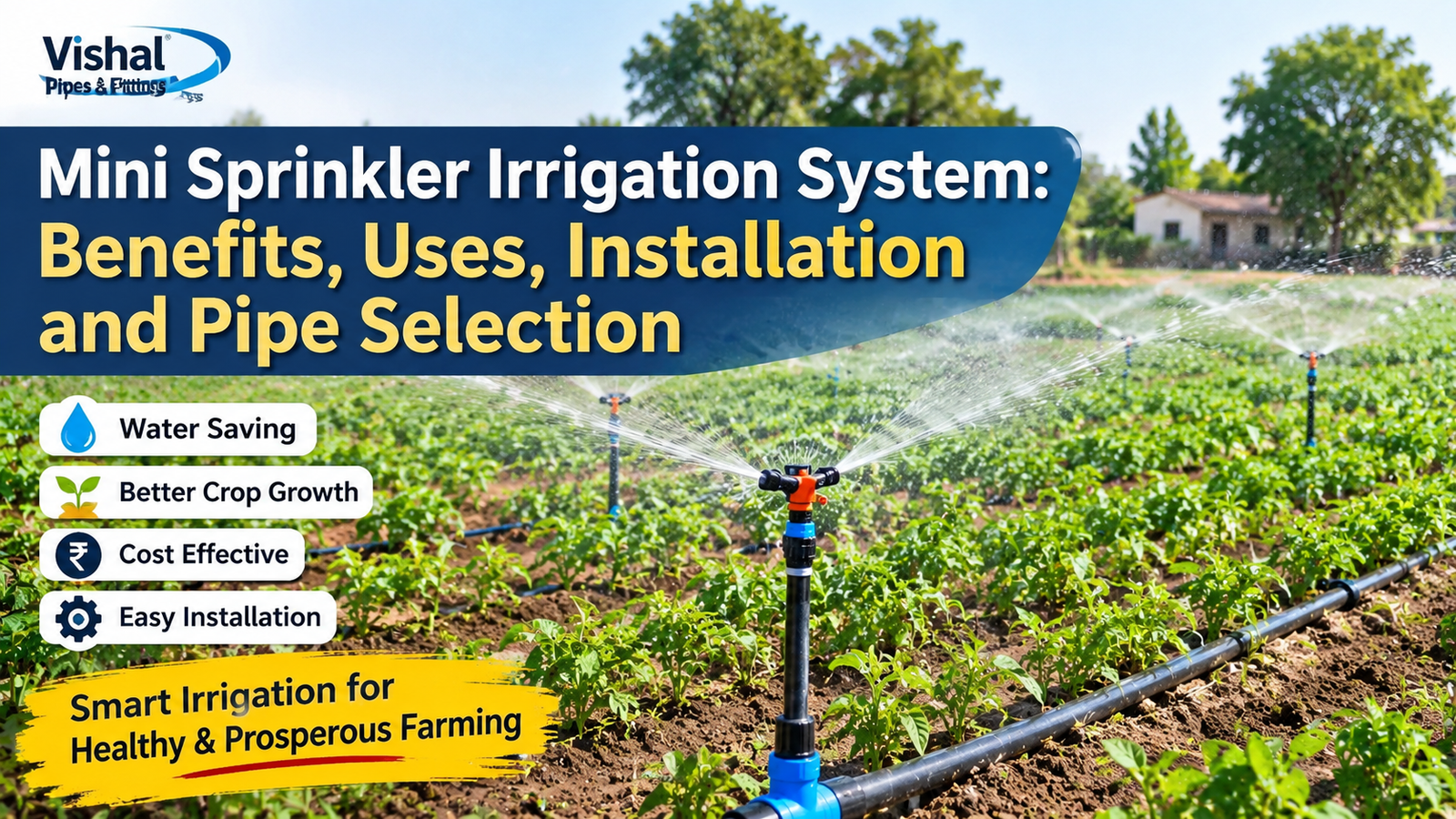
Mini Sprinkler Irrigation System: Benefits, Uses, Installation and Pipe Selection
A farmer can have a good water source and a suitable pump, but that does not automatically mean every part of the field will receive water evenly. The way water travels from the pump to the crop rows matters just as much as the irrigation equipment installed at the end of the pipeline.
This is one reason farmers consider a mini sprinkler irrigation system for vegetable cultivation, nurseries, orchards, flower farming and selected gardening applications. Instead of allowing water to flow across the field surface, mini sprinklers distribute it through small spray units connected to a network of pipes.
However, buying sprinkler heads is only one part of the decision. The pipe diameter, operating pressure, water discharge, filtration, sprinkler spacing and field layout all need to work together. If one part is selected without considering the others, the system may not deliver the coverage a farmer expects.
At Vishal Pipes and Fittings, Indore, agricultural piping is an important part of the product range. From a pipe manufacturer’s perspective, one point deserves attention before any irrigation purchase: the pipe should be selected according to the water it needs to carry, the pressure it must handle and the conditions in which it will be installed.
This guide explains how mini sprinkler irrigation works, where it may be useful, how to plan the pipeline, what to check during installation and how farmers can evaluate suppliers before making a purchase.

What Is a Mini Sprinkler Irrigation System?
A mini sprinkler irrigation system is a method of applying water through small sprinkler heads connected to a pressurized pipeline network. Each sprinkler releases water in a spray pattern over a selected area around the unit.
The water usually travels through a mainline, sub-main and lateral arrangement before reaching the sprinkler heads. The pump provides the required flow and pressure, while filters help prevent particles from entering and blocking the smaller openings in the sprinkler equipment.
Unlike flood irrigation, where water is allowed to move across the field surface, a sprinkler system applies water from above. The area covered by each unit depends on its design, nozzle, operating pressure, installation height and surrounding conditions.
A typical system may include:
- Water source: A borewell, open well, farm pond, storage tank or another suitable source.
- Pump: Supplies water at the flow rate and pressure required by the system.
- Mainline pipe: Carries water from the source towards the irrigation area.
- Sub-main pipe: Distributes water to different field sections.
- Lateral pipe: Carries water along the rows or selected irrigation zones.
- Mini sprinkler heads: Release water through the required spray pattern.
- Filter unit: Helps remove particles that could block nozzles.
- Valves and fittings: Control water flow and connect different pipeline sections.
The exact arrangement will differ from farm to farm. A small nursery may need a relatively simple layout, while a larger field with several irrigation zones will require more detailed planning.
A useful distinction: The pipe network carries water; the sprinkler head determines how that water is distributed. Farmers should check the compatibility of both rather than assuming that any agricultural pipe will work with every mini sprinkler.
How Does a Mini Sprinkler Irrigation System Work?
The working process starts at the water source. A pump draws or lifts water and sends it through the mainline. The water then moves through sub-main pipes and reaches the lateral network connected to the sprinkler units.
When the system operates within the sprinkler manufacturer’s recommended pressure range, the nozzles release water in a designed spray pattern.
The actual coverage is influenced by several factors:
- Sprinkler model and nozzle size.
- Water discharge from each sprinkler.
- Operating pressure at the sprinkler.
- Distance between sprinkler units.
- Height and position of the sprinkler.
- Wind speed and direction.
- Soil infiltration and field slope.
For example, a farmer irrigating several vegetable beds may position sprinkler units so that their spray patterns overlap across the intended area. But the spacing should not be decided simply by looking at the advertised throwing distance. The manufacturer’s spacing chart and recommended operating pressure should guide the layout.
A sprinkler may appear to be working because water is coming out of the nozzle. That alone does not prove that the entire field is receiving the required amount of water. The system needs to be checked at different points, including the far end of the pipeline.
Benefits of Mini Sprinkler Irrigation for Farmers
Mini sprinklers can be useful in suitable farming conditions, but their benefits depend on correct system design and operation. Here are the practical reasons farmers may consider them.
1. Controlled Water Distribution
Mini sprinklers distribute water over a selected area rather than relying on uncontrolled surface flow. This can help farmers irrigate defined crop sections and manage water application according to the field layout.
However, even distribution is not automatic. Incorrect spacing, pressure differences, blocked nozzles and strong winds can create areas that receive too much or too little water.
2. Useful for Different Agricultural Applications
Depending on crop requirements and local conditions, mini sprinklers may be considered for:
- Vegetable cultivation
- Plant nurseries
- Selected fruit orchards
- Flower cultivation
- Kitchen gardens
- Landscaping and gardening
- Other suitable horticultural applications
The choice should be based on the crop’s water requirement, plant height, canopy, soil type and sensitivity to wet foliage.
3. Less Dependence on Manual Watering
Manually watering several beds or nursery sections can take considerable time. A properly planned sprinkler arrangement can make it easier to operate selected areas through valves.
This may be helpful for farmers managing multiple plots or dividing their land into different irrigation sections. The system still needs regular inspection, but it can reduce the need to water every area manually.
4. Better Control Over Irrigation Timing
A farmer can decide when to operate each section and for how long. Irrigation duration can then be adjusted according to soil moisture, crop stage, weather and the water available.
Installing a sprinkler system does not automatically guarantee water savings. Long operating hours, leakage, unsuitable pressure and poor spacing can still waste water. The objective should be to apply the amount of water the crop needs, not simply to run the system for a fixed duration.
5. Useful for Nursery and Garden Areas
Nursery plants and young seedlings need careful moisture management. Mini sprinklers may be suitable for covering nursery beds when the spray intensity is appropriate for the plants and growing medium.
A strong spray can disturb delicate seedlings or wash away growing media. The nozzle and operating pressure should therefore be selected according to the nursery’s requirements.
6. Flexible Irrigation Section

Where Can Farmers Use Mini Sprinkler Irrigation?
The suitability of mini sprinklers depends on the crop and the conditions in which it is grown. The following applications are worth evaluating before installation.
Mini Sprinkler for Vegetable Farming
Selected vegetables, including leafy vegetables and nursery-grown vegetable plants, may be irrigated through mini sprinkler arrangements.
For fields with several beds, sprinkler positions can be planned to cover the intended growing area. The design should account for plant spacing, crop height and the amount of water required at different growth stages.
One point should not be overlooked: overhead irrigation wets foliage. In crops or weather conditions where prolonged leaf wetness increases disease risk, farmers should discuss the irrigation method and timing with a local agricultural adviser before choosing sprinklers.
Mini Sprinkler for Fruit Orchards
Mini sprinklers may be considered for selected orchard layouts. Their position should be based on tree spacing, canopy development and the intended wetted area around the trees.
Young trees and mature trees do not necessarily need the same coverage. As an orchard grows, the irrigation arrangement may need to be reviewed rather than assuming the original sprinkler positions will remain suitable.
Mini Sprinkler for Plant Nurseries
Nurseries often contain plants of different sizes and growing stages. A suitable sprinkler arrangement may help distribute water across nursery beds, but spray intensity matters.
Farmers should check whether the water droplets and spray pattern are appropriate for the seedlings. The system should also be easy to inspect because blocked nozzles can affect a small section without immediately being noticed.
Mini Sprinkler for Flower Cultivation
Flower growers may consider mini sprinklers where overhead irrigation is suitable for the crop. Plant height, spacing, foliage sensitivity and the timing of irrigation all need to be considered.
For flowers that are sensitive to wet petals or leaves, another irrigation method may be more appropriate.
Mini Sprinkler for Home Gardens
Mini sprinklers can also be used in larger home gardens, lawns and selected landscaping areas. A garden layout may require fewer sprinkler units and a shorter pipeline than a commercial farm.
Even in a small garden, it is worth checking pressure, coverage and fitting compatibility before buying the equipment.
Essential Components of a Mini Sprinkler Irrigation System
Understanding the components helps farmers discuss their requirements clearly with a supplier or irrigation designer.
1. Mainline Pipe
The mainline carries water from the pump or source towards the irrigation field. Its diameter should be selected according to the total flow requirement, pipeline length and acceptable pressure loss.
A pipe that is too small for the required flow can create excessive friction losses. This may reduce the pressure available at the far end of the system.
2. Sub-Main Pipe
The sub-main distributes water from the mainline to different irrigation zones. Its size depends on the number of laterals and the flow required by each section.
A well-planned sub-main arrangement can make it easier to operate and maintain separate parts of a farm.
3. Lateral or Mini Sprinkler Pipe
Lateral pipes carry water towards the sprinkler units. Their diameter, material, pressure suitability and connection type should match the intended system.
Farmers searching for mini sprinkler pipe in Madhya Pradesh should first clarify which part of the network they need: a mainline, sub-main, lateral or a pipe specifically designed to connect with the sprinkler units.
These are not interchangeable product descriptions. A pipe used to transfer water across a farm may have different requirements from a smaller lateral connected to multiple sprinkler heads.
4. Mini Sprinkler Heads
The sprinkler head controls the spray pattern and discharge. Different models can have different nozzle sizes, operating pressures and coverage characteristics.
Ask the equipment supplier for the technical information for the exact model being considered. Do not assume that all mini sprinklers have the same pressure or throwing distance.
5. Filter Unit
Water from a borewell, open well or storage source may contain sand and suspended particles. These can block small sprinkler openings.
A suitable filter helps reduce blockage risks. Filter selection and cleaning frequency should follow the water quality and the sprinkler manufacturer’s recommendations.
6. Valves, Connectors and Fittings
Valves help control water flow between irrigation sections. Tees, elbows, connectors and other fittings join the pipeline components.
Check that the fittings match the pipe dimensions and connection method. A loose or incompatible joint can cause leakage and affect the pressure available to the sprinkler units.
Farmers can explore the Vishal Pipe product range to review the company’s published agricultural and piping product categories. Confirm the specific product and application with the company before finalizing a mini sprinkler system.
How to Choose the Right Pipe for Mini Sprinkler Irrigation
Pipe selection should start with the water requirement, not simply the price or the diameter of the sprinkler connection.
1. Identify the Pipe’s Role in the System
First, identify whether the pipe is required for the mainline, sub-main or lateral.
A mainline may carry water for several irrigation sections. A lateral may supply a smaller group of sprinkler units. Each part can have a different flow and pressure requirement.
This distinction is important when comparing products from mini sprinkler pipe manufacturers or agricultural pipe suppliers.
2. Check the Pipe Material
HDPE is used in several agricultural water-distribution applications because suitable grades and pressure-rated products can be selected for different pipeline requirements.
However, the material name alone is not enough to establish suitability. Check the product’s intended application, pressure rating, dimensions, connection method and installation conditions.
3. Select the Correct Diameter
Pipe diameter affects the amount of water that can pass through the network and the friction losses along the pipeline.
Before choosing a diameter, consider:
- Total number of sprinklers operating together
- Discharge required by each sprinkler
- Total pipeline length
- Number of bends, tees and fittings
- Elevation changes across the field
- Available pump flow and pressure
- Whether the system will operate in sections
Do not select a pipe only because its connection appears to fit the sprinkler. The entire network should be checked for flow and pressure requirements.
4. Confirm the Pressure Rating
The sprinkler model has a recommended operating pressure. The pipe must be suitable for the pressure conditions in the system, including possible fluctuations.
The pump’s operating conditions, shut-off pressure and any pressure surges should also be considered. A qualified irrigation designer or supplier can help assess the required specification.
5. Check Fitting Compatibility
Confirm the connection dimensions and fitting type before purchasing. A pipe and connector that appear similar may not form a reliable joint if their dimensions or connection methods differ.
Ask the supplier to confirm compatibility rather than relying on appearance alone.
6. Consider the Installation Environment
Pipes installed above ground may be exposed to sunlight, movement, farm machinery and accidental damage. Underground installations have different requirements relating to soil conditions, burial and access for repairs.
The pipe specification should suit the actual installation method.
Farmers searching online for HDPE pipe dealers near me should compare the technical details and intended use of the product, not only the supplier’s distance or quoted price.
For buyers in Indore and nearby areas, speaking with an irrigation pipe manufacturer in Indore can be a useful starting point when comparing agricultural piping options. The important step is to share the actual application and obtain the relevant product details.
Step-by-Step Installation Guide for a Mini Sprinkler Irrigation System
A good installation begins with field planning. Connecting pipes first and thinking about the layout later can lead to unnecessary changes.
Step 1: Measure the Field
Record the field’s length, width, slope and crop arrangement. Mark the water source, access paths, trees, structures and other obstacles.
Prepare a simple sketch showing the proposed mainline, sub-main, laterals and sprinkler positions.
Step 2: Check the Water Source and Pump
Understand how much water the source can provide and what the pump can deliver under operating conditions.
A pump may supply enough water for a few sprinkler units but may not maintain the required flow and pressure when several units operate together.
The number of sprinklers operating in one section should be planned around the actual pump capacity.
Step 3: Decide Sprinkler Spacing
Spacing depends on the sprinkler model, nozzle, operating pressure, spray diameter, wind and crop layout.
Use the manufacturer’s recommended spacing chart. Allow for the required overlap between spray patterns rather than using the maximum advertised throwing distance as the spacing.
Step 4: Plan the Mainline and Sub-Main
Position the mainline so water can reach the required irrigation sections. Plan the sub-main routes according to the field layout and the number of laterals.
Keep valves and important joints accessible for inspection and maintenance.
Step 5: Install the Lateral Pipes
Connect the lateral pipes to the planned outlets. Check the alignment and make sure the pipe and fittings are suitable for the operating conditions.
Avoid forcing incompatible connectors into place. Follow the fitting manufacturer’s installation instructions.
Step 6: Position the Sprinkler Units
Install each sprinkler at the recommended height and position. Check that nearby plants, structures or equipment will not obstruct the intended spray pattern.
For crops that grow taller during the season, consider whether the sprinkler height or position may need adjustment.
Step 7: Install Filters and Valves
Install the filter in the position recommended for the system. Make sure it can be accessed and cleaned without dismantling the pipeline.
Place control valves where they can be operated conveniently to manage separate irrigation sections.
Step 8: Flush the Pipeline
Before normal operation, flush the pipeline according to the manufacturer’s instructions. This helps remove loose particles and installation debris that could block the sprinkler nozzles.
Step 9: Test Pressure and Distribution
Run the system and inspect the entire network.
Check:
- Whether all sprinkler heads are operating
- Whether joints and fittings are leaking
- Whether distant sprinklers receive adequate pressure
- Whether the spray patterns are consistent
- Whether the pressure is within the equipment’s recommended range
Where suitable, use pressure gauges at relevant points in the system. Collecting water from different locations can also help assess distribution.
Do not judge the installation only by the sprinkler nearest to the pump.
Step 10: Set the Irrigation Schedule
Irrigation duration depends on crop stage, soil type, weather and soil moisture.
Sandy soils and heavier clay soils do not absorb water in the same way. A schedule suitable for one field may not be suitable for another.
Observe soil moisture and adjust the schedule according to the crop’s requirements. Local agricultural guidance can help with crop-specific irrigation decisions.

Field Inspection: What to Record Before Regular Operation
A useful way to assess a newly installed system is to inspect it while water is flowing, not only when the pipes and sprinkler heads are lying in the field.
The following checklist can be used during a commissioning visit or a farmer’s own inspection.
1. Compare the nearest and farthest sprinklers.
Observe their spray patterns while the system is running. A noticeable difference may indicate pressure variation, blockage, leakage or a pipe-sizing issue.
2. Inspect every accessible connection.
Check joints, connectors, valves and sprinkler connections for leakage. Repair loose or damaged connections before regular operation.
3. Check irregular spray patterns.
If one sprinkler behaves differently from the others, inspect the nozzle for blockage or damage. Clean it only as directed by the equipment manufacturer.
4. Check soil moisture in the intended root zone.
A sprinkler can produce a visible spray without necessarily wetting the soil to the depth required by the crop. Check more than one location and consider the crop’s root development.
5. Keep a simple operating record.
Record the irrigation date, operating duration, number of active sprinklers, pump conditions, visible leakage and soil moisture observations.
These records can help farmers identify recurring problems and make more informed adjustments.
Mini Sprinkler Irrigation: A Practical Field Inspection Example
A mini sprinkler system needs more than correctly placed sprinkler heads. The pipe network, water pressure, fittings and field layout all influence how evenly water reaches the crops.
Consider an illustrative farm installation in Madhya Pradesh where a farmer is preparing a mini sprinkler system for vegetable cultivation. During a routine inspection, the important checks would include whether the mainline and lateral pipes are correctly connected, whether fittings are secure, and whether each sprinkler is distributing water across its intended area.
If some sprinklers show weaker discharge than others, the inspection should begin with checking the filter, nozzle condition, pipe connections and pressure at different points in the network. Any corrective action should be based on the actual cause rather than replacing pipes or fittings without inspection.
For a real Vishal Pipe field report, the company team should add the actual village, crop, field area, pipe material and size, measured operating conditions, issue identified and corrective action taken. The outcome should describe only what was observed and documented.
This is why selecting an appropriate agricultural irrigation pipe and checking the complete system before operation are important steps for farmers.
For more practical agricultural piping information, readers can explore the Vishal Pipe blog.
Common Mini Sprinkler Installation Mistakes Farmers Should Avoid
Even suitable equipment can under perform when the system is poorly planned. These are some issues worth checking.
1. Incorrect Sprinkler Spacing
Sprinklers placed too far apart can leave dry patches. Excessive overlap may apply more water than intended.
What to do: Follow the model-specific spacing chart and consider wind conditions.
2. Using an Undersized Pipe
A pipe that is too small for the required flow can increase friction losses, particularly when several sprinklers operate together.
What to do: Check the total flow, pipeline length, elevation and pressure requirement before finalizing the diameter.
3. Ignoring Filtration
Particles in the water can block small nozzle openings and disturb the spray pattern.
What to do: Select a suitable filter and follow its cleaning instructions.
4. Operating at the Wrong Pressure
Pressure that is too low or too high can affect sprinkler discharge and coverage.
What to do: Check the sprinkler manufacturer’s recommended operating range and measure pressure where appropriate.
5. Leaving Leaking Joints Unchecked
Lose connections can waste water and affect pressure across the network.
What to do: Inspect joints during operation and use compatible fittings.
6. Following the Same Irrigation Schedule All Year
Crop water requirements change with growth stage, weather and soil moisture.
What to do: Review the schedule regularly instead of relying on one fixed duration throughout the season.
Maintenance Tips for a Mini Sprinkler Irrigation System
Regular inspection can help identify small issues before they affect several parts of the field.
- Clean filters: Remove accumulated particles according to the filter manufacturer’s instructions.
- Inspect nozzles: Look for blockage, damage and irregular spray patterns.
- Check joints: Examine connectors, valves and fittings for leakage.
- Monitor pressure: Compare operating pressure with the sprinkler’s recommended range.
- Flush when required: Follow the equipment instructions for removing accumulated debris.
- Protect exposed pipes: Reduce the risk of damage from machinery, movement and other field activity.
- Inspect after farm operations: Check areas where tractors or other equipment may have crossed the pipeline.
- Store removable parts correctly: Clean and store seasonal components as recommended by their manufacturers.
The maintenance interval will depend on water quality, operating hours and the equipment used. A filter handling water with more suspended particles may need attention more frequently.
Mini Sprinkler vs Drip Irrigation: Which Is Better for Farming?
Mini sprinkler and drip irrigation systems serve different purposes. Neither is automatically the right choice for every crop.
| Comparison | Mini sprinkler | Drip irrigation |
| Water application | Sprays water over a selected area | Delivers water near individual plants |
| Coverage | Area-based spray pattern | Focused around plants or rows |
| Foliage | May wet leaves and foliage | Generally keeps foliage drier |
| Wind effect | Spray distribution can be affected by wind | Less affected by wind |
| Main planning needs | Sprinkler spacing, pressure and overlap | Emitter spacing, flow and pressure |
| Filtration | Required as per equipment needs | Required as per emitter needs |
| Possible applications | Suitable nurseries, selected vegetables, orchards and gardens | Orchards, vegetables and row crops |
When Should Farmers Consider Mini Sprinklers?
Mini sprinklers may be worth evaluating when the crop and field layout require water to be distributed over a selected area. The farmer should consider spray coverage, foliage wetness, wind and soil infiltration.
When May Drip Irrigation Be More Suitable?
Drip irrigation may be preferable when water needs to be delivered close to individual plants or rows, particularly where keeping foliage dry is important.
Before deciding, compare crop requirements, water availability, installation cost, filtration, maintenance and the advice of a qualified local irrigation professional.
How Much Does a Mini Sprinkler Irrigation System Cost?
There is no single price that applies to every farm. The total cost depends on the equipment, field layout and installation requirements.
Important cost factors include:
- Number and type of mini sprinkler units
- Nozzle and discharge specifications
- Mainline, sub-main and lateral pipe requirements
- Total pipeline length and pipe diameter
- Pump capacity and electrical requirements
- Filters, valves, connectors and fittings
- Installation labor
- Additional accessories and maintenance needs
A small garden may require only a few sprinkler units and a short pipeline. A commercial farm may need several irrigation zones, longer pipelines and additional equipment.
Farmers should compare the cost of the complete system rather than looking only at the price of individual sprinkler heads. A lower initial price may not represent better value if the components do not match the field requirement.
For a useful quotation, share the field dimensions, water source, pump details, crop, number of irrigation sections and the products required. This gives the supplier a clearer basis for discussing suitable options.
How to Choose Mini Sprinkler Pipe Manufacturers in Madhya Pradesh
A supplier should be able to explain what a product is designed for and provide the specifications needed to assess whether it suits the application.
Farmers comparing mini sprinkler pipe manufacturers or pipe manufacturers in Madhya Pradesh can use the following checklist.
Product Specifications
Ask for the pipe material, outside diameter, wall thickness, pressure rating and intended application. Request a product data sheet where available.
Application Suitability
Explain whether the pipe is required for a mainline, sub-main, lateral or another part of the irrigation network. A product suitable for one purpose should not automatically be treated as suitable for every part of a mini sprinkler system.
Fitting Compatibility
Check the connector dimensions, jointing method and availability of compatible fittings. This is especially important when combining products from different suppliers.
Manufacturing and Quality Information
Ask who manufactures the product and what quality documentation or testing information is available. Verify standards and certifications against the relevant product documentation rather than relying on a general company claim.
Technical Support
A useful supplier should be willing to understand the intended application and clarify product specifications. For a complete irrigation layout, farmers may also need advice from an irrigation designer or qualified installer.
Delivery and Availability
Confirm the required size, quantity, delivery location and expected supply schedule before placing an order.
Farmers looking for an irrigation pipe manufacturer in Indore can compare local suppliers with other manufacturers in the state. The right choice should depend on product suitability, documented specifications, fitting compatibility and service—not only the location of the supplier.
Agricultural Irrigation Pipe Options at Vishal Pipes and Fittings
Vishal Pipes and Fittings is an Indore-based pipe manufacturer with a range of products for agricultural and other piping applications. Its published product information includes sprinkler pipes and fittings, HDPE pipes, inline drip products and lateral pipe, among other categories.
The company’s product page currently lists its sprinkler pipe range with sizes from 50 mm to 160 mm and pressure classes from Class 1 to Class 4. It also lists a separate HDPE pipe range. Farmers should refer to the latest product documentation and confirm the exact specification before purchase.
One important clarification for mini sprinkler buyers: the availability of sprinkler pipes or HDPE pipes does not automatically confirm that a particular mini sprinkler head, small lateral or complete mini sprinkler kit is available. Ask the company to confirm the exact product, size, pressure suitability and fitting compatibility for the intended system.
You can learn more about the company on the Vishal Pipes and Fittings website or review the published agricultural and piping product categories.
For farmers and dealers comparing pipe manufacturers in Madhya Pradesh, it is worth sharing the application details with the supplier before requesting a quotation. The more clearly the requirement is explained, the easier it is to check whether a listed product is suitable.
Mini Sprinkler Irrigation: Practical Considerations for Farmers in Madhya Pradesh
Farming conditions are not identical across Madhya Pradesh. Soil, water availability, crop selection, field size and land slope can vary between districts and even between nearby farms.
A vegetable plot near Indore may have different irrigation requirements from an orchard or nursery elsewhere in the state. A layout that works for one farm should not be copied to another without checking the conditions.
Before selecting a mini sprinkler system, consider:
- Soil type and how quickly water infiltrates
- Water availability during different parts of the season
- Crop water requirement and growth stage
- Field dimensions and shape
- Ground slope and elevation differences
- Pump capacity and available electricity
- Local wind and weather conditions
- Crop sensitivity to wet foliage
- Access for pipeline inspection and maintenance
Where the field has an irregular shape, the pipe route and sprinkler positions may need additional planning. Where the available water supply is limited, dividing the system into sections may help match demand with pump capacity.
Farmers should also seek crop-specific advice from a local agricultural extension professional where overhead irrigation may affect disease risk or crop quality.
For company information and updates, readers can visit the Vishal Pipe events section.
Final Thoughts: Is a Mini Sprinkler Irrigation System Right for Your Farm?
A mini sprinkler irrigation system may be a useful option for farmers who need controlled overhead water distribution across selected areas. It can be considered for suitable vegetables, nurseries, orchards, flower cultivation and gardening, depending on crop and field conditions.
But the result depends on more than the sprinkler head. The water source, pump capacity, mainline, sub-main, lateral pipes, filtration, pressure and sprinkler spacing all need to be considered together.
Before purchasing, measure the field, understand the water available and identify the exact equipment required. Ask for the technical specifications of the pipe and sprinkler model, and test the system across the field before relying on it for regular irrigation.
If you are comparing agricultural piping options in Indore or elsewhere in Madhya Pradesh, contact Vishal Pipes and Fittings with your application details. The team can help you review its published product range and confirm whether the required pipe specification is available for your project.
Frequently Asked Questions About Mini Sprinkler Irrigation
1. What is a mini sprinkler irrigation system?
A mini sprinkler irrigation system uses small sprinkler heads connected to a pressurized pipe network to distribute water over a selected area. It may be suitable for certain vegetables, nurseries, orchards and garden applications.
2. What are the main benefits of mini sprinkler irrigation?
It can help distribute water over a defined area, reduce dependence on manual watering and allow farmers to operate selected irrigation sections. Actual water-use efficiency depends on system design, operating conditions and irrigation management.
3. Which crops are suitable for mini sprinkler irrigation?
Selected vegetables, nursery plants, fruit orchards, flowers and garden crops may be suitable. The decision depends on crop sensitivity to leaf wetness, soil type, local climate and irrigation requirements.
4. Which pipe is used in a mini sprinkler irrigation system?
A system may use suitable mainline, sub-main and lateral pipes made from HDPE or other application-specific materials. The correct product depends on flow, pressure, diameter, installation conditions and compatibility with the sprinkler equipment.
5. How do I choose the right mini sprinkler pipe?
Identify the pipe’s role in the system, then check its material, diameter, wall thickness, pressure rating, pipeline length and fitting compatibility. The complete network should be assessed rather than choosing a pipe only by the sprinkler connection size.
6. How much pressure is required for mini sprinklers?
The required pressure varies by sprinkler model, nozzle size and design. Check the manufacturer’s technical data for the exact model and measure operating pressure where appropriate.
7. What is the difference between mini sprinkler and drip irrigation?
Mini sprinklers distribute water over an area through spray patterns. Drip irrigation delivers water closer to individual plants or rows. The better option depends on crop requirements, soil, water availability and the importance of keeping foliage dry.
8. Can mini sprinklers be used for vegetable farming?
They may be suitable for selected vegetable crops. Farmers should consider crop sensitivity to wet foliage, local humidity, disease risk, soil conditions and irrigation timing before installation.
9. How often should a mini sprinkler system be maintained?
Inspect filters, nozzles, joints, valves and pipelines regularly. The maintenance frequency depends on water quality, operating hours and the equipment manufacturer’s recommendations.
10. Why do some mini sprinklers distribute less water than others?
Possible causes include pressure differences, blocked nozzles, leakage, unsuitable pipe sizing or incorrect sprinkler spacing. Compare the spray patterns and check pressure at different points in the system.
11. Where can I find mini sprinkler pipe manufacturers in Madhya Pradesh?
Compare manufacturers and suppliers based on product specifications, material, pressure rating, fitting compatibility, technical information and delivery arrangements. Confirm that the supplier offers the exact pipe type required for your system.
12. Does Vishal Pipe supply mini sprinkler pipes?
Vishal Pipe’s published product range includes sprinkler pipes and fittings, HDPE pipes and lateral pipe. Buyers should contact the company to confirm whether the exact mini sprinkler lateral, connector or other required component is available and suitable for their application.
13. What should I check before installing a mini sprinkler system?
Check the water source, pump capacity, field dimensions, crop requirements, soil type, sprinkler spacing, pipe diameter, filtration and operating pressure. Test the complete system before beginning regular irrigation.
About the Author
Komal Parmar – Agricultural & Piping Content Writer
Komal Parmar writes about HDPE pipes, mini sprinkler, agricultural piping, irrigation systems, pipe fittings and water-supply solutions. Her work focuses on explaining technical product and irrigation information in a practical way for farmers, contractors, dealers and businesses.
Last reviewed: November, 2026
