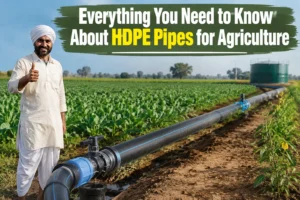

Why Choosing the Right Irrigation Pipe Can Change Your Farm
Irrigation Pipe is one of the most important parts of a modern farming system. A good pipe does more than carry water from a source to the field. It helps maintain proper water flow, reduce leakage, support efficient irrigation, and make daily farm operations easier.
Imagine a farmer who has invested in good seeds, fertilizers, machinery, and labor. The crop is growing well, but the irrigation line keeps leaking, joints become loose, or water pressure drops before reaching the far end of the field. The result can be uneven watering, wasted water, extra repair costs, and unnecessary stress.
This is why choosing the right pipe should not be based only on price. Farmers need to consider crop type, field size, water source, pressure, distance, soil conditions, irrigation method, and expected usage.
According to the FAO, agriculture accounts for more than 70% of global freshwater withdrawals, making efficient water management an important part of sustainable farming.
For farmers in and around Madhya Pradesh, selecting the right solution from a reliable HDPE Pipe Manufacturer in Indore, PVC Pipe Manufacturer in Indore, or trusted irrigation supplier can make a major difference in long-term performance.
What Is an Irrigation Pipe?
An irrigation pipe is a specially selected pipeline used to transport water from a source such as a borewell, open well, reservoir, tank, canal, or pump to agricultural land.
Depending on the farming requirement, pipes may be used for:
- Main water supply lines
- Sub-main lines
- Sprinkler systems
- Drip irrigation systems
- Pump discharge
- Water transfer between fields
- Borewell applications
- Temporary or permanent irrigation setups
The correct pipe allows water to move efficiently from the source to the required location. The wrong pipe can create pressure loss, leakage, frequent joint failures, or higher maintenance expenses.
That is why farmers should first understand their irrigation requirement before purchasing.
Types of Irrigation Pipe Commonly Used in Farming
There is no single pipe that is perfect for every farm. Different materials and designs are suitable for different applications.
HDPE Pipe for Agriculture
HDPE pipes are widely considered for agricultural water transportation because they offer flexibility, durability, and resistance to corrosion.
They can be useful where pipelines need to cover longer distances or where some flexibility is required during installation. Their relatively lightweight nature can also make handling easier compared with some rigid alternatives.
Farmers looking for durable water transportation can consult an HDPE pipe manufacturer in Indore to understand the right diameter, pressure class, and application.
PVC Pipe for Irrigation
PVC pipes are another popular option for agricultural and water-supply applications. They are lightweight, corrosion-resistant, and available in different sizes and specifications.
A reliable PVC pipe manufacturer in Indore can help buyers select suitable pipe dimensions according to their irrigation layout.
PVC can be especially useful in systems where rigid pipe installation is preferred and the operating conditions match the pipe’s specifications.
Sprinkler Irrigation Pipes
Sprinkler systems distribute water through sprinklers rather than allowing water to flow directly across the soil surface.
For farmers growing crops that benefit from controlled overhead irrigation, sprinkler pipelines can be an effective choice. The pipe size and pressure must match the sprinkler system because inadequate pressure can result in poor water distribution.
If you are planning a new system, speaking with an Irrigation Pipe Manufacturer in Indore or Sprinkler Pipe Manufacturer in Indore can help you understand the complete setup instead of purchasing pipes separately.
HDPE vs PVC: Which Is Better for Farming?
Both HDPE and PVC can be useful, but the better choice depends on your application.
| Factor | HDPE | PVC |
|---|---|---|
| Flexibility | High | Lower |
| Corrosion resistance | Excellent | Excellent |
| Handling | Relatively easy | Easy |
| Long-distance applications | Suitable | Suitable where properly designed |
| Impact resistance | Generally high | Depends on specification |
| Installation | Flexible installation options | Often suited to rigid layouts |
| Best selection method | Based on pressure and application | Based on pressure and application |
The important point is that farmers should not choose material only because one option is cheaper.
A better approach is to compare the pipe’s expected service life, operating pressure, installation conditions, maintenance requirements, and total project cost.
A professional Pipe Manufacturer in Indore can also help contractors and agricultural buyers determine whether HDPE or PVC is more appropriate for a particular project.
How to Choose the Best Irrigation Pipe for Farming
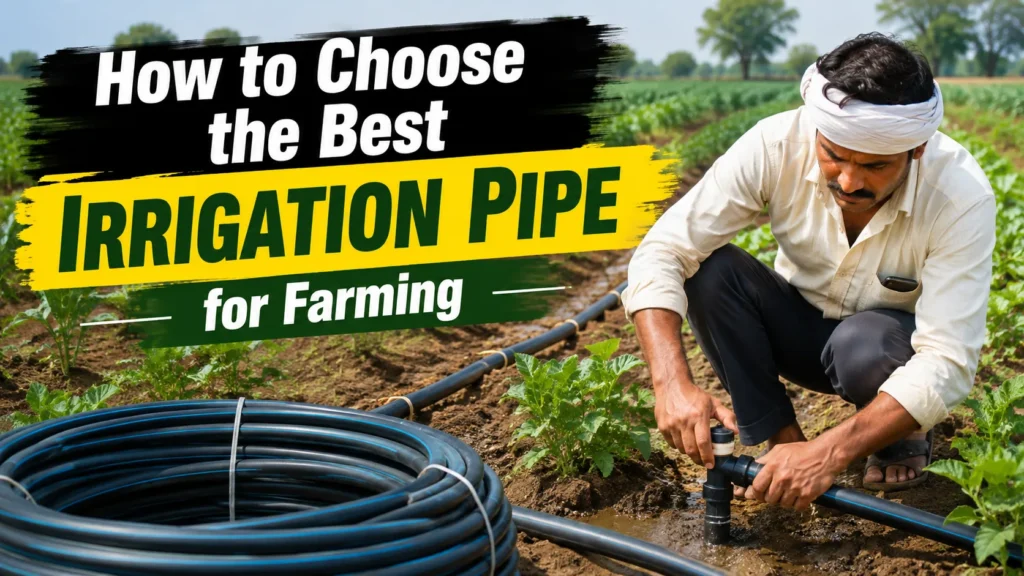
Before buying, follow a simple selection process.
Step 1: Identify Your Water Source
Start with the source.
Is your water coming from a borewell, open well, canal, reservoir, tank, or surface source?
A borewell connected to a pump may require different pressure and pipe specifications than a gravity-fed irrigation system.
Step 2: Measure the Distance
Next, determine the approximate distance between the water source and the field.
Longer pipelines can experience pressure loss. Therefore, simply selecting a small-diameter pipe because it costs less initially may not be the most economical decision.
Step 3: Check Pump Capacity
Your pipe should work properly with your pump.
Pump capacity, discharge, pressure, pipe diameter, elevation, and total pipeline length should be considered together.
For large agricultural projects, irrigation contractors should calculate the complete hydraulic requirement before finalizing the pipe.
Step 4: Consider the Irrigation Method
Your irrigation method also affects the pipe selection.
Drip irrigation, sprinkler irrigation, flood irrigation, and water-transfer applications have different requirements.
For sprinkler-based farming, working with Sprinkler pipe dealers near me can help farmers identify compatible pipes, fittings, and accessories.
Step 5: Select the Correct Diameter
Pipe diameter is not simply about choosing the largest available size.
A larger pipe may provide better flow under certain conditions, but the correct size depends on the required discharge, pressure, distance, pump, and system design.
For this reason, farmers should discuss the requirement with the manufacturer or technical supplier before purchasing large quantities.
Why Pipe Quality Matters in Agriculture
A low-cost pipe may look attractive when you compare prices, but farming is a long-term activity.
If a pipeline develops cracks, leaks, damaged joints, or pressure-related problems during the crop season, the repair can become more expensive than the original saving.
Good-quality pipes can help reduce unexpected maintenance when they are correctly selected, installed, and operated within their specifications.
This is particularly important for commercial farms, irrigation contractors, builders, and government infrastructure projects where reliability matters over a larger area.
When searching for a Pipe Supplier Near Me, buyers should check product specifications, availability, installation support, fittings, and after-sales assistance instead of comparing only the price per metre.
A Real Example: How Better Irrigation Can Improve Farm Management
Consider a farmer managing several acres of crops using traditional flood irrigation. Water is released into the field, but distribution is uneven. Some areas receive excess water while distant areas receive less.
Now imagine the same farmer shifting to a properly designed sprinkler system. Water can be distributed through controlled outlets, allowing the farmer to manage irrigation more systematically.
A government-reported PMKSY example from Barabanki, Uttar Pradesh, describes farmers Uma Shankar Verma and Subhash Verma moving from conventional flood irrigation to sprinkler irrigation in 2016. The government case study highlights improved resource efficiency and better agricultural performance following the change.
The lesson is simple: irrigation improvement is not only about installing a new pipe. The complete system must be designed around the crop, field, water source, pressure, and distribution method.
What Farmers Should Check Before Buying
Before placing an order, ask these practical questions:
What water source will the pipe connect to?
How far does the water need to travel?
What is the pump discharge and operating pressure?
Will the pipe be permanent or moved between fields?
Which irrigation method will be used?
What pipe diameter is required?
Which fittings and connectors are needed?
Does the supplier provide technical guidance?
These questions can prevent many common purchasing mistakes.
For example, someone searching for a HDPE Pipe Dealer Near Me may find several suppliers. However, the best supplier is not necessarily the one offering the lowest initial quote. Product quality, specifications, availability, and suitability for the application should also be checked.
Common Irrigation Pipe Buying Mistakes
Choosing Only on Price
The cheapest pipe may not always provide the lowest total cost.
A better comparison includes durability, maintenance, installation, fittings, expected service life, and performance.
Ignoring Water Pressure
Pressure is critical for sprinkler and pump-based systems. A pipe should be selected according to the working conditions rather than simply its appearance.
Buying the Wrong Diameter
An unsuitable diameter can affect water flow and system performance.
Always consider the complete pipeline instead of selecting the size independently.
Mixing Poor-Quality Fittings
Even a good-quality pipe can perform poorly if incompatible or low-quality fittings are used.
Joints, valves, connectors, bends, clamps, and other accessories should be suitable for the system.
Not Planning the Layout
Before purchasing hundreds of metres of pipe, create a basic field layout.
Mark the water source, pump, mainline, sub-main, irrigation sections, valves, and field boundaries.
This simple step can prevent unnecessary material purchases.
Irrigation Pipe Maintenance Tips for Farmers
Good maintenance can extend the useful life of an irrigation system.
Inspect the pipeline regularly for visible cracks, leakage, damaged joints, and unusual pressure changes. Clean filters and irrigation components according to the system requirements.
If the pipeline is moved frequently, avoid dragging it over sharp stones or rough surfaces when the pipe specification does not support such handling.
Before storing seasonal equipment, clean and inspect the pipes. Keep them away from unnecessary mechanical damage and follow the manufacturer’s storage recommendations.
Farmers can also maintain a simple record of repairs. If the same joint or section repeatedly fails, replacing the affected component may be more economical than repeatedly repairing it.
Where to Find Irrigation Pipes and Related Products in Indore
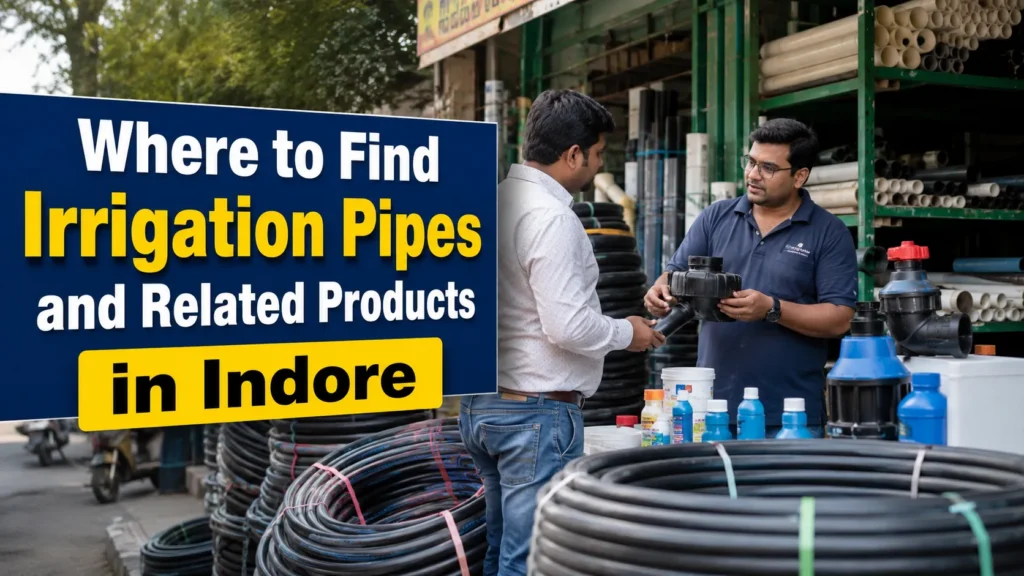
Farmers and contractors often search online using phrases such as Sprinkler irrigation pipe dealer in Indore, Sprinkler system dealer in Indore, or High density pipe dealer in Indore when planning agricultural irrigation projects.
Different buyers have different requirements. A farmer may need a complete field irrigation solution, while a contractor may need bulk quantities for a larger project.
Similarly, people looking for Suction pipe delear in indore may require pipes for pump suction applications rather than field distribution.
For general water-handling requirements, searches such as Pipe hose shop near me and Garden pipe dealer near me may also lead buyers toward local suppliers.
For larger agricultural and infrastructure projects, working directly with a manufacturer or established supplier can make product selection and bulk procurement easier.
Businesses searching for a Plastic pipe manufacturer in indore or Plastic pipe dealer in indore should compare product specifications and application suitability before making a final decision.
For borewell-related requirements, farmers may also search for a Best column pipe dealer in indore. The right selection should depend on borewell depth, pump setup, pipe specifications, and project requirements.
Irrigation Trends Farmers Should Watch
Agriculture is increasingly moving toward better water management rather than simply using more water.
India’s Economic Survey 2024–25 reported that irrigation coverage increased from 49.3% of gross cropped area in FY16 to 55% in FY21, while irrigation intensity increased from 144.2% to 154.5%. The government has also continued promoting water-efficiency measures through initiatives such as Per Drop More Crop.
More recently, the Government of India reported that more than 110.92 lakh hectares had been brought under micro-irrigation through the Per Drop More Crop scheme since its inception.
These developments point toward a clear direction: farmers and agricultural businesses are paying greater attention to efficient irrigation, better water distribution, and modern irrigation infrastructure.
This makes reliable pipes, fittings, sprinklers, valves, and properly designed irrigation networks increasingly important.
Quick Irrigation Pipe Buying Checklist
Before purchasing, keep this checklist ready:
- Identify the water source.
- Measure pipeline distance.
- Check pump discharge and pressure.
- Decide between HDPE, PVC, or another suitable solution.
- Select the correct diameter.
- Consider the irrigation method.
- Check pipe specifications and quality.
- Purchase compatible fittings.
- Plan the field layout.
- Compare total project cost, not only pipe price.
- Choose a reliable supplier.
- Ask about technical support and product availability.
How to Select the Right Pipe Supplier
Choosing the right supplier is almost as important as selecting the right material.
A dependable supplier should understand agricultural applications and provide clear information about pipe size, pressure rating, fittings, installation requirements, and product specifications.
If you are a farmer, ask whether the supplier can help with your actual field requirement. If you are a dealer or distributor, check consistency of supply and product range. Civil and irrigation contractors should also consider bulk availability and technical coordination.
For businesses looking for the Best Pipe Manufacturer in Indore, the decision should be based on product quality, manufacturing standards, application knowledge, supply capability, and customer support.
Why Vishal Pipe Can Be a Practical Choice for Your Irrigation Needs
Choosing an irrigation solution is an investment in your farm’s water management system.
At Vishal Pipe, the focus should be on helping customers identify the right pipe solution for agricultural, irrigation, construction, and water-supply requirements rather than treating every project in the same way.
Whether you are a farmer planning a new irrigation line, a dealer looking for dependable products, an irrigation contractor handling a large project, or a construction company requiring water-management solutions, the right pipe should be selected according to actual application requirements.
A quality-focused approach can help you avoid unnecessary replacements and create a more dependable irrigation network.
Frequently Asked Questions
Which pipe is best for agricultural irrigation?
There is no universal answer. HDPE and PVC are both commonly considered for agricultural applications. The right choice depends on water pressure, distance, irrigation method, field conditions, installation requirements, and budget.
Is HDPE better than PVC for farming?
HDPE can be advantageous where flexibility, impact resistance, and long-distance water transportation are important. PVC can be suitable for rigid pipeline systems. The final decision should be based on the project’s technical requirements.
What size pipe is best for irrigation?
Pipe size depends on required water flow, pump capacity, pipeline length, pressure, elevation, and irrigation equipment. Instead of choosing a size based only on price, get the system requirement evaluated.
Can the same pipe be used for sprinkler irrigation?
A pipe can be used for sprinkler irrigation when its specifications are suitable for the system’s required pressure and flow. The sprinkler network should be designed as a complete system.
How do I find a reliable irrigation pipe supplier in Indore?
Compare manufacturers and suppliers based on product quality, specifications, availability, technical guidance, fittings, and customer support. Searching for terms such as HDPE Pipe Supplier in Indore, PVC Pipe Supplier in Indore, or Irrigation Pipe Manufacturer in Indore can help you discover relevant local options.
Is irrigation pipe important for water conservation?
Yes. A properly designed irrigation network can help manage water distribution more effectively. However, the pipe alone does not guarantee water savings. Pump selection, irrigation method, scheduling, pressure management, field design, and maintenance also matter.
Final Word: Choose the Pipe According to Your Farm
The best irrigation system is not necessarily the one with the most expensive pipe. It is the one designed around your actual farming requirement.
Before buying, understand your water source, pump, field size, distance, pressure, crop, irrigation method, and future expansion plans. Then compare suitable HDPE, PVC, sprinkler, or other pipe solutions.
For farmers, dealers, irrigation contractors, builders, and infrastructure projects in Indore, choosing the right manufacturer and supplier can make procurement easier and help create a dependable water-management system.
If you are planning a new farm irrigation project or replacing an existing pipeline, speak with a trusted pipe manufacturer or supplier before placing your order. Contact Vishal Pipe to discuss your irrigation, agricultural, water-supply, or project requirements and find a suitable pipe solution for your application.