Agricultural Spray Pipe: What Farmers Should Know Before Buying
When a farmer purchases fertilizer or crop-protection products, the product itself is only one part of the application process. The equipment used to carry and apply the liquid also needs attention. A suitable spraying arrangement depends on the pump, connections, application equipment and the pipe selected for the job.
This is where an agricultural spray pipe becomes important.
In Madhya Pradesh, farming requirements vary from one field to another. A farmer cultivating soybean around Indore may have different spraying requirements from someone managing vegetables, horticultural crops or a nursery. The spraying equipment used, the liquid being applied and the field conditions all influence the choice of pipe.
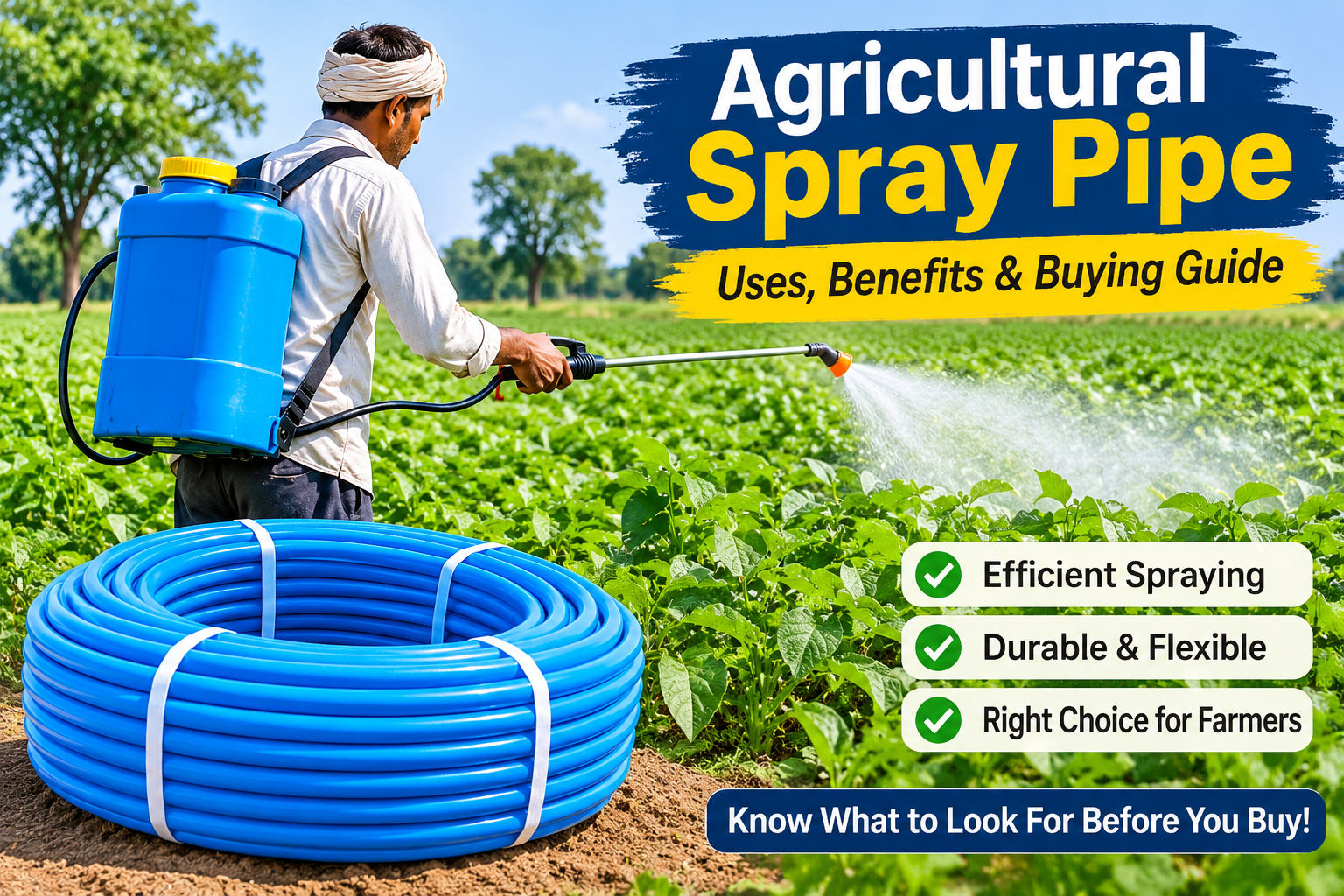
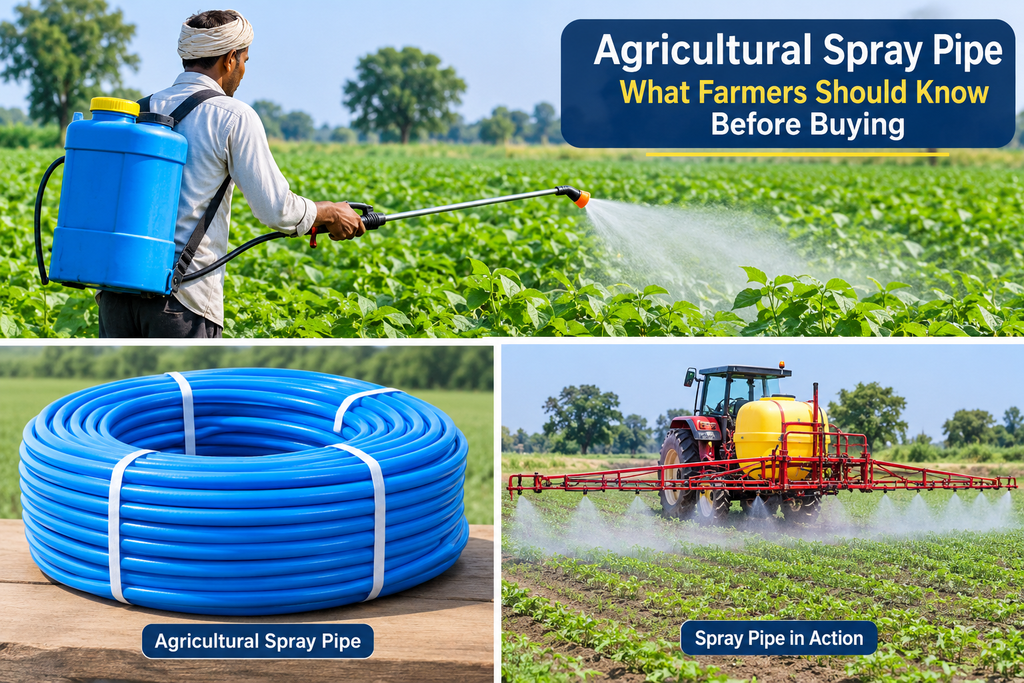
An agricultural spray pipe is a specialized pipe used as part of compatible agricultural spraying equipment. It carries suitable liquid from the supply arrangement towards the spraying outlet. Depending on the product specification and application, it may be used for fertilizer and pesticide spraying.
It should not be confused with a sprinkler pipe, drip irrigation pipe or ordinary water-supply pipe. These products serve different purposes and should be selected accordingly.
At Vishal Pipes and Fittings, an Indore-based pipe manufacturer, the Spray Pipe product is listed as a special-purpose MDPE pipe for agricultural spraying. Its product information describes a blue, flexible pipe with different internal diameter options.
For farmers, dealers and agricultural buyers, the important question is not simply which pipe is available. It is whether the pipe’s material, diameter, pressure specification and connections match the intended application.
This guide explains what an agricultural spray pipe does, where it is used, what to check before purchasing and how to choose a suitable manufacturer in Madhya Pradesh.
1. What Is an Agricultural Spray Pipe?
An agricultural spray pipe is a specialised pipe used in a compatible spraying arrangement to carry agricultural liquids towards the application equipment.
It forms one part of a larger system. Depending on the arrangement, the complete setup may include:
- A liquid storage tank or supply container.
- A compatible pump or spraying machine.
- A spray pipe.
- Suitable connectors and fittings.
- A spraying outlet or nozzle.
- Equipment controls and safety components.
The pump moves the liquid through the connected pipe. The liquid then reaches the spraying outlet, where it is applied according to the equipment’s design and the product instructions.
The pipe itself does not determine the correct spray pattern, application rate or chemical dosage. These depend on the complete equipment, the liquid formulation and the application method.
What Is the Difference Between a Spray Pipe and an Irrigation Pipe?
The terms agricultural pipe, irrigation pipe and spray pipe are sometimes used interchangeably in local markets. However, their applications can be quite different.
| Pipe type | Main purpose |
| Agricultural spray pipe | Carries suitable liquids in agricultural spraying equipment |
| HDPE pipe | Used for water conveyance and other specified applications |
| MDPE pressure pipe | Used for applications according to its material and pressure specification |
| Sprinkler pipe | Supplies water to a sprinkler irrigation system |
| Drip irrigation pipe | Delivers water through emitters near plants |
| Layflat pipe | Used for suitable water-transfer and irrigation arrangements |
| Suction hose | Used in compatible pumping arrangements to draw or transfer water |
For example, a farmer planning sprinkler irrigation needs a pipe suitable for water flow and the pressure requirements of the sprinkler system. A farmer looking for a fertiliser spray pipe needs to check the compatibility of the pipe with the spraying equipment and liquid.
A spray pipe should not automatically be substituted for an ordinary irrigation pipe, and an irrigation pipe should not be assumed suitable for chemical spraying.
Farmers comparing different products can explore the Vishal Pipe agricultural product range.
2. How Does an Agricultural Spray Pipe Work?
The working arrangement depends on the type of spraying machine and the equipment connected to it.
In a typical setup, agricultural liquid is placed in a suitable tank or supplied from a compatible source. A pump moves the liquid into the connected pipe. The pipe carries it towards the spraying outlet, where the equipment distributes the liquid over the intended area.
The basic process involves:
- Preparing the agricultural liquid according to its product label and approved instructions.
- Supplying the liquid to compatible spraying equipment.
- Connecting the spray pipe using suitable fittings.
- Operating the pump within the equipment’s specified limits.
- Moving the liquid through the pipe towards the application outlet.
- Applying the liquid according to the product instructions and recommended safety precautions.
The arrangement may differ depending on the spraying machine.
Why Does the Pipe Need to Match the Equipment?
A pipe that looks suitable may still be inappropriate for a particular spraying machine.
The internal diameter, pressure specification, fittings and material all need to match the equipment and application.
Before purchasing, confirm:
- Required internal diameter.
- Recommended working pressure.
- Pipe material.
- Chemical compatibility.
- Connector dimensions.
- Temperature limitations.
- Manufacturer’s handling instructions.
For pesticide and fertiliser applications, chemical compatibility is especially important. The suitability of a pipe depends on the actual formulation, concentration, temperature and exposure conditions.
Do not assume that every MDPE pipe is compatible with every agricultural chemical.
3. Major Uses of Agricultural Spray Pipes in Farming
Farmers use spraying equipment for different crop-management activities. The actual application depends on the crop, agricultural input, equipment and recommended method.
A suitable spray pipe may form part of the following arrangements when its specifications match the intended use.
A. Fertiliser Spraying
Fertiliser application is an important part of crop management. Some fertilizer products are applied through suitable spraying equipment, depending on their formulation and the recommended method of application.
In these arrangements, the spray pipe carries the prepared liquid towards the application outlet.
Farmers should check the fertilizer manufacturer’s instructions and confirm that the pipe material is compatible with the product.
A pipe should not be selected only because it is described as a fertilizer spray pipe. The specific formulation and equipment requirements still matter.
B. Pesticide Application
Pesticides are used to manage particular pests and crop diseases when treatment is appropriate.
A compatible agricultural spray pipe may form part of the spraying equipment used to carry the pesticide mixture towards the outlet.
The pipe must be suitable for the formulation being handled. Farmers should follow the pesticide label, equipment instructions and applicable safety requirements.
Avoid changing the chemical mixture or using an unverified pipe arrangement simply because it appears convenient.
C. Vegetable Farming
Vegetable crops such as tomato, chilli, brinjal and cabbage may require different crop-protection applications during their growing cycle.
The spraying arrangement should suit the crop structure, equipment and application requirement.
A suitable pipe can help connect the liquid supply to the spraying equipment, but it does not determine the correct dosage or treatment schedule.
Those decisions should follow the product label and qualified agricultural advice.
D. Horticulture and Fruit Cultivation
Fruit crops and horticultural plantations may have different canopy structures, plant spacing and equipment requirements.
The pipe selected for a spraying arrangement should be compatible with the equipment and the liquid being applied.
Farmers should consider the pipe route, connection points and handling requirements before purchasing.
E. Nursery Applications
Nurseries often have plants arranged in compact rows or sections. https://vishalpipe.com/our-products/Spraying equipment may need to be moved around these areas.
A suitable flexible pipe can form part of a compatible setup, provided the equipment and liquid requirements are met.
F. Other Agricultural Liquid-Handling Requirements
Some farms use specialised arrangements for transferring agricultural liquids between compatible tanks and equipment.
However, a spray pipe should not be treated as a universal chemical-transfer hose. Confirm its intended application with the manufacturer before using it for a different purpose.
4. Benefits of Choosing a Suitable Agricultural Spray Pipe
The usefulness of an agricultural spray pipe depends on its construction, compatibility and correct use.
When selected for the intended application, it can offer practical advantages.
Flexible Handling
Agricultural spraying equipment may need to be moved around crop rows and different field sections.
A flexible pipe can make positioning and handling easier than a rigid pipeline arrangement, depending on its construction and the equipment.
Farmers should still avoid sharp bends, twisting and dragging the pipe over rough surfaces.
Supports the Spraying Arrangement
The pipe provides a liquid-carrying connection between compatible equipment and the application outlet.
Its role is important, but the overall spraying performance also depends on the pump, nozzle, pressure, liquid formulation and equipment condition.
Easier Movement Around the Field
An appropriately selected flexible pipe can be easier to position during field operations.
Its handling characteristics should be checked against the actual working environment, especially where rough ground, crop residue or machinery movement is involved.
Suitable for a Specific Agricultural Application
A dedicated agricultural spray pipe is intended for a particular type of spraying application.
This is useful because farmers can select a product based on its stated purpose rather than assuming that every agricultural pipe performs the same function.
Compatible Equipment Connections
When the pipe diameter and fittings match the spraying equipment, the connection can be made according to the manufacturer’s instructions.
Correct connections help reduce avoidable leakage and interruptions.
Easier Visual Inspection
A flexible pipe can be inspected along its length for visible cuts, cracks, deformation and other signs of damage.
Regular inspection helps identify problems before the next spraying operation.
The right spray pipe is not necessarily the largest or the most expensive one. It is the product that matches the actual application and equipment specifications.
5. Understanding Vishal Spray Pipe Specifications
Before purchasing an agricultural spray pipe, understand the product information published by the manufacturer.
Vishal Pipe’s product page identifies its Spray Pipe as a blue, special-purpose MDPE pipe for fertilizer spraying. The product information lists the following specifications:
| Specification | Published information |
| Product | Vishal Spray Pipe |
| Material | MDPE |
| Colour | Blue |
| Internal diameter | 8 mm, 10 mm and 12 mm on the website |
| Pressure rating | 16 kg to 25 kg as displayed |
| Temperature range | -40°C to +60°C as displayed |
| Listed features | Leak proof, affordable, flexible, durable, robust and internally abrasion resistant |
| Application | Fertilizer spray pipe |
Important specification note: The downloadable product catalogue lists 8 mm and 10 mm internal diameter options, while the current website also lists 12 mm. The pressure rating is displayed as 16–25 kg without an explicitly stated unit. Confirm the current size availability, pressure-rating unit and recommended working pressure directly with Vishal Pipe before ordering.

What Does Internal Diameter Mean?
Internal diameter refers to the measurement across the inside of a pipe.
It affects the available space for liquid movement and is one of the specifications used when matching a pipe to equipment.
An 8 mm internal diameter and a 10 mm internal diameter do not provide identical flow conditions under otherwise similar circumstances.
However, a larger diameter is not automatically the right choice.
The correct option depends on:
- Spraying equipment requirements.
- Required flow.
- Operating pressure.
- Pipeline length.
- Connector dimensions.
- Manufacturer’s recommendations.
Why Is Pressure Rating Important?
Pressure rating indicates the pressure conditions for which a product is specified.
A pipe should not be selected by looking only at the highest number shown in a product listing.
The pump, pipe, fittings and connected components should all be suitable for the actual operating conditions.
Ask the manufacturer to confirm the pressure unit, recommended working pressure and relevant testing information.
What Is MDPE?
MDPE stands for Medium Density Polyethylene.
It is a polyethylene material used in different piping applications. Its suitability for a particular job depends on the material formulation, product construction and intended operating conditions.
The term MDPE alone does not guarantee compatibility with every fertiliser or pesticide.
For more information about Vishal Pipe and its product range, visit About Vishal Pipes and Fittings.
6. How to Choose the Right Agricultural Spray Pipe
Choosing a spray pipe should begin with the equipment and application, not just the price.
Before placing an order, farmers and dealers should consider the following points.
1. Identify the Intended Application
First, identify what the pipe will carry.
Is it required for fertiliser spraying, pesticide application or another specific operation?
The answer helps determine which material and compatibility details need to be checked.
2. Confirm the Required Internal Diameter
Ask the equipment supplier or manufacturer which internal diameter is suitable.
Compare that requirement with the pipe’s actual internal diameter and connector dimensions.
Do not choose a size only because it is readily available in the market.
3. Check the Operating Pressure
Find out the operating pressure specified for the spraying equipment.
The selected pipe and all connecting components should be suitable for the system’s working conditions.
If the pressure rating is written without a clear unit, request written clarification before ordering.
4. Verify Chemical Compatibility
This is one of the most important checks for agricultural spraying.
Compatibility depends on the exact chemical formulation, concentration, temperature and exposure conditions.
Ask the manufacturer whether the pipe is suitable for the specific product you intend to use.
Do not assume that a general polyethylene material description confirms suitability for every agricultural chemical.
5. Examine the Pipe
Before purchasing, check the product’s visible condition.
Look for:
- Cracks or cuts.
- Uneven or damaged sections.
- Deformation.
- Product identification.
- Correct dimensions.
- Coil condition.
- Manufacturer information.
For larger purchases, ask for the available technical specification and relevant quality documentation.
6. Check the Connectors
The connector should match the pipe and spraying equipment.
An unsuitable fitting can create leakage or connection problems even when the pipe itself is appropriate.
Do not force an incompatible connector onto a pipe.
7. Consider Field Conditions
Think about how the pipe will be handled.
Will it be moved frequently? Will it pass over rough ground? Will it be stored after each use? Will tractors or other machinery operate near it?
These conditions affect the care and protection required during use.
8. Confirm Availability and Order Details
Before placing a bulk order, confirm:
- Available internal diameters.
- Coil length.
- Quantity.
- Current product specifications.
- Delivery arrangements.
- Compatible fittings, if required.
Farmers searching for local pipe dealers should check whether the seller actually stocks the required spray-pipe category. A dealer selling HDPE water pipes may not necessarily stock a dedicated MDPE spray pipe.
7. Agricultural Spray Pipe vs HDPE Pipe vs Sprinkler Pipe
The terms HDPE, MDPE and agricultural pipe are often used in the same buying conversation. But the products should be selected according to their intended applications.
| Comparison | Agricultural Spray Pipe | HDPE Water Pipe | Sprinkler Pipe |
| Main application | Agricultural liquid spraying | Water conveyance and specified uses | Sprinkler irrigation |
| Material | Vishal Spray Pipe is listed as MDPE | High-density polyethylene | Product-specific, commonly HDPE |
| Main selection factors | Liquid compatibility, diameter and equipment | Flow, pressure, dimensions and application | Water flow, pressure and sprinkler layout |
| Connections | Compatible spraying equipment | Suitable water-pipe fittings | Sprinkler-system fittings |
| Intended use | Spraying arrangements | Water supply and irrigation applications | Pressurised water distribution |
Vishal Pipe lists Spray Pipe, HDPE Pipe and Sprinkler Pipe as separate product categories. This distinction is useful for buyers because each product has a different intended purpose.
Farmers planning a water-conveyance or sprinkler project should review the relevant specifications rather than selecting a spray pipe for an unrelated application.
Explore the Vishal Pipe product range to compare the available categories.
8. Installation and Handling: Practical Checks for Farmers
The correct installation method depends on the spraying equipment. Always follow the equipment manufacturer’s instructions.
The following checks can help prevent avoidable handling and connection problems.
Inspect Before Installation
Uncoil the pipe carefully and inspect its visible condition.
Look for cracks, cuts, deformation or damage caused during transport and storage.
Do not use a pipe that appears damaged or has an uncertain chemical-exposure history.
Confirm the Connections
Check that the connector dimensions and connection type match the pipe and equipment.
Avoid improvised connections that may leak or compromise the system.
Follow Pressure Limits
Confirm the recommended operating pressure for the complete arrangement.
Do not operate the pump beyond the specified limits of the pipe, fittings or spraying equipment.
Position the Pipe Carefully
Avoid twisting, unnecessary pulling and sharp bends.
Keep it away from cutting tools, sharp stones and moving machinery.
If farm vehicles regularly pass through the working area, position the pipe to reduce the risk of accidental crushing.
Inspect the Connected System
Before spraying, check the visible connections and pipe condition according to the equipment instructions.
If a leak or damage is found, stop the equipment safely and follow the prescribed procedure before making any correction.
Follow Chemical Safety Instructions
Use agricultural chemicals only according to their labels and applicable safety instructions.
Wear the recommended protective equipment. Avoid directing spray towards people, animals, water sources or unintended areas.
9. Common Spray Pipe Problems and What to Check
A suitable pipe still needs correct handling and inspection.
Here are some issues farmers may encounter.
Leakage Near a Connector
A leak around a connection may indicate an unsuitable fitting, damaged component or incorrect installation.
Stop the equipment safely, relieve pressure according to the manufacturer’s instructions and inspect the connection. Replace damaged parts with compatible components.
Visible Cracks or Cuts
Physical damage may occur if a pipe is dragged over sharp surfaces or handled roughly.
Inspect the damaged area and do not continue using a pipe that is no longer suitable for its intended pressure or liquid application.
Kinking During Operation
A sharp bend or twisted section may interfere with liquid movement.
Stop the equipment safely and reposition the pipe without forcing it into a tight bend. Follow the manufacturer’s bend-radius recommendations if provided.
Connector Does Not Fit
Different pipe sizes and equipment may require different connectors.
Confirm the actual dimensions and connector specification before purchasing replacement fittings.
Uncertain Chemical Compatibility
A pipe previously used with one liquid may not be suitable for another.
Ask the manufacturer before changing the liquid being carried. Do not assume that general material compatibility applies to every formulation.
Damage During Storage
Poor storage can expose a pipe to unnecessary physical damage.
Clean and store the pipe according to the manufacturer’s instructions, and inspect it before its next use.
Do not use ordinary adhesive tape or improvised sealing materials to repair a damaged pressure-carrying pipe. Replace or repair it only through an approved method.
10. Spray Pipe Maintenance: What Should Farmers Do?
Regular inspection helps identify visible problems before the next spraying operation.
Clean According to the Manufacturer’s Instructions
After use, follow the chemical label and equipment manufacturer’s cleaning instructions.
The cleaning method must be suitable for the pipe material and the liquid previously carried.
Do not mix cleaning agents or agricultural chemicals without appropriate guidance.
Inspect the Pipe Regularly
Check for cracks, cuts, loose fittings, deformation and visible deterioration.
Pay particular attention to the sections near connectors because they may experience repeated handling stress.
Avoid Rough Handling
Do not drag the pipe carelessly over sharp surfaces.
Lift or reposition it when necessary to reduce contact with stones, crop residue and other damaging objects.
Store It Properly
Keep the pipe in a clean and suitable storage area.
Avoid unnecessary exposure to damaging conditions and follow the product’s storage recommendations.
Keep a Record of Previous Use
Where a pipe is used in different agricultural operations, maintain a record of the liquid previously carried.
This can help prevent accidental use with an incompatible formulation.
Replace Damaged Components
Replace damaged connectors, fittings or pipe sections with compatible components.
A repair should not compromise the pressure rating or chemical suitability of the complete arrangement.
11. How to Find Reliable Spray Pipe Manufacturers in Madhya Pradesh
Farmers and dealers searching for spray pipe manufacturers in Madhya Pradesh should compare more than the price quoted per coil.
A suitable supplier should be able to explain the product’s intended application and provide clear specifications.
Check the Product Category
Confirm whether the supplier offers a dedicated agricultural spray pipe or only general-purpose water pipes.
Ask whether the product is intended for fertilizer spraying, pesticide application or another use.
Ask for Current Specifications
Request the actual internal diameter, pressure rating, material details and available coil length.
If a specification is unclear, ask the manufacturer to explain it before purchasing.
Verify the Manufacturer
Check the company’s official website, business information, product catalogue and contact details.
A reliable product enquiry should lead to clear information rather than unsupported marketing claims.
Compare Available Sizes
Confirm that the required diameter is currently available.
If your spraying equipment needs a specific size, verify it before placing a bulk order.
Ask About Product Documentation
Where available, request relevant technical specifications, quality documentation and product identification details.
Avoid relying on broad claims such as guaranteed chemical resistance or a fixed service life unless the manufacturer provides supporting evidence.
Consider Local Communication and Supply
Farmers and dealers in Indore, Dewas, Ujjain, Dhar, Mhow and other parts of Madhya Pradesh may prefer to speak with a manufacturer or supplier who can clarify product availability and dispatch arrangements.
However, location should not be the only selection factor. The product must still match the application.
12. Why Consider Vishal Pipes and Fittings for Agricultural Piping?
Vishal Pipes and Fittings is based in Indore, Madhya Pradesh, and offers a range of industrial and agricultural piping products.
The company’s About Us page states that it was established in 1969. Its listed product range includes HDPE, sprinkler, drip, MDPE and PVC pipes.
The company’s Spray Pipe is listed separately as a special-purpose MDPE product for fertilizer spraying.
For a farmer or dealer, this product distinction is important. Someone looking for a dedicated spray pipe should not automatically be directed towards a sprinkler pipe or a general water-supply pipe.
Start With the Actual Application
A useful product enquiry should begin with the intended use.
For example, a buyer looking for an agricultural spray pipe should be ready to explain:
- Whether the pipe is required for fertilizer or pesticide spraying.
- Which spraying equipment will be connected.
- Which internal diameter is required.
- What operating pressure the equipment uses.
- Which liquid formulation will be carried.
- What quantity and coil length are needed.
This information helps the manufacturer clarify the relevant specifications before an order is placed.
Explore Vishal Pipe’s Agricultural Products
Farmers, dealers and contractors can explore the Vishal Pipe website for information about its product categories.
For product comparisons, visit Vishal Pipe – Our Products.
To understand the company’s background and manufacturing activities, read About Vishal Pipes and Fittings.
For product enquiries, contact the company through its official contact page.
13. A Manufacturer’s Perspective: Questions We Would Clarify Before an Order
When a farmer or dealer approaches a pipe manufacturer, the first conversation should be about the application.
A request such as “I need an 8 mm spray pipe” provides a starting point, but it does not tell the manufacturer everything needed to confirm suitability.
Before finalizing the product, the buyer and manufacturer should clarify the equipment, liquid and operating conditions.
For example, a dealer in Indore may contact a manufacturer for spray pipes requested by a farming customer. Before confirming the order, the dealer should check:
- Is the product required for fertiliser spraying or another application?
- What internal diameter does the equipment require?
- What is the recommended working pressure?
- Which connector will be used?
- Is the intended liquid compatible with the pipe?
- What coil length and quantity are required?
These questions help prevent a common purchasing mistake: ordering a product based on a name or size without confirming whether it matches the actual equipment.
1. Manufacturer Inspection Record – Vishal Spray Pipe
| Inspection Details | Sample Information |
| Product Inspected | Vishal Spray Pipe |
| Inspection Date | 12 November 2026 |
| Product Category | Agricultural Spray Pipe |
| Internal Diameter Checked | 32 mm (Illustrative) |
| Inspection Carried Out By | Quality Control Team, Vishal Pipe |
| Inspection Method | Internal diameter measurement using Vernier Caliper |
| Surface Inspection | Visual inspection of inner and outer pipe surfaces |
| Observation | Pipe surface appeared smooth, with no visible cracks or major surface irregularities |
| Measurement Result | Actual measured reading to be recorded |
| Photographic Evidence | Original factory inspection photographs |
2. Real Farmer or Dealer Feedback
| Feedback Details | Sample Information |
| Customer Type | Farmer |
| Location | Indore, Madhya Pradesh |
| Application | Agricultural water distribution |
| Equipment Used | Water Pump |
| Pipe Product | Vishal Spray Pipe |
| Pipe Specification | 32 mm (Illustrative; verify actual size) |
| Installation Experience | Record actual customer feedback |
| Handling Experience | Record actual customer feedback |
| Water Distribution Observation | Record actual field observation |
| Customer Feedback | Add the farmer’s original words |
| Photographic Evidence | Original farm photograph with customer consent |
3. Evidence Vishal Pipe Should Maintain
| Evidence Type | What to Include |
| Product Photograph | Actual Vishal Spray Pipe |
| Measurement Photograph | Pipe diameter being measured |
| Inspection Photograph | Employee conducting inspection |
| Factory Photograph | Actual manufacturing or inspection area |
| Field Photograph | Indian farmer using the pipe |
| Customer Confirmation | Permission-based genuine feedback |
14. Common Buying Mistakes to Avoid
Before purchasing an agricultural spray pipe, avoid these mistakes:
Buying only on price: A low quotation does not confirm that the pipe is suitable for the equipment.
Ignoring internal diameter: The selected diameter should match the equipment’s requirements.
Assuming every MDPE pipe is chemically compatible: Confirm suitability for the actual fertiliser or pesticide formulation.
Ignoring pressure specifications: Check the pressure rating and unit for the pipe and connected components.
Confusing spray pipes with sprinkler pipes: They serve different applications.
Not checking connectors: An incompatible fitting can create leakage or connection problems.
Neglecting storage: Rough handling and poor storage can damage a flexible pipe.
Not requesting product details: Ask for current specifications before placing a bulk order.
15. Frequently Asked Questions About Agricultural Spray Pipes
1. What is an agricultural spray pipe used for?
An agricultural spray pipe is a liquid-carrying component used in compatible agricultural spraying equipment. It may be used for fertiliser and pesticide spraying where the pipe material and equipment are suitable for the application.
2. What is the difference between a spray pipe and a sprinkler pipe?
A spray pipe used for agricultural liquid application carries suitable liquid through spraying equipment. A sprinkler pipe supplies water to a sprinkler irrigation system. Their intended applications and connections are different.
3. What material is used in Vishal Spray Pipe?
Vishal Pipe’s product information identifies its Spray Pipe as a special-purpose MDPE pipe. Buyers should refer to the current product specification for details.
4. What sizes are available in Vishal Spray Pipe?
The current product page lists 8 mm, 10 mm and 12 mm internal diameter options. The downloadable catalogue lists 8 mm and 10 mm. Confirm current availability directly with the company.
5. What is the pressure rating of Vishal Spray Pipe?
The published product information displays a pressure rating of 16 kg to 25 kg. Since the unit is not explicitly clarified, buyers should request written confirmation of the pressure unit and recommended working pressure.
6. Can an agricultural spray pipe be used for pesticide spraying?
It may be suitable where the pipe material and equipment are compatible with the pesticide formulation. Confirm compatibility with the manufacturer and follow the pesticide label and equipment instructions.
7. Can fertiliser be carried through an agricultural spray pipe?
Vishal Pipe lists its Spray Pipe for fertilizer spraying. However, suitability should be confirmed for the particular fertilizer formulation, concentration and operating conditions.
8. How do I select the correct spray pipe diameter?
Check the internal diameter required by the spraying equipment, the required flow and pressure, and the manufacturer’s specifications. Do not select a size based only on appearance.
9. How can I find spray pipe manufacturers in Madhya Pradesh?
Compare agricultural pipe manufacturers in Madhya Pradesh based on their product range, material specifications, available sizes, business information and technical support. You can contact Indore-based Vishal Pipes and Fittings for information about its Spray Pipe.
10. Where can I find HDPE pipe dealers near me?
Search for local HDPE pipe dealers and verify that they stock the product you need. Remember that HDPE water pipes and MDPE agricultural spray pipes may serve different purposes.
11. How should agricultural spray pipes be maintained?
Inspect the pipe regularly, clean it according to the manufacturer’s and chemical-label instructions, avoid sharp bends and rough handling, and store it appropriately. Replace damaged sections and incompatible fittings.
12. Is a spray pipe the same as a pesticide sprayer hose?
The terms may be used differently by suppliers. Check the product’s construction, material, dimensions, pressure rating and intended application before purchasing.
13. Why should farmers contact a manufacturer before buying?
A manufacturer can clarify available specifications, product applications, size options and compatibility information. This helps buyers avoid selecting a pipe that does not match their equipment.
Conclusion: Choose a Spray Pipe According to Your Farm’s Requirements
Agricultural spraying requires suitable equipment, careful handling and the right product specifications.
An agricultural spray pipe should be selected according to the liquid being carried, the spraying equipment, internal diameter, pressure requirements and material compatibility.
For farmers and dealers, the best starting point is to understand the actual application before comparing prices. A dedicated fertilizer spray pipe should not be confused with a sprinkler pipe or an ordinary water-supply pipe.
If you are searching for spray pipe manufacturers in Madhya Pradesh, comparing pipe manufacturers in Madhya Pradesh or looking for an irrigation pipe manufacturer in Indore, take time to review the product specifications and discuss your requirements with the manufacturer.
Vishal Pipes and Fittings, based in Indore, offers a range of agricultural and industrial piping products, including its dedicated Spray Pipe category.
Before placing an order, share your equipment requirements, confirm the available size and pressure details, and ask about compatibility with the intended agricultural liquid.
The right agricultural pipe is the one that suits the work it is meant to do.
To explore the available products or discuss your requirements, visit Vishal Pipes and Fittings or use the official contact page.
About the Author
Komal Parmar | Agricultural & Piping Content Writer
Komal Parmar writes about agricultural piping, HDPE and MDPE pipes, irrigation systems, pipe fittings and water-management solutions. Her content is intended to help farmers, dealers, contractors and agricultural buyers understand product applications and make informed purchasing decisions.
Last reviewed: November,2026