When the Right Pipe Makes All the Difference
Imagine a farmer standing in his field early in the morning. The pump is running, but water is not reaching the far end of the field with enough pressure. A small leakage has developed near one joint, and a section of the old pipeline has become difficult to handle.Now imagine the same situation in a house or a construction project. A leaking water line can damage walls, waste water and create unnecessary repair costs.This is why choosing the right PVC Pipes is not simply about finding an affordable pipe. It is about selecting a piping solution that matches the pressure, water flow, installation conditions and purpose of the project.
For farmers, builders, contractors, dealers and infrastructure teams, the right piping system can make water movement easier, reduce maintenance problems and improve long-term reliability.
If you are looking for an HDPE Pipe Manufacturer in Indore, PVC Pipe Manufacturer in Indore, or a reliable Pipe Manufacturer in Indore, understanding the basic differences between pipe materials and applications is an important first step.
What Are PVC Pipes?
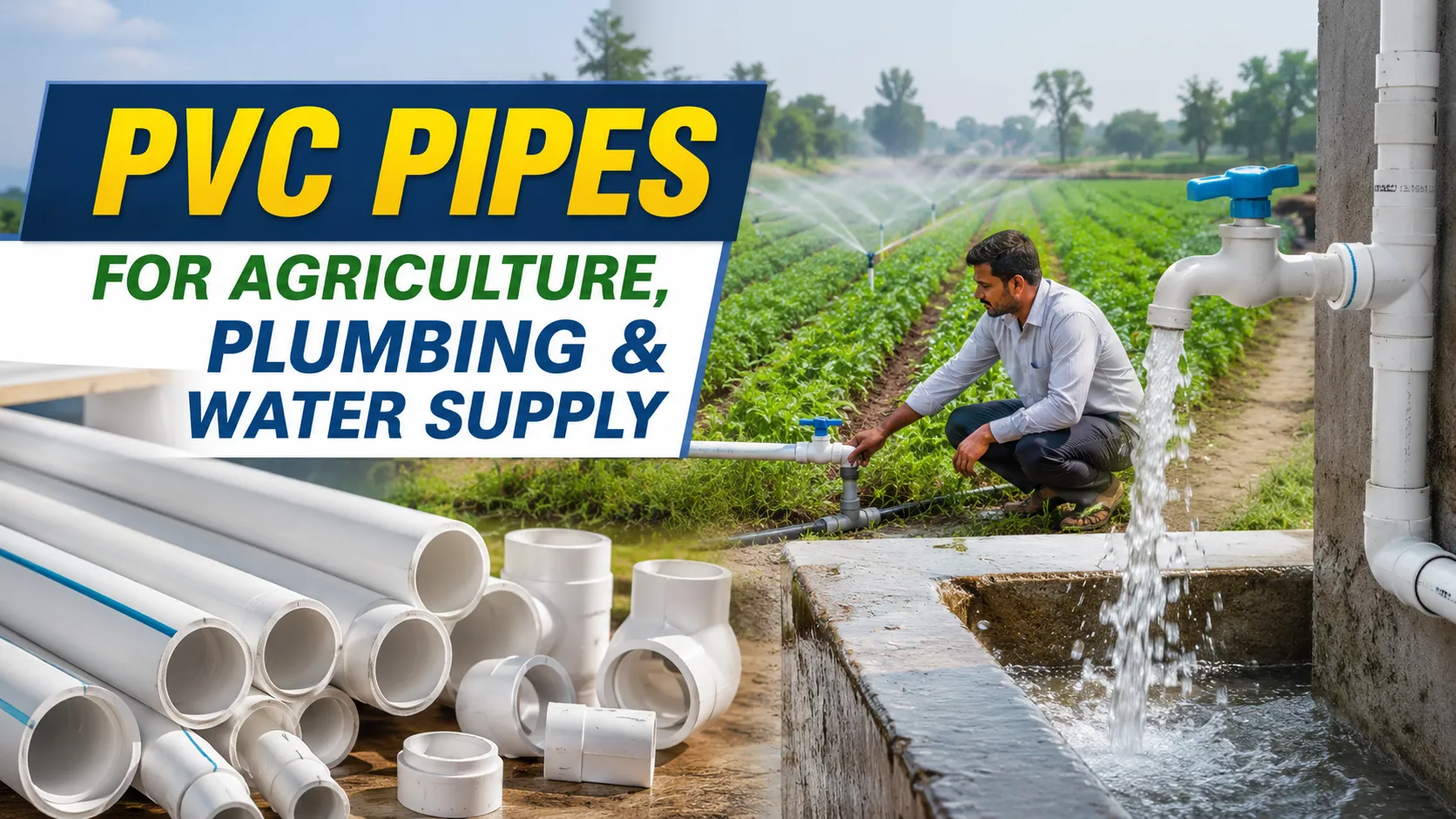
PVC stands for polyvinyl chloride, a widely used thermoplastic material used for manufacturing pipes and fittings. PVC-based piping is popular because it is relatively lightweight, resistant to corrosion and suitable for many water-handling applications.
For agriculture, these pipes can be used in suitable irrigation and water-delivery systems. In plumbing, they are commonly selected for cold-water and drainage-related applications depending on the pipe type and applicable standard.
The Bureau of Indian Standards recognizes IS 4985:2021 for unplasticized PVC pipes for potable water supplies. The standard also distinguishes applications including water supply and agricultural use.
That distinction matters because not every pipe should be treated as suitable for every job. Diameter, pressure class, joint type, application and installation conditions should always be considered before purchasing.
Why PVC Pipes Are Popular in Agriculture
Agriculture depends heavily on dependable water movement. A farmer may have a borewell, pump, storage tank and irrigation network, but the entire system can suffer if the pipeline is poorly selected.
This is where properly specified PVC piping can become useful.
For irrigation projects, the pipe needs to carry water efficiently while handling the working conditions of the farm. Weight also matters because agricultural pipelines may need to be moved, installed or rearranged according to the crop and irrigation layout.
For a farmer searching for an Irrigation Pipe Manufacturer in Indore, the first question should not be “Which pipe is cheapest?” A better question is, “Which pipe is appropriate for my water flow, pressure and irrigation method?”
The answer can vary from one farm to another.
For example, a small vegetable farm may have completely different requirements from a large agricultural field supplied by a high-capacity pump. A sprinkler system also creates different requirements compared with a simple water-transfer line.
PVC Pipes for Irrigation Systems
Irrigation networks may include pumps, mainlines, sub-mainlines, valves, fittings and sprinkler or drip components.
A well-designed system distributes water according to the crop requirement instead of simply moving as much water as possible.
Farmers considering Sprinkler pipe dealers near me should therefore check more than product availability. Pipe diameter, pressure rating, connection method and compatibility with the sprinkler system are equally important.
A farmer planning a sprinkler project can also consult a Sprinkler irrigation pipe dealer in Indore to understand which pipe arrangement suits the pump capacity and field layout.
The objective should be simple: deliver the required amount of water to the required location without unnecessary losses.
PVC Pipes in Plumbing and Water Supply
Agriculture is only one part of the picture.
PVC-based piping also has an important role in plumbing and water management. Its corrosion resistance and relatively easy handling make suitable PVC products useful for many water and drainage applications.
For potable-water applications, the product must meet the relevant specification rather than being selected simply because it carries the PVC label. BIS lists IS 4985:2021 for unplasticized PVC pipes for potable water supplies.
This is particularly important for builders and plumbing contractors.
A contractor working on a residential building, commercial property or institutional project should select the pipe according to the intended service, pressure and applicable standard.
If you are comparing a PVC Pipe Supplier in Indore, ask about the product specification, pressure class, available sizes and intended application before placing a bulk order.
Key Benefits of PVC Pipes
One reason these pipes remain popular is their balance between performance, handling and cost.
1. Lightweight Handling
Compared with many traditional metal piping options, PVC products can be easier to transport and handle during installation.
This can be particularly helpful on farms where pipelines may need to be carried across uneven ground.
2. Resistance to Corrosion
PVC does not rust like conventional steel or iron. This makes it useful in many water-handling environments where corrosion could otherwise become a maintenance concern.
3. Easy Installation
Depending on the product and jointing system, installation can be relatively straightforward.
Proper fittings and correct jointing remain essential because a good pipe can still perform poorly if connections are incorrectly installed.
4. Low Maintenance Requirements
A correctly selected and installed piping system can reduce routine maintenance problems.
However, “low maintenance” should never be interpreted as “maintenance-free.” Pipes should still be inspected for physical damage, joint problems and changes in system performance.
5. Smooth Internal Surface
The relatively smooth internal surface of suitable PVC pipes can support efficient water movement. Actual flow performance, however, depends on pipe diameter, length, fittings, pressure and system design.
Choosing the Right Pipe: A Practical Step-by-Step Guide
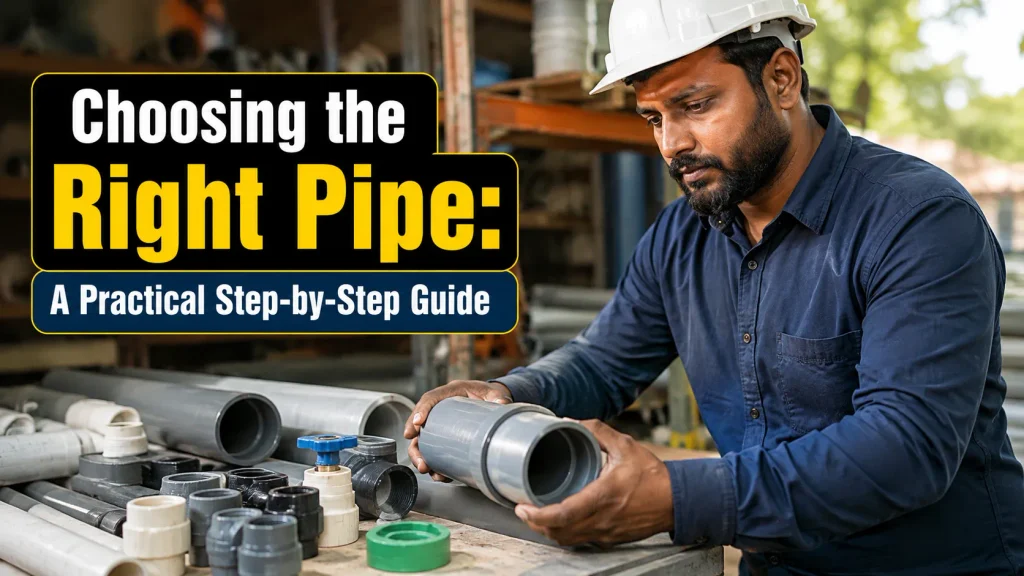
Buying a pipe becomes much easier when you follow a simple process.
Step 1: Identify the Application
Start by asking where the pipe will be used.
Is it for agricultural irrigation, potable water, drainage, a pump suction line, sprinkler irrigation or another application?
Different applications can require different pipe specifications.
For agricultural pump suction and delivery systems, BIS identifies IS 12231 for unplasticized PVC pipes used in suction and delivery lines of agricultural pump sets.
Step 2: Check Required Pressure
Pressure is one of the most important factors.
A pipe that works well in a low-pressure application may not be appropriate for a higher-pressure system.
Under IS 4985:2021, PVC water-supply pipes are categorized into pressure classes ranging from 0.25 MPa to 1.25 MPa in the listed classes.
The actual requirement should be determined from the system design rather than guessed.
Step 3: Select the Correct Diameter
Pipe diameter affects water flow.
A very small diameter may restrict flow, while unnecessarily choosing a very large diameter can increase project cost.
Farmers and contractors should consider pump capacity, required flow, pipeline length and elevation before finalizing the size.
Step 4: Examine the Jointing Method
Pipes may use different connection systems.
BIS documentation for IS 4985:2021 identifies plain-ended pipes, socketed pipes for elastomeric sealing-ring joints and socketed pipes for solvent-cement jointing.
Choose a system that matches the project requirements and installation practice.
Step 5: Buy From a Reliable Supplier
A dependable supplier can help you avoid mismatched products.
If you are searching for a Pipe Supplier Near Me, compare product specifications, availability, application suitability and technical guidance instead of focusing only on price.
PVC Pipes vs HDPE Pipes
Both PVC and HDPE have important applications. The better choice depends on the project.
| Feature | PVC | HDPE |
|---|---|---|
| Weight | Lightweight | Lightweight |
| Corrosion resistance | Excellent | Excellent |
| Flexibility | Lower | Higher |
| Typical joining | Socket/solvent or suitable joint systems | Butt fusion/electrofusion and other systems |
| Agricultural use | Suitable for selected applications | Widely used in many agricultural systems |
| Handling | Easy | Easy |
| Best choice | Depends on application | Depends on application |
For projects requiring greater flexibility, an HDPE Pipe Supplier in Indore may be worth considering. For applications where rigid piping and the relevant PVC specification are suitable, a PVC solution may be more appropriate.
A reliable HDPE pipe manufacturer in indore should also be able to explain pressure class, diameter and application suitability rather than simply selling a product.
What About Suction and Pump Applications?
Pump systems require special attention because suction conditions are different from ordinary water distribution.
A poorly selected suction pipe can affect pump performance and create operational problems.
For this reason, customers searching for a Suction pipe delear in indore should confirm that the product is intended for the required suction and delivery application.
BIS specifically lists IS 12231 for unplasticized PVC pipes used in suction and delivery lines of agricultural pump sets.
The lesson is simple: never select a suction pipe only by diameter. The pump, suction conditions, pressure, distance and pipe construction all need to be considered.
How Dealers and Contractors Can Choose Better Products
Dealers often have customers asking for a pipe by name rather than by specification.
A farmer might say, “Give me a six-inch irrigation pipe.”
A contractor might ask for “the strongest pipe available.”
But these descriptions are not enough.
A professional supplier should ask about the application, water source, pressure, pipe length, connection method and expected operating conditions.
This approach helps a Plastic pipe manufacturer in Indore or dealer recommend the right product instead of simply offering whatever is available in stock.
The same principle applies to a Plastic pipe dealer in Indore serving farmers, builders and plumbing professionals.
A Simple Case Study: Improving a Farm Irrigation Layout
Consider a hypothetical 10-acre farm where water from a pump has to reach several sections of the field.
The farmer initially uses an undersized mainline because it costs less. The result is uneven water delivery, longer pumping periods and frustration at the far end of the field.
Instead of immediately replacing the entire irrigation system, a contractor reviews the pump capacity, pipeline distance, elevation and required flow.
The mainline is then correctly sized, suitable fittings are installed and the irrigation sections are arranged more logically.
The lesson is not that a particular material always solves the problem.
The real lesson is that pipe selection and system design must work together.
A good pipe cannot compensate for a badly designed irrigation network.
Common Mistakes to Avoid
One common mistake is choosing a pipe based only on price. A lower initial price can become expensive if the product does not suit the pressure or application.
Another problem is mixing incompatible fittings or jointing methods. Even a quality pipe can leak when the connection is poorly executed.
Some buyers also ignore storage. Pipes left exposed to unsuitable conditions, dragged roughly over sharp surfaces or handled carelessly can suffer avoidable damage before installation.
Farmers should also avoid assuming that every pipe marketed for irrigation has the same pressure capability.
When buying from a Garden pipe dealer near me, for example, make sure the product is actually suitable for the intended garden or irrigation application instead of assuming that all flexible hoses and rigid pipes perform identically.
A Buyer’s Checklist
Before purchasing, ask yourself these questions:
- What is the exact application?
- What water flow is required?
- What working pressure will the system have?
- What diameter is appropriate?
- How long will the pipeline be?
- Is the pipe exposed to sunlight or buried?
- What type of fittings are required?
- Is the product made for the intended application?
- Does the product meet the applicable Indian Standard?
- Can the supplier provide technical guidance?
If you are comparing a Best Pipe Manufacturer in Indore, these questions can help you judge suppliers on value and suitability rather than price alone.
When Should You Consider HDPE Instead?
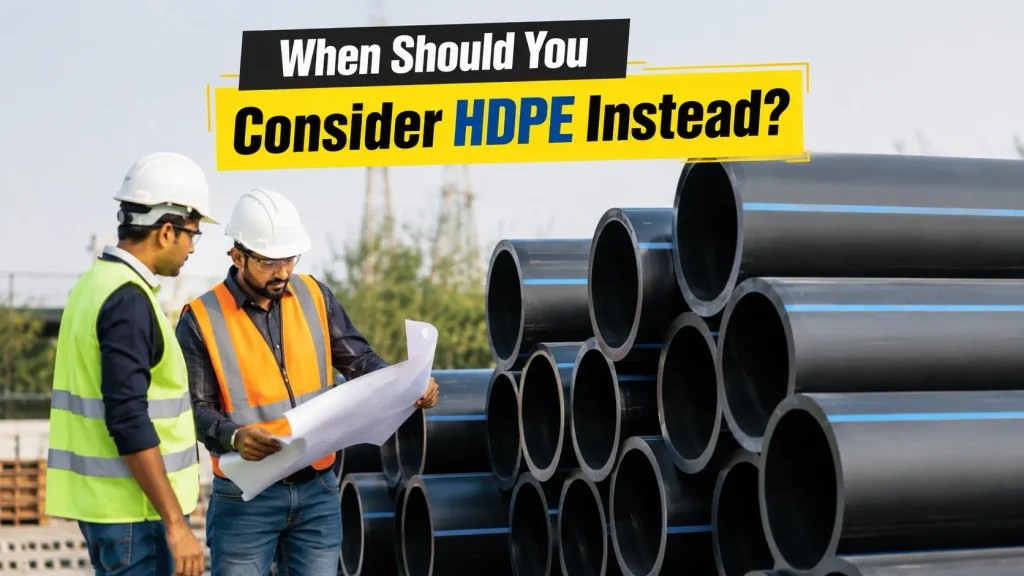
PVC is not automatically the best answer for every project.
HDPE can be attractive where flexibility, long continuous runs and specific joining methods are important. It is widely used in agricultural and infrastructure applications.
Customers looking for a High density pipe dealer in Indore may therefore want to compare HDPE with PVC before making a final decision.
For a large irrigation network, the decision should be based on the complete system rather than material preference alone.
An experienced supplier can help compare the two options according to pressure, terrain, installation method, expected service conditions and budget.
Industry Trend: Better Water Management, Better Piping
Modern agriculture is moving toward more controlled water management.
Sprinkler and drip systems are becoming increasingly important where farmers want to manage water distribution more carefully. This is creating greater demand for reliable pipes, fittings and supporting irrigation equipment.
At the same time, builders and infrastructure contractors are looking for piping systems that are practical to install and maintain.
This means the future of piping is not simply about producing more pipes.
It is about producing and selecting the right piping solution for the right application.
That is why customers searching for a Sprinkler system dealer in Indore or an HDPE Pipe Dealer Near Me should look for suppliers who understand complete irrigation systems rather than individual products alone.
Vishal Pipe: Supporting Agriculture and Piping Needs
Choosing the right supplier can make the buying process much easier.
Vishal Pipe describes itself as a sprinkler irrigation pipe manufacturer and dealer serving agriculture and industrial applications, with products including sprinkler pipes, HDPE pipes, suction hose and column pipe.
The company also highlights product customization, quality manufacturing, timely delivery and after-sales support as part of its working process.
For farmers, dealers, contractors and builders in and around Indore, the focus should always remain on matching the product to the actual application.
If you are comparing a Best column pipe dealer in indore, irrigation supplier or general piping supplier, ask for product details before making the purchase.
Frequently Asked Questions
Are PVC Pipes suitable for agriculture?
Yes, suitable PVC products can be used in agricultural water and irrigation applications. The exact pipe should be selected according to pressure, diameter, application and the applicable specification. BIS recognizes agricultural use within the relevant PVC water-supply standard framework.
Are PVC Pipes good for water supply?
They can be suitable for water-supply applications when the correct product is selected. For potable water, buyers should verify that the pipe meets the applicable standard, such as IS 4985:2021 for unplasticized PVC pipes for potable water supplies.
Which is better, PVC or HDPE?
Neither material is universally better. PVC can be a strong choice for suitable rigid piping applications, while HDPE offers advantages such as greater flexibility in many systems. The correct choice depends on project requirements.
How do I select the correct pipe size?
Consider required flow, pump capacity, pressure, pipeline length, elevation and the number of outlets. A qualified supplier or irrigation professional can help calculate the appropriate size.
Can PVC be used for pump suction?
Certain unplasticized PVC pipes are specifically covered for agricultural pump suction and delivery applications under IS 12231. Always confirm that the product is designed and specified for the intended service.
How can I find a reliable pipe supplier?
Look for a supplier that can provide clear information about material, pressure class, dimensions, application, fittings and applicable standards. Local availability and after-sales support can also be valuable for large projects.
Final Thoughts: Choose the Pipe Around the Project
The best piping decision starts with understanding the job.
A farmer needs dependable water movement across the field. A plumbing contractor needs predictable installation and performance. A builder needs a reliable system that fits project specifications. A dealer needs products that customers can trust.
The material is important, but the complete system matters even more.
Before ordering, check the application, pressure, diameter, fittings and relevant standards. Compare PVC with HDPE when appropriate, and work with a supplier who can explain the differences clearly.
Whether you need agricultural irrigation piping, water-supply solutions or supporting products, making an informed decision today can help prevent unnecessary repairs tomorrow.
If you are planning an irrigation, agricultural or water-supply project in Indore, connect with Vishal Pipe to discuss your requirements and find a suitable piping solution for your application.