The Right Pipe Can Change Your Irrigation Results
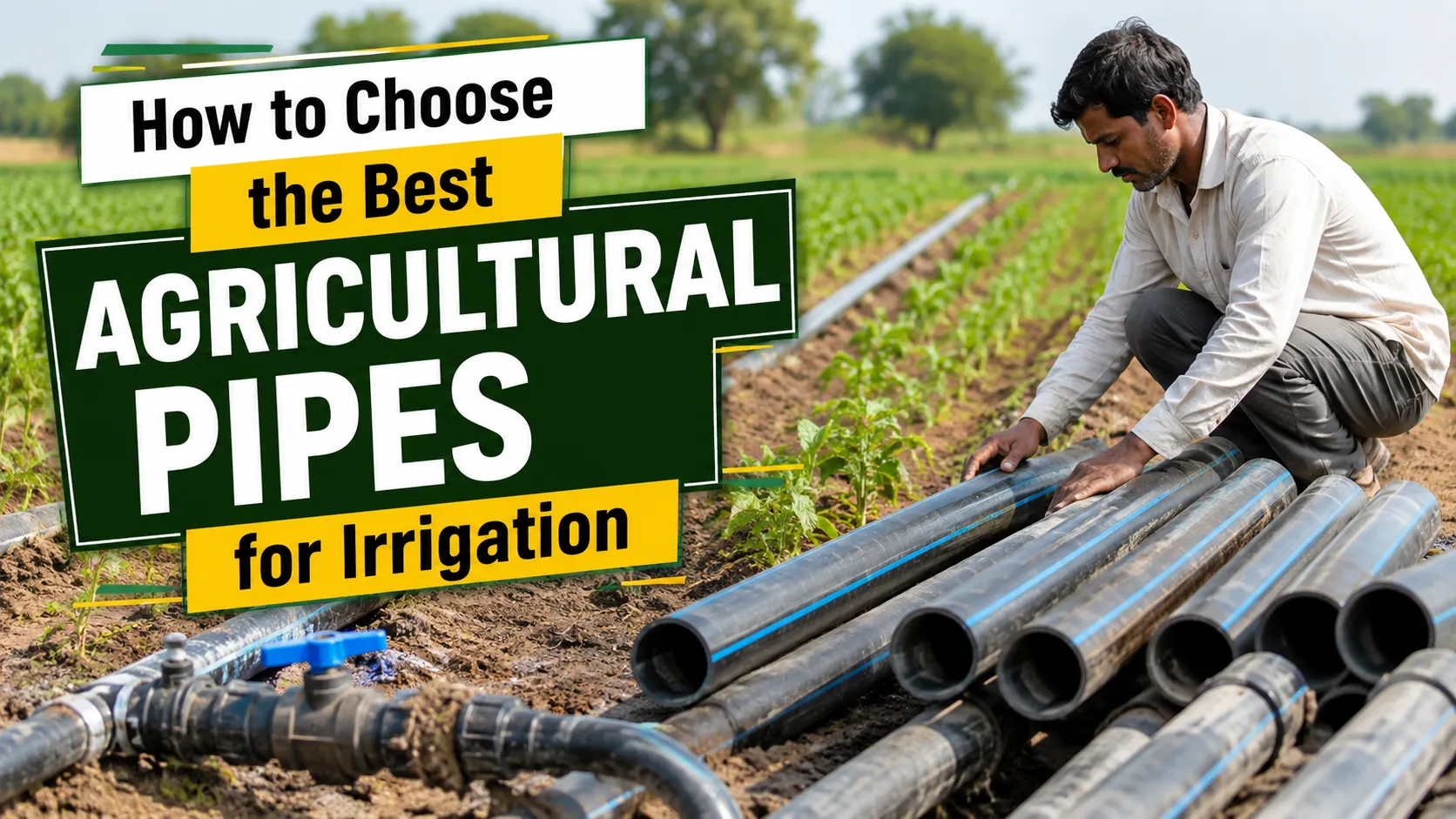
Agricultural Pipes may look like a simple part of a farm irrigation system, but the right pipe can make a major difference in water flow, pressure, maintenance, and long-term farming costs. Imagine spending hours preparing your field, starting the pump, and then discovering that water is reaching one section properly while another remains dry. In many cases, the problem is not the pump or the crop—it is the piping system.
Today, farmers are moving from traditional irrigation methods toward drip and sprinkler systems because efficient water management has become increasingly important. According to the Government of India, 110.92 lakh hectares had been brought under micro-irrigation under the Per Drop More Crop initiative, highlighting the growing importance of efficient irrigation infrastructure.
But choosing a pipe should not be based only on price. Pipe material, diameter, pressure rating, installation method, crop requirement, water source, and field size all matter.
Whether you are a farmer, contractor, dealer, builder, or government project professional, this guide will help you understand how to select the right pipe for irrigation.
Why Choosing the Right Agricultural Pipes Matters
A good irrigation system needs more than a powerful water pump. Water must travel from the source to the field with minimum leakage and suitable pressure.
Poor-quality or incorrectly sized pipes can lead to:
- Water leakage
- Uneven irrigation
- Pressure loss
- Frequent repairs
- Higher pumping costs
- Reduced system life
- Unnecessary maintenance
Government studies have also reported that micro-irrigation can significantly improve water-use efficiency compared with conventional flood irrigation. Earlier government findings reported irrigation-cost reductions, lower electricity consumption, and improved productivity in several applications.
For farmers, this means the pipe should be treated as an important part of the overall irrigation investment rather than simply another farm accessory.
Types of Agricultural Pipes Used for Irrigation
Different farms require different piping solutions. There is no single pipe that works perfectly for every field.
HDPE Agricultural Pipes
HDPE pipes are widely used for water conveyance because they are flexible, durable, and suitable for many agricultural applications. They can be useful where the pipeline needs to cross uneven ground or where long-term outdoor use is expected.
For farmers looking for reliable products, choosing an experienced HDPE pipe manufacturer in indore can help ensure that the pipe specification matches the application.
HDPE is also commonly used in irrigation networks where pressure, durability, and reduced leakage are important considerations.
PVC Agricultural Pipes
PVC pipes are another common choice for irrigation systems. They are lightweight, relatively easy to install, and suitable for many water-distribution applications.
A reliable PVC pipe manufacturer in indore can help farmers and contractors select the appropriate diameter and pressure class according to the project.
PVC can be particularly useful for fixed irrigation layouts where the pipeline does not need frequent movement.
Sprinkler Pipes
Sprinkler irrigation requires suitable pipes and fittings to carry water from the pump or mainline to sprinkler points. The correct pipe should support the required pressure and flow.
If you are setting up or expanding a sprinkler network, working with a Sprinkler irrigation pipe dealer in indore can make it easier to choose compatible pipes, fittings, and accessories.
How to Choose the Best Agricultural Pipes for Your Farm
Choosing a pipe becomes easier when you look at the irrigation system as a whole.
1. Understand Your Water Source
Start with the source of water.
Is it a borewell, open well, pond, reservoir, canal, or storage tank?
The water source affects the pump, pressure, pipe diameter, and overall layout. A pipeline connected to a high-pressure pump may require a different specification from a low-pressure gravity-fed system.
Also check whether the water contains sand, mud, or other particles. In such cases, filtration and suitable maintenance become important.
2. Check the Required Pipe Diameter
Pipe diameter directly affects water flow.
A pipe that is too small can create unnecessary pressure loss. A very large pipe, on the other hand, may increase the initial project cost without providing a practical benefit.
The correct size depends on:
- Pump capacity
- Total pipeline length
- Required water flow
- Number of outlets
- Field size
- Elevation changes
- Irrigation method
For larger projects, contractors should calculate the hydraulic requirements before ordering material instead of selecting a pipe based only on availability.
3. Consider Pressure Requirements
Pressure is especially important in sprinkler and pressurized irrigation systems.
A pipe should be capable of handling the operating pressure of the system with an appropriate safety margin. Pressure requirements may vary depending on the pump, elevation, fittings, and sprinkler arrangement.
A professional Sprinkler system dealer in indore can help match the piping system with the required sprinkler pressure and layout.
4. Select the Right Material
The choice between HDPE, PVC, and other pipe options depends on the application.
HDPE may be preferred where flexibility and durability are important. PVC can be suitable for fixed installations where lightweight rigid piping is useful. Flexible hose solutions may work for temporary connections or specific farm applications.
The objective is not to choose the most expensive material. It is to choose the material that provides the best balance of performance, service life, and cost for the actual field.
5. Think About Installation Conditions
Look at the field before purchasing.
Will the pipe be installed underground?
Will tractors regularly pass over the pipeline?
Does the pipeline need to be moved?
Are there slopes or uneven areas?
Will the pipe remain exposed to sunlight?
These questions can change the best choice.
For example, a farmer who frequently moves irrigation lines may need a different solution from a farmer installing a permanent underground network.
Agricultural Pipes Comparison: HDPE vs PVC
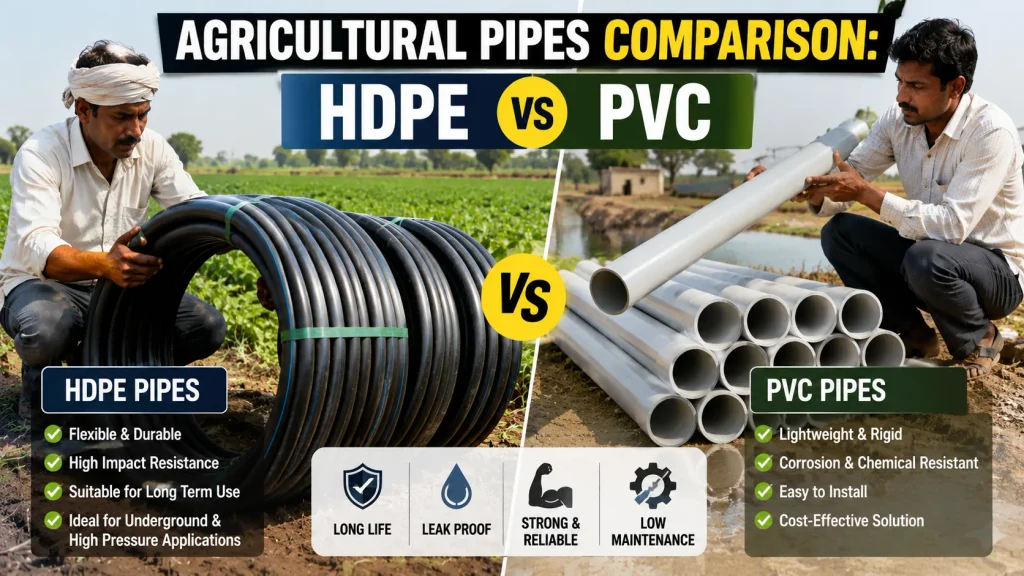
| Feature | HDPE Pipes | PVC Pipes |
|---|---|---|
| Flexibility | High | Lower |
| Installation | Suitable for varied terrain | Suitable for fixed layouts |
| Durability | High | High when properly selected |
| Weight | Lightweight | Lightweight |
| Typical Use | Water conveyance, irrigation networks | Fixed irrigation and water distribution |
| Best Consideration | Flexibility and long-term use | Fixed installation and cost planning |
The final decision should always depend on the project’s hydraulic requirements and installation conditions.
A Simple Step-by-Step Guide for Farmers
Before buying your next irrigation pipeline, follow this process.
Step 1: Measure the field.
Know the approximate distance between the water source and the irrigation area.
Step 2: Check the pump.
Note the pump capacity and expected operating pressure.
Step 3: Identify the irrigation method.
Decide whether you are using sprinkler, drip, flood, or another system.
Step 4: Calculate flow requirements.
Consider how many sprinklers or outlets may operate at the same time.
Step 5: Select the material.
Compare HDPE, PVC, and flexible pipe options based on the installation.
Step 6: Confirm pressure rating and diameter.
Do not purchase only because the pipe is cheaper or immediately available.
Step 7: Check fittings.
Elbows, valves, connectors, tees, clamps, filters, and other components should be compatible.
Step 8: Buy from a reliable supplier.
Product quality and technical guidance can have a major impact on the life of the irrigation system.
A Practical Example: Why Pipe Selection Matters
Consider two farmers with similar-sized fields.
Farmer A chooses a pipe only by looking at the lowest price. The pipe diameter is smaller than the system requires, and pressure drops toward the far end of the field. Sprinklers near the pump work properly, but the distant section receives less water.
Farmer B first checks pump capacity, pipeline length, required flow, and sprinkler pressure. The initial pipe cost is slightly higher, but the irrigation network distributes water more consistently.
The lesson is simple: the cheapest pipe is not always the lowest-cost solution.
A pipe that performs properly can reduce repeated repairs, water losses, and installation problems over its useful life.
Industry Trend: Irrigation Is Becoming More Water-Efficient
India’s irrigation sector is increasingly focused on better water management. The Economic Survey 2024–25 reported that irrigation coverage increased from 49.3% of gross cropped area in FY2016 to 55% in FY2021. It also reported substantial expansion under the Per Drop More Crop initiative.
More recent government information states that over 110 lakh hectares have been brought under micro-irrigation through the programme since its inception.
This shift creates growing demand for dependable irrigation pipelines, sprinkler systems, fittings, and water-conveyance products.
For suppliers and contractors, this also means customers increasingly expect complete irrigation solutions rather than just individual pipes.
Common Mistakes to Avoid When Buying Agricultural Pipes
One common mistake is selecting a pipe only because its price is lower. A lower purchase price may not mean lower ownership cost.
Another mistake is ignoring pressure requirements. A pipe used in a pressurized sprinkler system must be selected according to the system’s working conditions.
Some buyers also focus on the pipe but forget fittings and valves. A strong pipe connected with poor-quality accessories can still result in leakage and performance problems.
Buying from an unreliable source is another risk. Product specifications, consistency, and after-sales support matter, particularly for large agricultural and infrastructure projects.
Finally, avoid choosing pipe diameter without considering the complete irrigation network.
What Should Dealers and Contractors Look For?
Pipe dealers, irrigation contractors, builders, and government departments often purchase in larger quantities. Their priorities can differ from those of individual farmers.
They should consider product consistency, availability, technical specifications, project requirements, delivery capacity, and supplier reliability.
A HDPE pipe supplier in indore can be a useful sourcing option for projects that require durable water-conveyance solutions. Similarly, a PVC pipe supplier in indore can support fixed irrigation and water-distribution requirements.
Contractors looking for local sourcing may also search for a Pipe Supplier Near Me, HDPE Pipe Dealer Near Me, or Sprinkler pipe dealers near me. However, location alone should not determine the purchase. Product suitability and supplier reliability should remain the priority.
For specific agricultural requirements, customers may also look for a High density pipe dealer in indore or a Plastic pipe dealer in indore to compare available options.
Choosing an Agricultural Pipe Supplier
A dependable supplier should be able to answer basic technical questions clearly.
Ask about the pipe material, size, pressure rating, application, fittings, availability, and installation requirements.
If you are purchasing flexible solutions, searches such as Pipe hose shop near me or Garden pipe dealer near me may help identify local options, but always verify that the product is suitable for agricultural use.
For column-pipe applications, customers may also search for a Best column pipe dealer in indore based on the required borewell or water-lifting application.
The right supplier should focus on solving the irrigation requirement rather than simply selling a product.
What Makes a Good Irrigation Pipe System?
A good system should provide:
- Consistent water flow
- Suitable pressure
- Minimum leakage
- Easy maintenance
- Correct pipe sizing
- Compatible fittings
- Long service life
- Practical installation
- Reasonable overall cost
The pipe is only one part of the system. Pump selection, filtration, valves, fittings, sprinkler heads, layout, and maintenance all influence final performance.
Quick Agricultural Pipes Buying Checklist
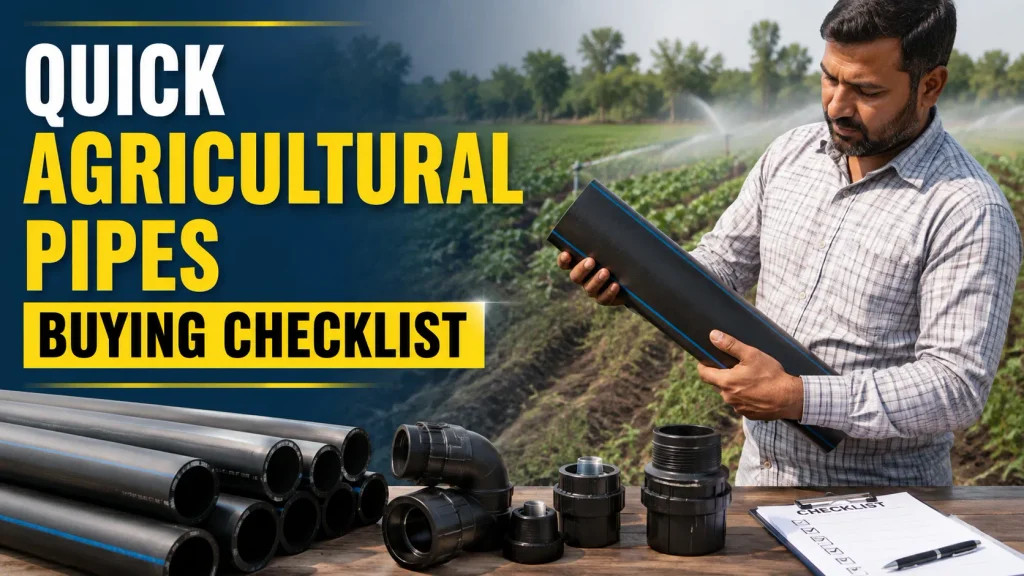
Before placing an order, ask yourself:
- What is my water source?
- What is the pump capacity?
- How long is the pipeline?
- What pipe diameter do I need?
- What operating pressure is required?
- Am I using sprinkler, drip, or another irrigation method?
- Should I choose HDPE, PVC, or another option?
- Will the pipe be fixed or moved regularly?
- Are compatible fittings available?
- Does the supplier provide suitable technical guidance?
If you can answer these questions, your buying decision becomes much easier.
Why Vishal Pipe Can Be a Practical Choice
For farmers and irrigation professionals in Indore, choosing a local and experienced supplier can simplify sourcing and project support.
Vishal Pipe describes itself as a sprinkler irrigation pipe manufacturer and dealer serving agricultural and industrial applications, with products including sprinkler pipes, HDPE pipes, farming pipes, and related piping solutions.
For customers comparing suppliers, a Pipe Manufacturer in Indore should be evaluated on product suitability, quality, availability, technical understanding, and service—not just price.
Those looking for the Best Pipe Manufacturer in Indore should therefore compare the complete value offered for their particular application.
Frequently Asked Questions
Which type of pipe is best for agricultural irrigation?
There is no single best option for every farm. HDPE and PVC are both commonly used, while sprinkler and flexible pipes serve specific applications. The best choice depends on pressure, flow, field layout, pipe length, and installation conditions.
Are HDPE pipes suitable for irrigation?
Yes. HDPE pipes are widely used for agricultural water conveyance and irrigation applications. Their flexibility and durability can make them useful for different field conditions.
Are PVC pipes suitable for sprinkler irrigation?
PVC can be suitable for sprinkler irrigation when the pipe specification, pressure rating, diameter, fittings, and complete system design are appropriate.
How do I choose the correct pipe diameter?
Consider pump capacity, required flow, pipeline length, number of outlets, pressure requirements, and elevation changes. For larger systems, hydraulic calculations should be carried out before final selection.
Where can I find irrigation pipes in Indore?
Farmers and contractors can compare local suppliers and manufacturers based on product range, technical specifications, availability, and service. Searching for an Irrigation Pipe Manufacturer in Indore or Sprinkler Pipe Manufacturer in Indore can help identify relevant suppliers.
What should I check before buying sprinkler pipes?
Check diameter, pressure rating, material, fittings, expected flow, installation method, and compatibility with the sprinkler system.
Final Thoughts: Choose for Performance, Not Just Price
The right irrigation pipeline can support better water distribution, easier maintenance, and more dependable farm operations. That is why choosing Agricultural Pipes should begin with understanding your field and irrigation requirements.
Farmers should look beyond the initial price. Contractors should check specifications and system compatibility. Dealers should focus on consistent supply and product quality. Builders and government departments should consider long-term project performance.
Whether you need HDPE, PVC, sprinkler, or other irrigation piping solutions, start with the basics: water source, pump, flow, pressure, diameter, installation, and application.
If you are planning a new irrigation system or replacing an existing pipeline, speak with a reliable pipe manufacturer or dealer and discuss your exact requirements before placing an order.