
Understanding the Key Differences Between PVC and HDPE Pipes
Understanding the Key Differences Between PVC and HDPE Pipes
When engineering an underground water distribution network—whether it’s for a massive municipal supply, an industrial plant, or a widespread agricultural project—selecting the right piping material is the single most critical decision you will make. The pipes you bury today dictate your network’s maintenance costs, leakage rates, and operational lifespan for the next fifty years.
For decades, Polyvinyl Chloride (PVC) and High-Density Polyethylene (HDPE) have been the top two contenders dominating the infrastructure landscape. While both are vast improvements over legacy metal piping, they possess radically different physical properties, installation methodologies, and performance metrics under pressure.
Let’s dive into a head-to-head engineering comparison to help you determine which material is truly optimized for your specific underground application.
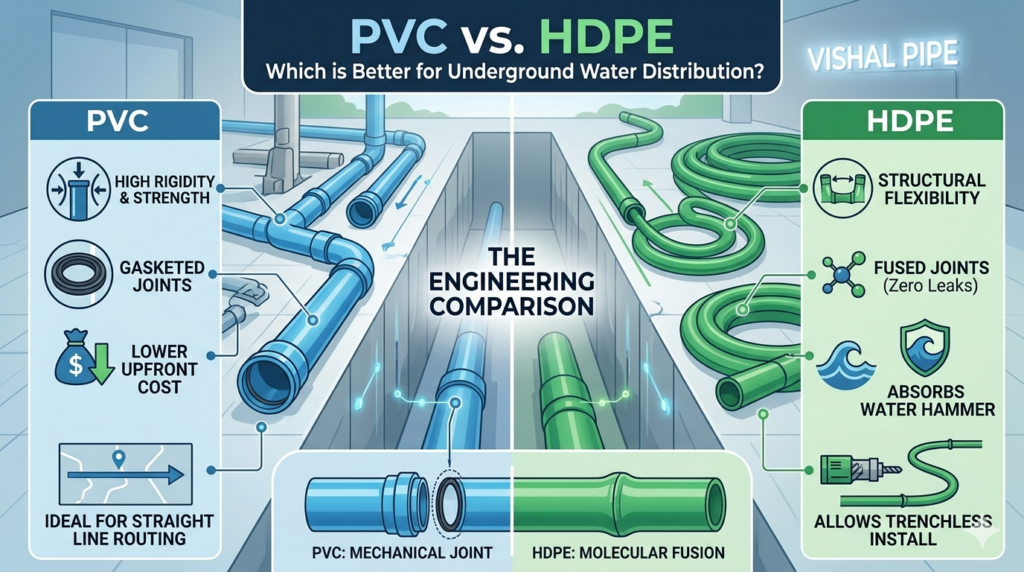
1. Material Composition and Structural Flexibility
Section Focused Keyword: Plastic pipe manufacturer in indore
To understand how these pipes perform underground, we have to look at their chemical structure. PVC is a rigid amorphous polymer. This rigidity gives it exceptional tensile strength and high hoop stress capacity, allowing it to withstand high internal pressures without expanding.
On the other hand, HDPE is a semi-crystalline thermoplastic known for its remarkable elasticity and ductility. When ground shifting, seismic activity, or heavy surface traffic causes soil settlement, an HDPE pipe flexes and absorbs the stress. A rigid PVC pipe, while strong, lacks this elasticity and is more prone to cracking under sudden, localized structural shifts.
If your project involves unstable soil conditions, deep burials, or high dynamic loads, partnering with an established plastic pipe manufacturer in indore like Vishal Pipe ensures you get high-grade raw polymers designed to withstand these specific subterranean stresses.
2. Jointing Technologies and Leak Prevention
Section Focused Keyword: HDPE pipe manufacturer in indore
The weakest point of any underground pipeline is almost always the joint. This is where PVC and HDPE fundamentally diverge in engineering execution:
- PVC Jointing (Gasketed or Solvent Cemented): PVC pipes are typically joined using bell-and-spigot ends with elastomeric gaskets or mechanical joints. While installation is incredibly fast and requires no specialized machinery, these joints are mechanical. Over time, ground movement, root intrusion, or pressure surges can compromise the seals, leading to minor leaks.
- HDPE Jointing (Heat Fusion): HDPE pipes are joined using butt-fusion or electrofusion techniques. The pipe ends are heated and pressed together, molecularly fusing them into a single, continuous line.
[Mechanical Joint (PVC)]  --> Vulnerable to soil shifting over time
[Fused Joint (HDPE)]      --> Molecularly continuous, zero leak points
The result of heat fusion is a zero-leak, monolithic system where the joint is just as strong—if not stronger—than the pipe itself. For critical municipal mains where water loss cannot be tolerated, sourcing material from a certified HDPE pipe manufacturer in indore to execute a fully fused line is often the gold standard.
3. Hydraulics, Flow Efficiency, and Water Hammer Resistance
Section Focused Keyword: Best underground water pipes
Both materials feature incredibly smooth internal bores (boasting a Hazen-Williams friction coefficient of approximately $C = 150$), meaning they resist scaling, corrosion, and biological growth far better than ductile iron or concrete. This ultra-smooth interior keeps pumping costs low and maintains consistent flow rates over decades.
However, they react very differently to Water Hammer (sudden hydraulic shock waves caused by rapid valve closures or pump start-ups). Because PVC is rigid, it has a higher modulus of elasticity, making it more susceptible to fatigue and catastrophic failure from repeated pressure surges. HDPE’s flexible walls act as a natural shock absorber, safely expanding and contracting to absorb surge pressures up to twice its continuous pressure rating.
4. Installation Mechanics, Logistical Efficiency, and Cost
Section Focused Keyword: PVC pipe manufacturer in indore
From a pure material cost perspective, straight-length PVC is often the more economical upfront investment. It is lightweight, easy to cut on-site, and doesn’t require specialized welding crews, making it a favorite for contractors working on standard grid layouts or straightforward agricultural drainage.
However, HDPE shines in complex terrains. Because lower-diameter HDPE pipes can be delivered in long, continuous coils, you can eliminate up to 80% of the fittings required for a standard PVC installation. Furthermore, HDPE’s flexibility allows for Trenchless Technology like Horizontal Directional Drilling (HDD). Instead of digging up roads, lawns, or structures to lay a pipeline, a fused HDPE line can be pulled right through a small borehole underground.
When evaluating total project costs (material + labor + lifetime maintenance), consulting with a premier PVC pipe manufacturer in indore who also specializes in advanced HDPE solutions allows you to blend both materials across your network to maximize your budget.
The Verdict: Which System Wins?
There is no universal “winner” between PVC and HDPE; rather, there is the right pipe for the right application.
- Choose PVC if: Your project features stable soil, straightforward straight-line routing, strict budget constraints on initial material procurement, and a need for high mechanical rigidity without complex welding equipment.
- Choose HDPE if: You are designing a high-consequence underground distribution main, working in shifting or rocky soil, utilizing trenchless installation to avoid disrupting surface infrastructure, or requiring a zero-leak network with high water-hammer resistance.
At Vishal Pipe, we don’t believe in one-size-fits-all infrastructure. We manufacture top-tier, compliant PVC and HDPE piping systems engineered to deliver water safely and efficiently for generations.
