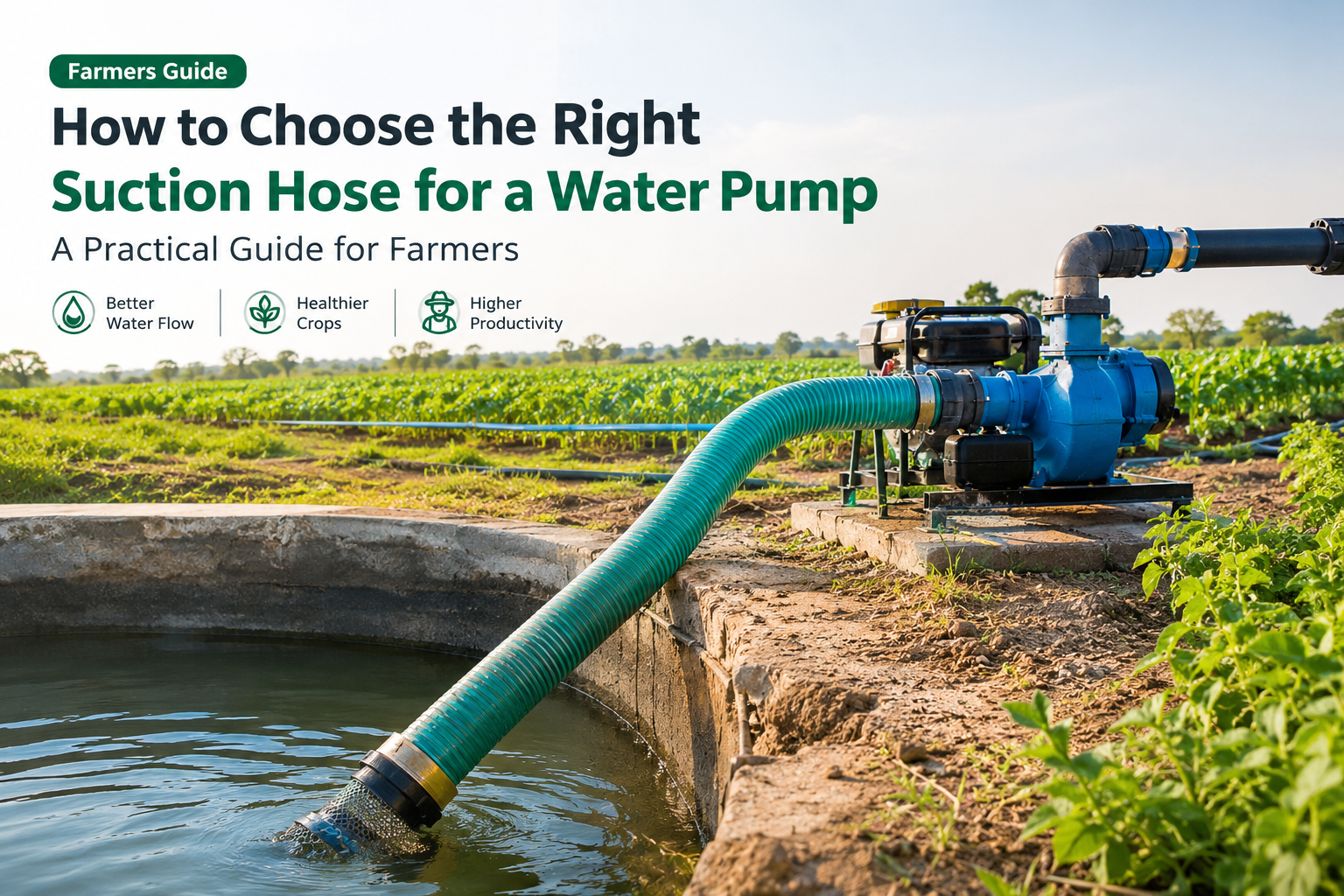
Learn how to choose the right suction hose for reliable water flow, better pump performance, and smooth agricultural irrigation.
Choosing a Suction Hose Is More Than Choosing a Pipe
When a farmer switches on a water pump, the expectation is simple: water should come from the source and reach the field without unnecessary trouble.
But the pump is only one part of that system.
Between the water source and the pump is the suction line. If that line is undersized, too long, poorly connected, unsuitable for suction or badly positioned, the pump may not receive water as it should.
This is something farmers often discover only after installation—when the pump takes too long to prime, water flow is lower than expected, the hose starts deforming, or the system keeps losing its prime.
For agricultural applications, these are not small inconveniences. A delay in irrigation can mean extra labour, wasted electricity or diesel, and more work at exactly the time when the crop needs water.
So, how do you choose the right suction hose for a water pump?
The answer starts with the pump and water source—not with the price of the hose.
A suitable suction hose for water pump applications should be selected according to the pump manufacturer’s requirements, inlet size, expected flow, suction distance, vertical lift, water source, hose construction, fittings and actual field conditions.
Quick answer: Do not select a suction hose simply because it fits the pump connection. Check the pump inlet, required flow, suction lift, hose length, suction suitability, reinforcement, fittings and installation conditions before purchasing.
For farmers in and around Indore and across Madhya Pradesh, this application-first approach can prevent many avoidable piping problems.
What Is a Water Pump Suction Hose?
A suction hose is installed between the water source and the inlet of a pump.
A typical agricultural water system may look like this:
Pond / Well / Tank → Suction Hose → Pump → Delivery Line → Irrigation System → Crop
The suction side is different from the delivery side.
A delivery pipe carries water away from the pump under the pressure produced by the pump. A suction hose, on the other hand, has to remain stable while water is being drawn toward the pump.
That means an ordinary flexible hose is not automatically suitable.
A hose that works perfectly for moving water on the discharge side may not be appropriate for pump suction. If its construction is not suitable for suction conditions, it may deform or collapse and restrict water entering the pump.
This is why farmers should look specifically for a product intended or specified for suction service.
Why the Right Suction Hose Matters in Farming
Agricultural water systems are rarely installed in laboratory conditions.
On a farm, the hose may be exposed to:
- Mud and soil
- Dust
- Stones
- Direct sunlight
- Heat
- Repeated bending
- Tractors and farm machinery
- Changes in water level
- Leaves and other debris
- Frequent connection and disconnection
The water source itself may also be challenging.
A farmer may draw water from a:
- Farm pond
- Open well
- Storage tank
- Canal
- Reservoir
- Other agricultural water source
The distance between the source and pump can vary from one installation to another.
This is why there is no single “best” suction hose for every farm.
The correct product is the one that matches the actual application.
A small mistake can affect the whole irrigation system
A poorly selected suction line may contribute to:
- Difficult priming
- Reduced or unstable water flow
- Hose deformation
- Air leakage through poorly sealed connections
- Excessive suction-side resistance
- Repeated maintenance
- Unnecessary hose replacement
The important point is that the suction hose should be considered as part of the complete pumping system—not as an isolated product.
8 Things to Check Before Buying a Suction Hose for a Water Pump
1. Start With the Pump Inlet Size
The first question we recommend asking is:
What is the pump’s suction inlet size?
Do not assume that any hose that can physically be connected to the pump is the correct hose.
Pump capacity, inlet arrangement and system design all matter.
A significantly undersized suction hose can increase resistance and restrict the water available to the pump. In some installations, a larger suction line may also be appropriate depending on the pump and hydraulic design.
Therefore, use the pump manufacturer’s recommendation as the starting point.
Before contacting an irrigation pipe supplier, keep the following information ready:
- Pump make and model
- Pump inlet size
- Pump capacity, if known
- Required water flow
- Water source
- Approximate suction distance
- Vertical lift
- Intended irrigation application
This makes product selection much more accurate.
2. Measure the Suction Distance
Hose length matters.
The longer the suction line, the more attention should be given to friction losses, bends, fittings and the overall suction arrangement.
Before ordering a water pump suction pipe, measure:
- Horizontal distance from the water source to the pump
- Vertical difference between the water level and pump
- Number of bends
- Location of the pump
- Position of the water intake
- Space available for installation
Where practical, keep the suction route reasonably direct.
Avoid unnecessary loops and sharp bends.
If the pump can safely be positioned closer to the water source, that may be a better solution than simply adding more suction hose.
A practical point from the field
A farmer may initially think, “I will take a little extra hose so that I have enough.”
That sounds sensible, but extra suction-side length is not always harmless.
Measure first. Buy according to the actual installation.
3. Make Sure the Hose Is Suitable for Suction
This is one of the most important checks.
A suction hose needs enough structural strength to resist deformation under the operating conditions of the pump.
If a hose is not designed for suction service, it may flatten or collapse when the pump is operating.
When comparing an agricultural suction hose, ask the supplier:
- Is this product intended for suction applications?
- What reinforcement does it have?
- What sizes are available?
- What applications is it designed for?
- What are the manufacturer’s operating recommendations?
Do not choose solely by appearance.
Two hoses may look similar from the outside while behaving very differently under suction.
4. Check the Hose Construction and Reinforcement
A thicker-looking hose is not automatically a better hose.
Construction matters.
Depending on the product design, reinforcement can help the hose maintain its shape under suction and during handling.
When selecting a hose, look at:
- Reinforcement construction
- Flexibility
- Wall construction
- Suction suitability
- Available sizes
- Temperature recommendations
- Intended application
- Expected operating conditions
For agricultural work, the hose may be moved, dragged, connected and disconnected many times.
The product therefore needs to balance flexibility with the structural strength required for its intended use.
Manufacturer’s buying tip: Don’t ask only, “How thick is the hose?” Ask, “What is this hose designed to do?”
That question usually leads to a better buying decision.
5. Select the Material According to the Application
Different piping materials and constructions are suited to different applications.
The right choice depends on:
- Water source
- Pump arrangement
- Frequency of use
- Outdoor exposure
- Required flexibility
- Installation conditions
- Expected service life
- Handling requirements
For agricultural users, practical handling is important.
A hose that is technically suitable but difficult to handle may not be the best choice for an installation that is frequently moved.
On the other hand, a permanently installed suction arrangement may have different priorities.
This is why material selection should be based on application rather than appearance or price alone.
6. Never Ignore the Fittings
A good hose cannot compensate for a poor connection.
The suction line should be properly sealed because air entering the suction system can interfere with priming and water movement.
Depending on the installation, components may include:
- Hose connectors
- Clamps
- Couplings
- Adapters
- Strainers
- Foot valves
- Threaded fittings
The exact components required depend on the pump and water-source arrangement.
Before installation, check:
Hose → Connector → Clamp/Coupling → Pump inlet
Every connection should be compatible and properly secured.
Avoid makeshift connections simply because they are convenient.
A small leak at a suction-side connection can create a disproportionately large operating problem.
7. Consider the Water Source
The same suction arrangement may not be appropriate for every water source.
Farm pond
A pond can contain:
- Leaves
- Floating vegetation
- Sediment
- Mud
- Other debris
The intake arrangement should be positioned appropriately and protected from excessive debris.
Open well
An open well may also contain dirt, leaves and suspended material.
A suitable strainer or inlet arrangement may be necessary depending on the system.
Storage tank
A tank may require a relatively short suction line, but correct fittings and inlet positioning still matter.
Canal or reservoir
Water level and debris conditions may change with the season.
The suction arrangement should therefore be considered with the expected operating conditions in mind.
The suction hose is only one part of the water intake system. The position of the inlet, filtration or straining arrangement, water level and pump location also affect how the system behaves.
8. Think About Actual Farm Conditions
Agricultural equipment has to survive real use.
A suction hose may encounter:
- Strong sunlight
- Heat
- Mud
- Dust
- Stones
- Repeated bending
- Farm machinery
- Animal movement
- Accidental dragging
If the hose is frequently moved, flexibility and handling become important.
If it remains installed for long periods, installation quality, protection and durability become more important.
The right question is not:
“Which hose is strongest?”
It is:
“Which hose is appropriate for the way I will actually use it?”
What Size Suction Hose Do You Need?
There is no universal suction hose size for every water pump.
The appropriate size depends on factors such as:
| What to check | Why it matters |
| Pump inlet size | Establishes the starting point for hose selection |
| Pump capacity | Influences the required water flow |
| Required flow | Determines the hydraulic requirement |
| Suction length | Longer lines can increase resistance |
| Suction lift | Vertical lift affects the suction arrangement |
| Water source | Debris and water-level conditions may affect installation |
| Fittings | Incorrect fittings can restrict flow or allow air leakage |
| Pump manufacturer’s recommendation | Provides the most relevant equipment-specific guidance |
Do not use this rule:
“If it fits, it will work.”
Instead, use:
Pump specification + system requirement + correct hose construction + correct installation = better suction-side performance.
If you are unsure about the correct suction hose size, provide the pump model, inlet size, water-source distance and vertical lift to the supplier before ordering.
Suction Hose vs Delivery Pipe: Don’t Mix Them Up
This is a common mistake among first-time buyers.
Suction hose
Used on the inlet side of the pump.
Water source → Suction hose → Pump
It must be suitable for the suction conditions created by the pumping system.
Delivery pipe
Used on the outlet side of the pump.
Pump → Delivery pipe → Irrigation system
It must be suitable for the pressure and flow conditions of the discharge system.
The two products may look similar, but they perform different jobs.
Never assume that a normal delivery hose can automatically be used as a suction hose.
How to Install a Water Pump Suction Pipe Correctly
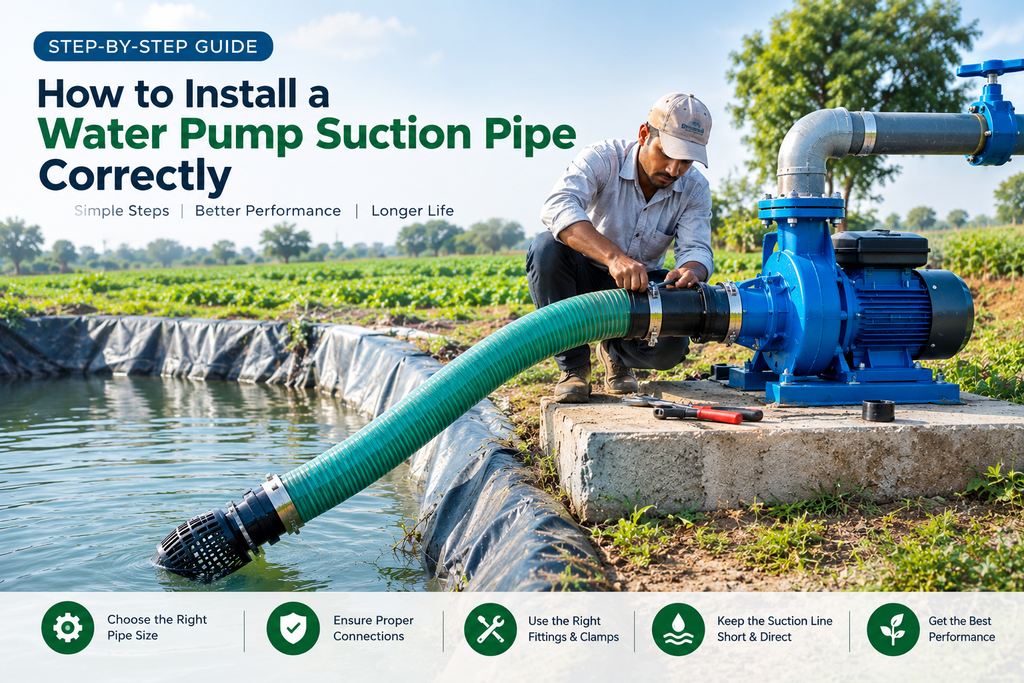
Choosing the right product is only half the job.
Installation also matters.
A practical installation sequence is:
Step 1: Position the pump correctly
Place the pump in a safe and practical location while keeping the suction route as direct as possible.
Step 2: Keep the suction line reasonably short
Avoid unnecessary length, loops and sharp bends.
Step 3: Use the correct hose diameter
Follow the pump manufacturer’s requirements and the hydraulic needs of the system.
Step 4: Make the connections secure
Use compatible connectors, clamps, couplings and adapters.
Step 5: Prevent air leakage
Inspect every suction-side connection carefully.
Step 6: Use the appropriate intake arrangement
Where required, use a suitable strainer or foot valve according to the pump and water-source setup.
Step 7: Follow the pump manufacturer’s priming procedure
Do not assume that every pump is primed in exactly the same way.
Step 8: Test the system
After starting the pump, check for:
- Unusual hose deformation
- Air leakage
- Unstable water flow
- Unusual noise
- Difficulty maintaining prime
- Loose connections
If the pump does not behave as expected, stop and check the suction system rather than simply running the pump longer.
7 Common Suction Hose Problems and What to Check
| Problem | Possible cause | What to check |
| Pump does not prime | Air leakage or incorrect priming | Connections, seals and priming procedure |
| Hose collapses | Hose construction unsuitable for suction | Suction suitability and reinforcement |
| Low water flow | Restriction, undersized hose or excessive suction-side resistance | Diameter, length, bends and inlet |
| Pump repeatedly loses prime | Air entering the suction line or unsuitable inlet arrangement | Connections, clamps, valves and intake |
| Water flow fluctuates | Air entry, obstruction or unstable water source | Hose, fittings and water level |
| Hose becomes damaged | Rough handling or environmental exposure | Routing, storage and protection |
| Debris enters pump | Poor intake protection | Strainer/intake positioning |
This type of troubleshooting is often more useful to a farmer than a generic statement that “quality pipes improve performance.”
How the Suction Hose Fits Into an Agricultural Irrigation System
A farm irrigation system is a chain.
For example:
Water Source → Suction Hose → Pump → Mainline → Irrigation Pipe → Distribution System → Crop
If one part of that chain is poorly selected, the entire system can be affected.
A correctly selected suction hose helps the pump receive water under the intended operating conditions.
After the pump, the delivery system takes over.
This is where an irrigation pipe for farming becomes important.
The irrigation pipe needs to match the application, required flow, pressure conditions, field layout and method of water distribution.
That is why we recommend looking at the entire system rather than purchasing every pipe independently.
Choosing the Right Irrigation Pipe for Farming
The best irrigation pipe for farming depends on what the pipe has to do.
Consider:
- Distance water needs to travel
- Required flow
- Working pressure
- Field size
- Crop type
- Irrigation method
- Installation method
- Whether the pipe is permanent or frequently moved
- Exposure to sunlight and field conditions
For some applications, HDPE pipe for agriculture may be considered because HDPE piping can be used in a variety of agricultural water-management applications when the product specification matches the intended service.
However, farmers should not select HDPE simply because the material is popular.
Check the actual product specification, size, pressure class where applicable, fittings and intended application.
[Internal link opportunity: Link “HDPE pipe for agriculture” to the relevant Vishal product/category page.]
You can also explore the broader Vishal product range here:
Explore Vishal Pipes and Fittings products
Suction Hose + Irrigation Pipe + Rain Pipe: Think of the Complete System
Consider a farmer irrigating a vegetable field from a farm pond.
The arrangement may look like:
Farm Pond → Agricultural Suction Hose → Pump → Main Irrigation Line → Rain Pipe → Crop
Each component performs a different job.
The suction hose brings water to the pump.
The pump moves the water.
The main irrigation pipe carries water toward the field.
The rain pipe distributes water in the crop area where that system is suitable.
This is why buying the biggest pipe or the cheapest pipe is not necessarily the right approach.
The system should be designed around the farm’s actual water requirement.
What Is a Rain Pipe Used for in Agriculture?
A rain pipe is used for water distribution in suitable agricultural and gardening applications.
Unlike a suction hose, it is not intended to bring water from the source to the pump.
Its role is downstream:
Pump → Irrigation Line → Rain Pipe → Crop
Rain pipe selection should consider:
- Crop type
- Crop spacing
- Field size
- Water availability
- Pump capacity
- Working pressure
- Pipe length
- Field layout
- Soil conditions
- Desired water distribution
Farmers looking for an irrigation solution should therefore avoid treating a rain pipe as a replacement for a suction hose or delivery line.
They solve different problems.
A Practical Farmer Example: Pond to Vegetable Field
Let’s take a simple example.
A farmer has a pond beside a vegetable field.
The system may be:
Pond → Suction Hose → Water Pump → Main Irrigation Pipe → Rain Pipe → Vegetable Crop
Before buying anything, the farmer should answer five questions:
- What is the pump inlet size?
- How far is the pump from the pond?
- How high is the pump above the water level?
- How much water does the irrigation system require?
- How will water be distributed across the crop rows?
Only after answering these questions should the farmer select the suction hose and irrigation components.
This is the approach we recommend because it reduces the risk of buying components that look suitable individually but do not work well together.
What We Look at Before Recommending Agricultural Piping
At Vishal Pipes and Fittings, the useful starting point is not simply, “Which pipe do you want?”
The better question is:
“What are you trying to do with the water?”
For an agricultural requirement, the information worth collecting includes:
- Pump type and model
- Pump inlet and outlet size
- Water source
- Approximate suction distance
- Vertical lift
- Required flow
- Field size
- Irrigation method
- Whether the pipe will be fixed or moved
- Required fittings
- Local operating conditions
- list
How to Choose an Irrigation Pipe Supplier in Indore or Madhya Pradesh
Farmers searching for an irrigation pipe supplier should look beyond price.
Before placing an order, ask:
1. Does the supplier understand agricultural applications?
A supplier should be able to discuss the application, not just the product name.
2. Are product specifications available?
Check sizes, materials, construction, application and other relevant specifications.
3. Can they help with fittings?
A pipe is only one part of the installation.
4. Is the product range suitable for your requirement?
Depending on the project, you may need suction products, irrigation piping, HDPE products, fittings or rain pipe solutions.
5. Can you get support after purchase?
This becomes important when farmers need replacement components, additional lengths or compatible fittings.
6. Is the manufacturer transparent about its business?
Look for information about the company, products, location, team and manufacturing capabilities.
For more information about Vishal Pipes and Fittings:
Learn about Vishal Pipes and Fittings
Choosing an Irrigation Pipe Manufacturer in Indore
Farmers, contractors and agricultural businesses searching for an irrigation pipe manufacturer in Indore should compare manufacturers on more than availability.
Look at:
- Product range
- Application suitability
- Product specifications
- Manufacturing information
- Quality-control practices
- Fittings and accessories
- Customer support
- Availability
- Experience in agricultural applications
[INSERT VERIFIED VISHAL MANUFACTURING INFORMATION]
For example, the company can strengthen this section with genuine details such as:
- Manufacturing location
- Years in operation
- Major product categories
- Production capabilities
- Quality-control process
- Relevant certifications, if applicable
- Service areas
- Actual agricultural markets served
Do not add a certification, production figure, years-of-experience claim or geographic claim unless the company can verify it.
That transparency is part of building trust.
What Farmers Should Look for in an Agricultural Pipe Manufacturer
Whether you are comparing manufacturers in Madhya Pradesh or suppliers from another state, ask practical questions.
Product
Is the product actually designed for your application?
Specification
Are dimensions and relevant technical specifications clearly provided?
Consistency
Does the manufacturer have a defined quality-control process?
Support
Can someone help you understand which product is appropriate?
Availability
Can you obtain compatible fittings or replacement products when needed?
Transparency
Does the company clearly explain who they are and what they manufacture?
A professional supplier should help the customer make an informed decision rather than simply pushing the largest or most expensive product.
10-Step Suction Hose Buying Checklist
Before ordering your suction hose for water pump, work through these steps.
Step 1 — Identify your pump
Record the pump brand, model and inlet size.
Step 2 — Identify your water source
Pond, well, tank, canal or reservoir?
Step 3 — Measure the distance
Measure the approximate horizontal distance between the water source and pump.
Step 4 — Measure the vertical lift
Determine the difference between the water level and pump position.
Step 5 — Confirm the required flow
Use the pump and irrigation-system requirements.
Step 6 — Select the appropriate suction construction
Do not substitute an ordinary flexible hose without confirming suitability.
Step 7 — Select compatible fittings
Check connectors, clamps, couplings, valves and adapters.
Step 8 — Inspect before installation
Check the hose and fittings for damage.
Step 9 — Test the system
Look for air leakage, hose deformation and unstable water flow.
Step 10 — Maintain it
Inspect the system before intensive irrigation periods and whenever performance changes.
Common Buying Mistakes Farmers Should Avoid
Buying only on price
The cheapest product is not necessarily the lowest-cost solution over its useful life.
Choosing a hose because it fits
Physical compatibility does not automatically mean hydraulic suitability.
Using a delivery hose for suction
Always confirm the product’s intended application.
Ignoring suction-side air leakage
A small leak can interfere with priming and water movement.
Adding unnecessary suction length
Keep the suction route practical and avoid unnecessary bends.
Ignoring the water source
Debris, sediment and changing water levels can affect the intake arrangement.
Choosing by thickness alone
Construction and application suitability matter more than appearance.
Forgetting the rest of the irrigation system
The suction hose, pump, mainline and field distribution system should work together.
How to Maintain an Agricultural Suction Hose
Good maintenance does not need to be complicated.
Before an important irrigation cycle, inspect the hose for:
- Cracks
- Cuts
- Bulges
- Flattened sections
- Deformation
- Damaged connectors
- Loose clamps
- Leakage
- Excessive wear
Also:
- Avoid sharp bends
- Keep the hose away from tractor and tiller movement
- Protect it from unnecessary dragging over sharp stones
- Keep connections clean
- Store removable hoses away from damaging conditions
- Follow the manufacturer’s storage recommendations
A five-minute inspection can be worthwhile when the alternative is discovering a problem after the pump has already been taken to the field.
Where to Start if You Are Not Sure Which Pipe You Need
If you are a farmer or contractor and you are unsure whether you need a suction hose, irrigation pipe, HDPE pipe, delivery pipe or rain pipe, start with the application.
Tell your supplier:
“This is my pump, this is my water source, this is the distance, this is the height difference, and this is where I need to take the water.”
That information is much more useful than simply saying:
“Give me a pipe for irrigation.”
A knowledgeable irrigation pipe supplier should be able to use those details to guide the product-selection conversation.
For Vishal’s product range, you can start here:
View Vishal Pipes and Fittings products
Why Application-Based Pipe Selection Matters
There is no single pipe that is “best” for every agricultural job.
A pipe used for:
- Pump suction
- Water delivery
- Mainline irrigation
- Field irrigation
- Rain pipe irrigation
- Gardening
- Water storage
- Other agricultural applications
may have different requirements.
For example, the requirements of an agricultural suction hose are not the same as those of an irrigation pipe for farming.
Likewise, an HDPE pipe for agriculture used for a particular water-delivery application should be selected according to its intended service and specification rather than simply because HDPE is widely used.
The correct product is determined by the job it has to perform.
Written by: Komal Parmar
Role: Agricultural & Piping Content Writer
Komal Parmar writes about agricultural piping, irrigation systems, HDPE pipes, pipe fittings and water-management applications, with a focus on turning technical information into practical guidance for farmers, contractors, dealers and businesses.
Review scope: Pump suction applications, agricultural piping, irrigation systems and product-selection guidance.
Last reviewed: October 2026
About Vishal Pipes and Fittings:
Readers can learn more about the company, its background and its business activities on the official company page:
About Vishal Pipes and Fittings
Frequently Asked Questions
1. What is a suction hose for a water pump?
A suction hose connects the water source to the pump inlet and carries water toward the pump. It needs to be suitable for the suction conditions of the pumping system and should not collapse or deform under normal operating conditions.
2. Can I use any flexible pipe as a water pump suction pipe?
Not necessarily. A flexible pipe designed for another application may not be suitable for suction. Always check whether the product is intended for suction service and whether its construction matches the pump and installation.
3. How do I choose the right suction hose size?
Start with the pump manufacturer’s recommended inlet arrangement. Then consider pump capacity, required flow, suction length, vertical lift, fittings and the overall system design.
4. Does a longer suction hose reduce performance?
A longer suction line can increase resistance. Unnecessary length, bends and restrictive fittings can make the suction arrangement less efficient. Where practical, keep the suction route reasonably direct.
5. Why does a suction hose collapse?
Collapse can occur when a hose is not designed for the suction conditions, when the operating conditions exceed the hose’s capability, or when the hose is sharply bent, obstructed or otherwise restricted.
6. Why is my water pump not getting enough water?
Possible causes include air leakage, an unsuitable or undersized suction hose, excessive suction-side resistance, blocked intake protection, incorrect installation, water-level changes or pump-related issues. Check the complete suction system rather than assuming the pump itself is the only problem.
7. Is a suction hose the same as an irrigation pipe?
No. A suction hose is generally used to bring water to the pump. An irrigation pipe is used downstream to carry or distribute water within the irrigation system.
8. What is an agricultural suction hose used for?
An agricultural suction hose can be used to draw water from sources such as ponds, tanks, wells and other water-storage or supply points toward an agricultural pump, provided the product is suitable for the specific application.
9. What should I check before buying an irrigation pipe for farming?
Consider water flow, working pressure, distance, crop requirements, field layout, irrigation method, installation conditions and the pipe’s product specifications.
10. Is HDPE pipe suitable for agriculture?
HDPE piping is used in various agricultural water-management applications, but suitability depends on the particular product specification and intended service. Check the size, pressure requirements, fittings and manufacturer’s application guidance before purchasing.
11. How do I choose an irrigation pipe supplier?
Compare the supplier’s product range, specifications, agricultural application knowledge, availability, fittings, customer support and transparency. Do not choose only on price.
12. How do I choose an irrigation pipe manufacturer in Indore?
Look for a manufacturer that can provide clear product information, application guidance, relevant specifications and dependable customer support. If possible, verify manufacturing and quality claims directly with the company.
13. What should I ask a pipe manufacturer before buying?
Ask about product application, available sizes, specifications, fittings, installation requirements, operating conditions, maintenance and product availability.
14. Can a rain pipe replace a suction hose?
No. A rain pipe and suction hose have different functions. The suction hose brings water toward the pump, while a rain pipe distributes water to the crop area in suitable irrigation applications.
15. How often should I inspect a suction hose?
Inspect it regularly and especially before periods of intensive irrigation. Look for cracks, cuts, deformation, loose fittings, damaged clamps and signs of leakage.
Need Help Choosing the Right Agricultural Pipe?
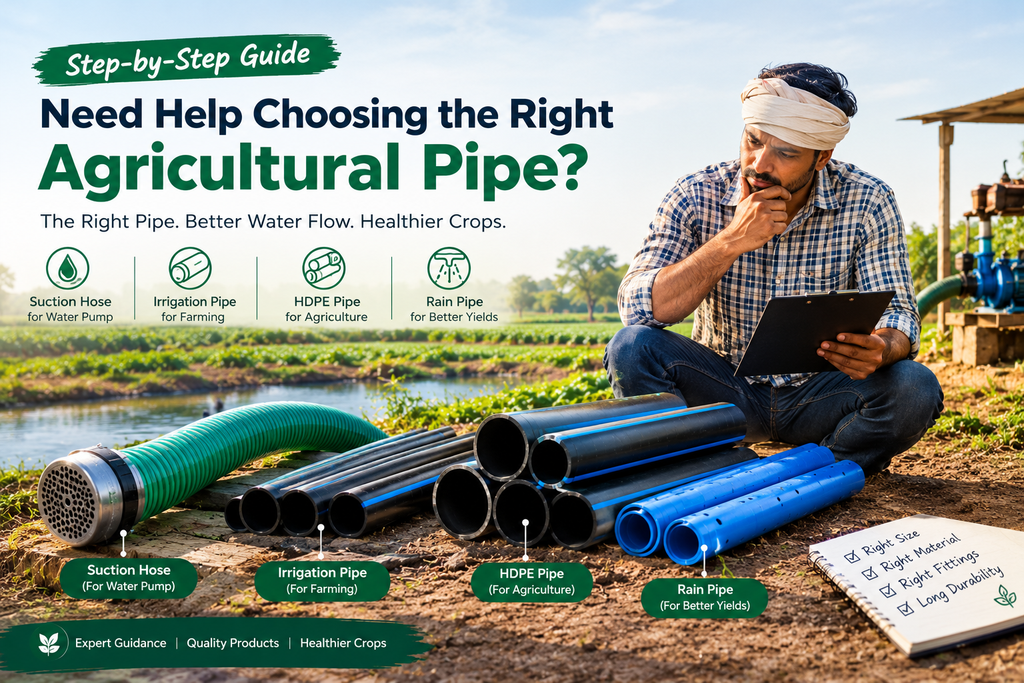
If you are unsure whether you need a suction hose for water pump, water pump suction pipe, irrigation pipe for farming, agricultural suction hose or HDPE pipe for agriculture, do not guess based only on photographs or pipe diameter.
Share the basic details of your application:
- Pump make/model
- Pump inlet size
- Water source
- Approximate suction distance
- Vertical lift
- Required flow, if known
- Field size
- Irrigation method
- Required pipe length
- Whether the system is permanent or movable
These details make it easier to identify a practical solution.
For information about Vishal Pipes and Fittings:
Visit Vishal Pipes and Fittings
You can also explore the available products:
And learn more about the company:
Final Takeaway
Choosing a suction hose may look like a small part of an irrigation project, but it can influence how reliably the entire pumping system operates.
The right choice starts with the application.
Check the:
- Pump inlet
- Required flow
- Suction distance
- Vertical lift
- Hose construction
- Reinforcement
- Material
- Fittings
- Water source
- Farm environment
Then consider how the suction system connects with the pump, mainline and irrigation pipe for farming.
For farmers, the goal should not be to buy the cheapest pipe or the biggest pipe.
The goal is to create a dependable path for water, from the source, through the pump, through the irrigation system and finally to the crop.
That is the principle we recommend: understand the application first, then select the product.