It’s a frustrating scenario every farmer and commercial grower faces at some point. You’ve prepped a great plot of land, your seed selection is top-notch, and your agricultural layout looks pristine—yet, your yield fails to match its true potential because your watering method is inefficient. Instead of optimizing resources, choosing the wrong setup in the rain pipe vs drip irrigation debate means your hard-earned money is literally evaporating or draining away, swallowing up the profits that should have been yours.
Why is this happening?
The harsh reality of modern agriculture is that you don’t automatically conserve resources by simply using “modern” pipes; you optimize by choosing the exact irrigation footprint tailored to your crop layout, soil type, and local water pressure. If your fields are suffering from uneven watering or skyrocketing water bills, it’s highly likely because your infrastructure needs a specialized upgrade.
To help you choose the ultimate water-saving setup, let’s pull back the curtain on the Rain Pipe vs Drip Irrigation debate and discover exactly how to maximize your crop yields while saving every drop.
1. Rain Pipe vs Drip Irrigation: The Core Water-Saving Showdown
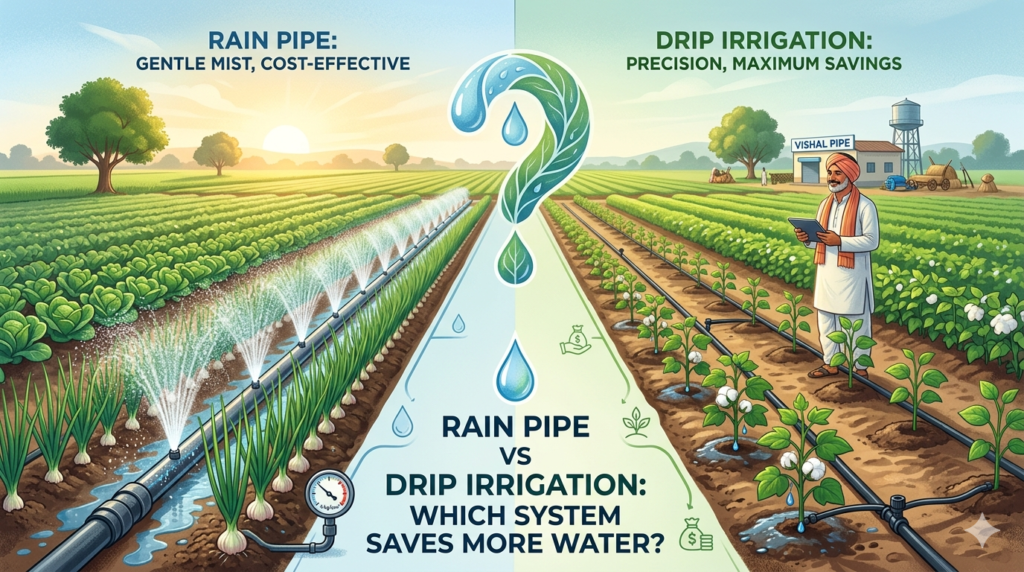
When it comes to selecting a water-smart system, Rain Pipe vs Drip Irrigation is the ultimate comparison. While both systems leave old-school, wasteful flood irrigation in the dust, they approach water conservation from completely different technical angles.
- Drip Irrigation Systems: These function by delivering water drop-by-drop directly into the plant’s root zone through specialized emitters. By watering only the immediate soil surrounding the roots, drip systems eliminate surface evaporation and completely stop water from drifting into uncropped field edges. This hyper-targeted delivery boasts an incredible water-use efficiency rate of 90% to 100%.
- Rain Pipe Systems: Rain pipes are multi-layered HDPE/LDPE hoses with nano-punched micro-holes that spray a soft, uniform, mist-like fountain over a narrow strip of land. They mimic natural rainfall rather than spot-watering a single root. Operating at lower pressures, they are exceptionally good at maintaining high soil moisture for closely spaced crops.
The Verdict on Water Savings
If pure, absolute mathematical water savings is your only goal, drip irrigation wins. It restricts water strictly to the plant base, preventing weed growth in between rows and avoiding the minor evaporative losses that occur when spraying water into the air. However, as we will explore below, “best” is context-dependent.
2. When to Choose a Rain Pipe System (The Cost-Effective Sprinkler Alternative)
If you are cultivating closely spaced crops like groundnuts, onions, garlic, leafy greens, or certain vegetables, a rain pipe system is a massive game-changer.
   [Rain Pipe Micro-Spray Dynamic]
                 ▲
                 │── Nano-Punched Zig-Zag Holes (Uniform Flow)
                 │── Zero Clogging Risk (No Emitters/Filters Needed)
                 └── Low Pressure Operation (Works at 1 kg/cm²)
Because rain pipes do not use tiny emitter nozzles, they don’t suffer from the frequent clogging issues caused by hard water or minor debris. They require much less technical knowledge to deploy, cut initial installation costs by roughly 25% to 50% compared to traditional micro-sprinklers or complex drip webs, and can be rolled up and shifted in minutes.
If your farm layout requires a broad, gentle overhead mist without the massive expenses and high power demands of traditional metallic sprinklers, you need to contact a reliable local supplier. Searching for verified sprinkler system dealer in indore options will connect you with experts who can configure these low-pressure, high-efficiency rain setups.
3. Why Drip Irrigation Rules High-Value and Row-Crop Farming
For orchards, wide-spaced row crops (like cotton, sugarcane, or maize), and uneven terrains, drip irrigation remains the undisputed king.
Because water never touches the leaves, drip setups drastically minimize foliar disease and fungal growth caused by excess canopy moisture. Furthermore, drip irrigation gives you the power of fertigation—injecting liquid fertilizers directly into the water stream so nutrients flow directly to the roots alongside the water, cutting fertilizer waste by up to 30%.
4. Selecting the Right Infrastructure Partner for Your Fields
An irrigation system is only as good as the raw materials keeping it together. Cheap, unbranded plastic pipelines will crack under intense summer heat, lose pressure uniformity, and leak precious water back into the water table before it ever reaches your crops.
To protect your agricultural investments, it pays to connect with established distribution professionals who understand regional soil demands, water tables, and pressure dynamics.
- For Piping Foundations: Before designing your field lines, consult a trusted plastic pipe dealer in indore to source high-grade, UV-stabilized uPVC or HDPE pipes that serve as the main and sub-main lines for your entire network.
- For Precision Spray & Mist Networks: If you decide that a micro-spray or soft-sprinkler layout fits your crop footprint perfectly, visiting a certified sprinkler irrigation pipe dealer in indore ensures you get specialized pipes capable of handling fluctuating field pressures without bursting.
- For Nearby Sourcing & Troubleshooting: Don’t buy your components from anonymous online portals. Working face-to-face with professional sprinkler pipe dealers near me gives you immediate access to localized warranties, replacement parts, and expert engineering layout guidance.
The Ultimate Comparison Checklist
To help you make the right choice for your next cultivation cycle, here is a quick, practical breakdown of how these systems stack up in real-world scenarios:
| Feature/Metric | Drip Irrigation Systems | Rain Pipe Systems |
| Water Efficiency Rate | 90% – 100% (Highest overall water savings) | 80% – 85% (Excellent for mist/overhead) |
| Best Crop Fit | Wide-spaced row crops, orchards, vineyards | Closely spaced crops, onions, leafy greens, groundnuts |
| Clogging Risk | High (Requires clean water & filtration) | Very Low (No filters or delicate emitters) |
| Installation Cost | Higher capital investment & technical setup | Lower cost, DIY-friendly, highly portable |
| Fertigation Capability | Perfect (Delivers nutrients straight to roots) | Moderate (Disperses over the canopy/soil surface) |
Stop Wasting Water: Upgrade with Vishal Pipe
Your fields shouldn’t be losing water, and your business shouldn’t be losing hard-earned profits to sub-par infrastructure. Choosing between rain pipes and drip lines isn’t about finding a single “perfect” solution; it’s about executing a precise strategy that fits your crops, budget, and terrain perfectly.
At Vishal Pipe, we specialize in manufacturing heavy-duty, long-lasting agricultural pipes engineered to withstand the harshest field conditions. Whether you need hyper-targeted drip layouts to maximize a scarce water source, robust rain pipes for close-spaced vegetables, or ultra-durable main pipelines to connect your pump stations, our products deliver measurable, long-term results.
Don’t let another drop of water go to waste. Reach out to our team or visit an authorized regional dealer today to turn your agricultural property into a high-yielding, water-smart asset!