
The Growing Shift Toward HDPE Pipes in Industrial Piping
For decades, industrial fluid management relied on a predictable blueprint: use heavy-duty steel or iron lines for raw durability, or turn to standard plastic alternatives for simple setups. However, modern manufacturing, chemical processing, and infrastructure demand materials that cut down long-term operational costs and eliminate recurring pipeline failures—a challenge that has made high-performance hdpe pipes the premier upgrade across modern industries.
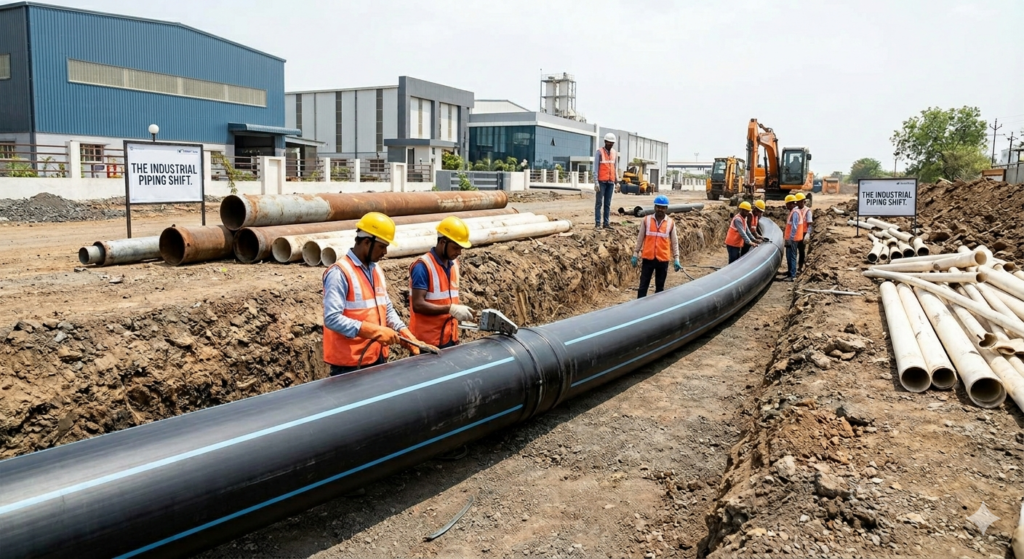
Today, a clear paradigm shift is unfolding across industrial sectors. High-Density Polyethylene (HDPE pipe) systems are rapidly phasing out traditional galvanized iron (GI), ductile iron, and Polyvinyl Chloride (PVC) networks.
As an authority in industrial fluid logistics, Vishal Pipe breaks down the structural, financial, and mechanical reasons behind this industry-wide transition—and how selecting the right HDPE pipe manufacturer in indore can future-proof your layout.
1. Absolute Corrosion and Chemical Resistance
Traditional metallic pipelines are fundamentally vulnerable to chemical degradation. Over time, constant exposure to moisture, industrial chemicals, and acidic soils leads to rust, scaling, and internal pitting. While PVC offers a partial step up from metals, it remains susceptible to specific aggressive chemical compounds and environmental stressors.
An HDPE pipe, by contrast, is biologically and chemically inert. It features an incredibly low stress response to chemical-induced strain, ensuring it will not rust, corrode, or support bacterial buildup. This makes it an ideal pipeline standard for transporting everything from treated industrial wastewater to volatile hydrocarbons and harsh chemical effluents.
2. Zero-Leak Jointing via Heat Fusion
One of the most persistent failure points in metal and PVC pipelines resides at the joints. Threaded metal collars, mechanical gaskets, and solvent-welded PVC couplings are vulnerable to shifting ground, vibration, and temperature-induced pressure surges. When a joint fails, it leads to costly downtime, product loss, and structural damage.
HDPE systems eliminate this weakness through a specialized heat fusion process (such as butt fusion or electrofusion).
- The pipe ends are heated and pressed together to form a homogenous bond.
- The resulting joint becomes physically stronger than the pipe itself.
- This creates a continuous, monolithic run of piping with zero leak potential.
Traditional Joints (PVC/Metal) ──> Mechanical Gaskets/Solvent ──> Vulnerable to Leaks ❌
HDPE Heat Fusion Jointing      ──> Monolithic Molecular Bond  ──> 100% Leak-Proof     ✅
3. High Flexibility and Impact Toughness
Traditional piping materials are notoriously rigid. Metal pipes require precision-cut angles and extensive fittings to navigate bends, while standard PVC can easily fracture under sudden impacts, freezing temperatures, or localized ground shifting.
HDPE stands out due to its exceptional ductility and material toughness. It can bend on-site to follow natural terrain contours or industrial paths without requiring excessive elbow joints. If you are dealing with underground applications—such as connecting with a certified suction pipe delear in indore or setting up deep well submersibles—the flexibility of HDPE absorbs transient shock waves (water hammer) that would instantly split a rigid PVC line.
4. Drastically Lower Total Cost of Ownership (TCO)
While the upfront material price of heavy iron or specialized alloys fluctuates wildly, the true cost of a pipeline must factor in its entire lifecycle:
| Feature / Benefit | Traditional Metal | Standard PVC | Vishal Pipe HDPE |
| Average Lifespan | 15–20 Years (Rust Prone) | 20–30 Years (Brittle Risk) | 50+ Years |
| Installation Weight | Extremely Heavy (Requires Cranes) | Light (But Fragile) | Lightweight & Durable |
| Flow Efficiency | Decreases over time due to scaling | Moderate | Maintains smooth inner wall |
| Cathodic Protection | Required (High Maintenance) | Not Required | Not Required |
Because HDPE is lightweight, transporting and handling sections requires fewer heavy rigs on-site. When sourced through an experienced plastic pipe dealer in indore, businesses save significantly on freight, deployment machinery, and labor hours.
Secure Your Engineering Infrastructure with Vishal Pipe
Transitioning away from legacy metal or rigid plastic isn’t just an upgrade in material—it is a conscious choice to protect your operational bottom line. By eliminating joint failures, scale buildup, and chemical degradation, HDPE guarantees uninterrupted plant operations for decades.
As a trusted HDPE pipe manufacturer in indore, Vishal Pipe specializes in engineering premium industrial, agricultural, and commercial-grade piping systems. Whether you are looking to install heavy-duty industrial fluid lines or require specialized distribution support through an established plastic pipe dealer in indore, we supply verified, pressure-tested solutions tailored to your project’s unique demands.
